Wednesday, November 12, 2014

The remembered victim

It was the crime that people remembered, not the victim.
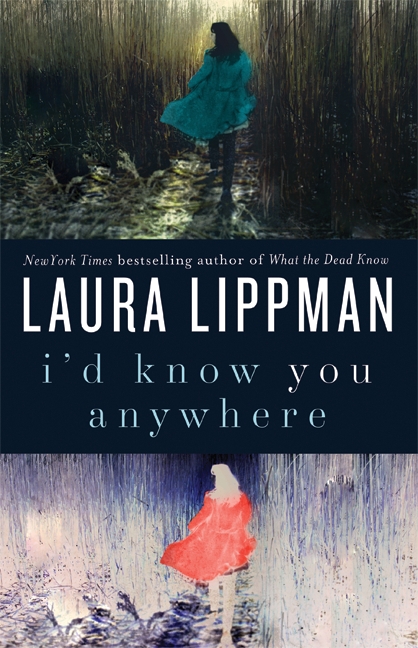
Laura Lippman, I'd Know You Anywhere

When I started reading Laura Lippman's 2010 novel I'd Know You Anywhere, I wondered how she was going to make a story -- and knowing Lippman, a riveting story -- when the crimes in question (the abduction and murder of a series of teenage girls) happened years before and the killer sits on death row awaiting his execution. I needn't have worried, for the author pulls it off beautifully, and without relying too heavily on flashbacks.

The key to Lippman's story is that one of Walter Bowman's victims survived. Elizabeth Lerner, now Eliza Benedict, is married and has two children of her own, including a troubled daughter about the same age as she was when she stumbled upon Walter burying one of his victims. He grabbed her and took her with him on his travels. Trying to survive, she cooperated in every way, even to the point of not attempting to escape when she had the chance and aiding in the abduction of another girl, Holly Tackett. Her testimony helped put Walter on death row, where he has been for the past 20 years. But now he has found her again and hopes he can manipulate her as did years before, this time to save his life.

Eliza, who had thought her role in Walter Bowman's murder spree had long been forgotten, finds herself not just pressured by Walter but also caught between two women with opposing agendas. Trudy Tackett, Holly's mother, still blames Eliza for living when her own daughter died, and she wants to make sure Eliza does nothing to keep Walter from his appointment with death. Meanwhile Barbara, a woman who devotes herself to helping violent convicts, pushes Eliza to go along with Walter's scheme. In an author's note at the end of the novel, Lippman writes, "I did my best to make sure that every point of the (death penalty) triangle -- for, against, confused -- was represented by a character who is recognizably human." That she does very well, and all three women are flesh-and-blood characters you can understand, whether you agree with them or not.

Monday, November 10, 2014

Good stories vs. true stories

Good stories trump true stories. What happens with gossip also happens, more often than we might think, with history and the nightly news. Stories are told not necessarily because they are true but simply because they make good stories, which often means they conform with a particular bias.

Elizabeth Little comments on this power of good stories as it applies to language in her enchanting book Trip of the Tongue. The city of Puyallup, Wash., not far from Tacoma, obviously got its name from the Puyalllup Indian tribe from that area, but what does the word actually mean? The popular explanation is that the word means "generous people," and it is easy to see why that story would be popular. You can imagine what the local Chamber of Commerce might be able to do with it.

Yet Little found with a bit of research that the word actually means "bend at the bottom" or perhaps "bottom of the bend," which nicely describes where the city of Puyallup is located along a river. In other words, Puyallup, Wash., means about the same thing as South Bend, Ind. It's just harder to spell and harder to say and, because it is not an English word, opens the door for a better story.

Another example cited by Little has to do with the Chinese word for crisis. For years I have heard speakers point out that this word also means opportunity, the lesson being that a crisis, viewed in the right way, can also be an opportunity for positive change. That's a wonderful story, but Little points out that it's just not true.

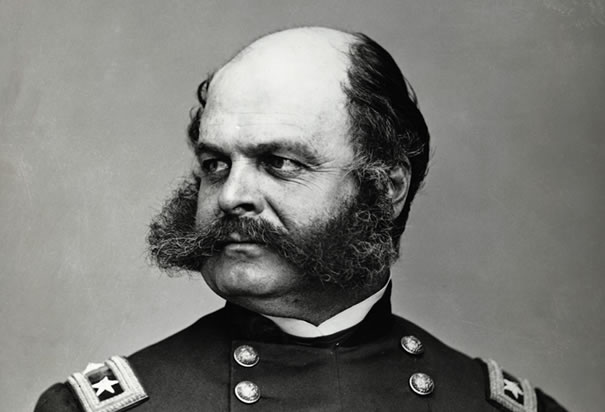
Ambrose Burnside
Little's comments made me think of a couple of common words that have both been attributed to Civil War generals: hooker and sideburns. The popular story is that the men serving under Major Gen. Joseph Hooker spent so much of their off-duty time in brothels that prostitutes came to be called hookers. Not true. The slang term has been in use at least since 1845, several years before the Civil War.

As for sideburns, the story has this word going back to Gen. Ambrose Burnside, known for the prominent whiskers on the side of his head. Happily, this story turns out to be true, showing that sometimes, at least, a good story can also be the true story.

Friday, November 7, 2014

Who's in control?

I don't have a very clear idea of who the characters are until they start talking.
Joan Didion

The notion that characters, in some sense, write their own stories is probably familiar to anyone who has listened to writers talk about their work. Usually there is at least one novelist at any gathering of writers who reflects on how characters tend to run away with the plot, taking it in new directions the author had never intended.
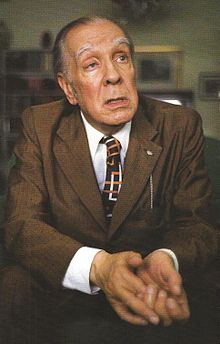
Borges
No less a writer than Jorge Luis Borges has said, "Many of the characters are fools and they are always playing tricks on me and treating me badly," suggesting that writing stories becomes something of a wrestling match in which the characters usually manage to pin the author.

I never realized this was a sensitive issue with some writers until I heard novelist Ann Patchett speak at Kenyon College a couple of weeks ago. She made it clear that, for better or worse, she writes her own stories. Her characters are her own creation and they speak only the words she puts into their mouths.

I have since found a couple of quotations from other writers who, more heatedly, say much the same thing.

John Cheever said, "The legend that characters run away from their authors -- taking up drugs, having sex operations, and becoming president -- implies that the writer is a fool with no knowledge or mastery of his craft. The idea of authors running around helplessly behind their cretinous inventions is contemptible."

Vladimir Nabokov put it this way, "The trite little whimsy about characters getting out of hand; it is a old as the quills. My characters are galley slaves."

During her Kenyon lecture, Patchett rebelled against another notion that someone or something other than the author might be responsible for the final product. She told the story, also told by novelist Elizabeth Gilbert, about the time the two of them, close friends, were discussing works in progress. Patchett was at that time working on State of Wonder, and Gilbert mentioned she had abandoned her own novel set in the Amazon. When Patchett asked what Gilbert's story was about, Gilbert outlined a plot eerily similar to Patchett's own, about a medical researcher in Minnesota, having an affair with her boss, who must travel to the Amazon.

Gilbert's explanation for this uncanny coincidence was that good ideas travel around the globe looking for receptive minds to bring them to fruition. The Amazon idea first landed on Gilbert, who ultimately rejected it. So the idea moved on to Patchett, who turned it into a great novel.

Patchett cannot explain how she and her friend both had the same idea, but she finds Gilbert's explanation silly. If two people have the same idea at the same time, perhaps it is "an incredibly banal idea," she thought at the time. That can sometimes be true. I recall that back in the early Seventies, two novels about fires in skyscrapers came out at about the same time. They were The Tower by Richard Martin Stern, which I reviewed at the time, and The Inferno, by Thomas M. Scortia and Frank M. Robinson. The two novels were later combined into one movie, The Towering Inferno, which won some Oscars.

In science and discovery it is not that unusual for ideas to strike different people at the same time, as in the case of the invention of the telephone and the theory of evolution. Even so, Patchett and Gilbert both conceiving the same plot for a novel does seem astounding. Perhaps suggesting that ideas travel through space looking for a home, like believing characters write the story themselves, is just a way of explaining the unexplainable.
Wednesday, November 5, 2014

The ideal reader

Read as many of the great books as you can before the age of 22.
James Michener

Last Friday in a post called "A skeptic's view of literature," I observed that for most of us, if we have read the great books or the classics at all, it was likely back when they were assigned reading for high school or college classes. We read them because we had to read them. After our formal education ends, if we read at all (and many college graduates never again open a book) it is much more likely to be something by Michener than Shakespeare or Tolstoy.

Yet two quotations, including the one from James Michener above, make me consider that there may be more to our reading of classics in our youth than just the reading required for English classes. A few days ago while reading an essay on despair by Joyce Carol Oates in the book Deadly Sins, I found this line, "Perhaps the ideal reader is an adolescent: restless, vulnerable, passionate, hungry to learn, skeptical and naive by
turns; with an unquestioned faith in the power of the imagination to change, if not life, one's comprehension of life."

Both Michener and Oates suggest those years before full adulthood may be the best time to read important literature, the best time to absorb it, to be influenced by it and inspired by it. More importantly, it may be the time in our lives when we are the most open to it, the most willing to read these books even when they are just recommended reading, not required reading.

Go into any large bookstore and you are likely to find a table of important books, both old and recent, that seems to be there primarily for adolescent readers. It is probably located in the young adult section of the store. These are not necessarily books that have been assigned in area schools. More likely they are just books adolescents, more than adults, will be drawn to.

I recall that it was in those years before graduation from college that I read so many books that were not necessarily great books but were nevertheless books I had heard about and wondered about, books I thought it might be valuable to read. These included such books as Lord of the Flies, 1984, Brave New World and most of the works of Steinbeck and Salinger. Perhaps it was then, more than any other time of my life, when I was, as Oates suggests, the ideal reader.

Monday, November 3, 2014

Sin in the city

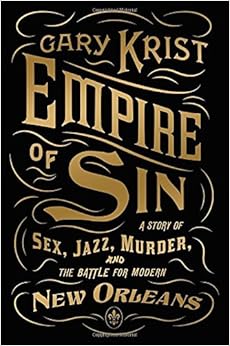
The first notable thing about Gary Krist's new book, Empire of Sin: A Story of Sex, Jazz, Murder, and the Battle for Modern New Orleans, may be its subtitle. The main title speaks of sin, yet between sex and murder lies jazz. Jazz?

Well, yes. It turns out that when reformers tried to clean up New Orleans early in the last century, their first target was not prostitution, gambling, booze, corruption or even gangland murders, but dancing. They didn't want women, at least not white women, in places where that new music, sometimes called jazz and sometimes jass, was being played by black musicians. Jazz, played by the likes of Jelly Roll Morton and a still very young Louis Armstrong, drew white audiences to clubs where black musicians played, and reformers found this as objectionable as anything else that was going on in Storyville.

An editorial in the Times-Picayune called "jass" a "form of musical vice" and said, "Its musical value is nil, and its possibilities of harm are great."

Storyville, named for Sidney Story, a New Orleans alderman, was a district of the city where vice was officially tolerated for a number of years. There was also a smaller area that became known as Black Storyville, but black musicians and a few black prostitutes were permitted in Storyville, just not black clientele. The area flourished and fortunes were made by those who owned the businesses, but Storyville was eventually crushed by those seeking reform. Prohibition, which became federal law at the close of World War I, put the final nail in Storyville's coffin. This did not end the sin in New Orleans, of course. It just went into hiding.

Most of the best jazz musicians fled New Orleans, finding more tolerant audiences in Chicago and elsewhere.

As for murder, there was plenty of that in New Orleans at the turn of the century, much of it associated with Italian mobsters. The most feared murderer at the time, the so-called Axeman, was never caught, and his identity remains a mystery to this day, although Krist suspects those killings, too, were mostly gang-related. A burly man broke into homes in the middle of the night and attacked people in their beds with an axe. Most, but not all, of the victims were Italians who owned small grocery stores.

Books about sin and the city have a lure, just like sin and cities themselves. I am thinking particularly of Karen Abbott's Sin and the Second City and Erik Larson's The Devil in the White City, both about Chicago. Krist himself wrote City of Scoundrels, also about Chicago. And just a couple of days ago I saw a similar book about Steubenville, Ohio. Empire of Sin may not be the best book of this kind, but it does make fascinating reading.

Friday, October 31, 2014

A skeptic's view of literature

I have been listening to a lecture series from The Great Courses called The Skeptic's Guide to the Great Books by Grant L. Voth, professor emeritus in English and Interdisciplinary Studies at Monterey Peninsula College. Voth's idea is that the so-called Great Books, while they truly are great and worthy of study, intimidate most readers. If we have read them at all, chances are it was because they were assigned reading in high school or college classes. Few of us feel up to tackling them voluntarily.

So Voth suggests alternatives. Instead of reading Tolstoy's daunting War and Peace, try Gogol's Dead Souls, he says. Gogol's book is shorter, easier to read and more fun, yet its rewards are similar to those offered by Tolstoy, including giving an understanding of Russian history.

In the same way he proposes reading Robert Penn Warren's All the King's Men in place of Joseph Conrad's greatest novels or Mikhail Bulgakov's The Master and Margarita instead of Faust.

Voth goes further and advocates reading some popular fiction as serious literature. He specifically talks about Death of an Expert Witness, a mystery by P.D. James; The Spy Who Came in from the Cold, a spy thriller by John LeCarre, and Yann Martel's runaway bestseller Life of Pi.

Voth raises the question of what is literary fiction anyway. There are those who seem to believe books need to be old, in some cases very old, to be any good. Popular fiction is not worth even mentioning in a college classroom or serious literary journal. Yet the novels of Charles Dickens were popular fiction in their day. So were the works of Sir Walter Scott, Anthony Trollope, Mark Twain and others whose books are now poured over by literary scholars.

I recall reading recently in The Secret Life of Words by Henry Hitchings that William Shakespeare deliberately tried to make his plays accessible to ordinary people. Some of his contemporaries frowned on him for, in effect, talking down to his audience. That these plays seem difficult for modern readers and audiences to follow says more about how the English language has changed through the centuries than about Shakespeare's writing itself. "(I)t was not the playwright's instinct to be difficult," Hitchings says.

If I may bring up Ann Patchett one more time this week, as a prelude to last week's Kenyon Review Literary Festival the review conducted a month-long online discussion of Patchett's State of Wonder. This discussion, mostly by literary scholars such as David Lynn, the editor of The Kenyon Review, makes fascinating reading for those of us who have read the novel and makes clear that, perhaps despite being one of the biggest bestsellers of the past few years, State of Wonder is also serious literature worthy of study and reflection. It is more than just a good adventure story.

Stories that cause us to think, that offer a variety of interpretations and that give us new pleasures and insights each time we reread them can be regarded as literature, even if they also happen to be popular fiction. That is Grant L. Voth's skeptic's view, and I agree with him.

Wednesday, October 29, 2014

Squashing butterflies

Ann Patchett compares writing novels to squashing butterflies. That surprising yet, when she explained it. apt analogy came last Saturday night in her lecture at Kenyon College as part of the Kenyon Review Literary Festival, where the author of State of Wonder was the star attraction.

While working on a book, she said, the ideas, characters and plotlines float around in her head like butterflies floating around in a garden. They seem beautiful and perfect. Yet if you capture a butterfly, kill it and tack it to a board for display, much of the beauty it showed in life is gone. So it is, she said, when ideas are transferred to paper. They never seem as beautiful as they seemed in her head.

"I am able to forgive myself for not being as much as I want to be," Patchett said. She simply moves on to the next book, rarely looking back at a book once it is published. Squashed butterflies don't interest her.

The gist of her lecture, which was open to the public but which was aimed primarily at students in Kenyon College's writing program, was that writing has more to do with hard work than either talent or inspiration. Real writers, she suggested, don't wait for the muse to strike before beginning to write. They just write. Real writers don't sit around complaining about not being as gifted as others. They write.

If you want to succeed, work, she said. "We control the outcome of our own life."