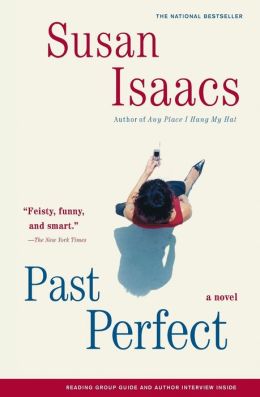
I happened to finish reading Past Perfect, the 2007 novel by Susan Isaacs, soon after starting Spellbound by Beauty: Alfred Hitchcock and His Leading Ladies, a 2008 book by Donald Spoto. So naturally I couldn't help thinking about Past Perfect as a Hitchcock movie and Katie Schottland as a Hitchcock heroine.
Spy stories, especially those in which ordinary people (often ordinary women with extraordinary beauty) get caught in dangerous situations) were a Hitchcock staple, from The 39 Steps to Torn Curtain. That's what happens in the Isaacs novel. Actually Katie had worked for the CIA, writing mostly routine reports, in her early 20s, but then 15 years ago she had been fired without explanation. Now she writes a successful television series called Spy Guys, but the unfairness of her termination still rankles. So when she gets a call from Lisa, a former CIA colleague, asking for her help and, as bait, promising to reveal the truth about why she was canned, Katie is hooked. But then Lisa never calls back.
Katie wonders if something might have happened to Lisa, but mostly she just wants to get to the bottom of her disgrace of 15 years before. So, her son off to summer camp and her husband preoccupied with his work, she begins making contact with people she worked with at the agency, including her former boss with whom, like many other women in his department, she had had a brief fling. Though a novice at actual espionage, Katie keeps digging until she uncovers the whole complicated truth, nearly at the cost of her life.
A 40-year-old Jewish mother may not seem the ideal Hitchcock leading lady, but Katie is vibrant and sexually appealing enough to have drawn the director to this story. And given his apparent delight in placing his actresses in unpleasant circumstances, such as by keeping Madeleine Carroll handcuffed to Robert Donat for long hours each day during the shooting of The 39 Steps, he might have relished the opportunity to place his Katie in some Florida brambles as she tries to elude a killer.
Susan Isaacs writes her thriller with humor and gradually building suspense. We will never discover what Hitchcock might have done with this story, but we can certainly enjoy what Isaacs does with it.
Friday, December 26, 2014
Wednesday, December 24, 2014
New versions of old stories
Last night I caught a few minutes of The Muppet Christmas Carol on television and marveled once again at how the story written so many years ago by Charles Dickens keeps getting told and retold in so many different forms. A year ago in this space I observed that even the John Mortimer short story Rumpole and the Christmas Spirit, so different from the Dickens tale, can nevertheless be seen as a variation on the Dickens formula. What might Dickens have thought had he been visited by the Ghost of Christmas Future and allowed to see how his creation would evolve over time?
Other classic stories similarly get retold in so many different ways. I am thinking particularly of the Greek myths and the Grimm fairy tales, but there are plenty of other examples. And at Christmas we must also mention the original story, the Nativity, which is still reenacted thousands of times each year at this time, usually with children in the starring roles.
The December issue of Christianity Today includes an article by Sarah Arthur called "Have Yourself a Merry Kitschy Christmas" about the many variations on the basic Nativity set that have been created. Some might strike purists as sacrilegious, such as those featuring superheroes or, in the Meat Nativity, bacon and sausages on a bed of hash browns. This doesn't bother Arthur, however. Whether Wonder Woman or a little girl in her bathrobe portrays Mary doesn't really matter. What's important, as in the case of A Christmas Carol performed by Muppets, is the story itself.
Monday, December 22, 2014
The importance of a good title
Many a new novel has sunk without a trace because it has a dull, unmemorable title.
My wife volunteered to become the librarian at the condominium complex where we are living in Florida. What this means in practice is that I do 90 percent of the work of sorting, organizing and shelving, while she gets 90 percent of the credit.
The books on our shelves have all been donated by residents, and the most popular authors clearly are James Patterson, Nora Roberts, Danielle Steel and a handful of others. While trying to find room for all these books on our shelves I have noticed how dull so many of the titles are. Steel has written Matters of the Heart, Remembrance, Bittersweet, Silent Honor and Sisters. Nora Roberts wrote Change of Heart and Happy Endings. Patterson did Double Cross, Honeymoon and Swimsuit.
Contrast these titles with some by less prominent authors: What the Body Remembers by Shauna Singh Baldwin, The Weight of Silence by Heather Gudenkauf, The Patchwork Marriage by Jane Green and The Light Between the Oceans by M.L. Stedman.
I do not question Susan Hill's conclusion about the importance of a good title, but good titles do seem to be much more important for beginning writers and writers who have never gotten high on best-seller lists. When you have reached the stature of a James Patterson, Nora Roberts or Danielle Steel, apparently, titles don't matter so much. It is the author's name on the cover that sells the book. I do wonder, however, how fans of these authors can remember which of their books they have read and which they haven't.
Susan Hill, Howards End is on the Landing
My wife volunteered to become the librarian at the condominium complex where we are living in Florida. What this means in practice is that I do 90 percent of the work of sorting, organizing and shelving, while she gets 90 percent of the credit.
The books on our shelves have all been donated by residents, and the most popular authors clearly are James Patterson, Nora Roberts, Danielle Steel and a handful of others. While trying to find room for all these books on our shelves I have noticed how dull so many of the titles are. Steel has written Matters of the Heart, Remembrance, Bittersweet, Silent Honor and Sisters. Nora Roberts wrote Change of Heart and Happy Endings. Patterson did Double Cross, Honeymoon and Swimsuit.
Contrast these titles with some by less prominent authors: What the Body Remembers by Shauna Singh Baldwin, The Weight of Silence by Heather Gudenkauf, The Patchwork Marriage by Jane Green and The Light Between the Oceans by M.L. Stedman.
I do not question Susan Hill's conclusion about the importance of a good title, but good titles do seem to be much more important for beginning writers and writers who have never gotten high on best-seller lists. When you have reached the stature of a James Patterson, Nora Roberts or Danielle Steel, apparently, titles don't matter so much. It is the author's name on the cover that sells the book. I do wonder, however, how fans of these authors can remember which of their books they have read and which they haven't.
Friday, December 19, 2014
Strength out of weakness
In her eulogy for Pauline Kael, her daughter, Gina, said, "Pauline's greatest weakness, her failure as a person, became her great strength, her liberation as a writer and a critic." It's an interesting idea, that one's strengths may be attributable to one's weaknesses, but I think it may sometimes be true. It may even be true in my own case.
Kael, who at one time was the most influential film critic in the country, certainly had her weaknesses. Among these was her treatment of her own daughter as a virtual slave, depending upon her to type her reviews, run her errands and provide her transportation, while denying her the freedom to live her own life. Kael's friendships so often depended upon those friends agreeing with her and, at least in the case of other movie critics, not becoming as prominent as she. She allowed herself to be courted by directors and others in the movie business, always insisting a favorable review from her could not be bought, even when so many of her reviews suggested otherwise.
Brian Kellow mentions many other Pauline Kael weaknesses in his 2011 biography Pauline Kael: A Life in the Dark, yet the book hardly qualifies as a hatchet job, for his emphasis lies with her significant strengths. She was, whether you agreed with her opinions or not, a terrific writer whose prose jumped off the pages of The New Yorker. Although she rarely wrote about anything other than movies, her reviews managed to be commentary on the times, as well. They were also surprisingly autobiographical. Once urged to write her memoirs, Kael replied, "I think I have."
Writing here a few months back I compared the movie criticism of Kael with that done by novelist Graham Greene back in the 1930s. I noted the similarity in their writing styles, while noting that Kael, at least from her reviews, seemed to be better read than Greene. From her biography I learned that in her youth Kael admired Greene's film criticism and was influenced by his work at the start of her career. As for her reading, I learned that when she heard a movie was going to be based on a novel, she made it a point to read that novel before seeing the film. How many other movie reviewers would go to that much trouble?
Kellow's book nicely summarizes Kael's most important and controversial reviews and articles over the years, yet I think he too often inserts his own opinions about these films, faulting Kael when her opinions don't match his own, which seems to be what he criticizes Kael for doing.
Wednesday, December 17, 2014
Our body's literary needs
I now realize that it is a diary that I have been looking for all over the house ...
Susan Hill devotes a couple of consecutive essays in her book to her search through her house for a book she wanted to read that day. She had no idea what that book might be until she came across some diaries, specifically The Journal of Sir Walter Scott. That, she decided, is what she had been looking for all day without realizing it. "I have found my book," she announces with satisfaction.
Earlier in the day I had been reading Masha Hamilton's wonderful novel The Camel Bookmobile (I will probably have more to say about this later) when I came across, much as Hill did that particular diary, the line where Hamilton's character Fiona Sweeney reflects on the knack so many readers have for finding just the right book at the right time: "Fi was convinced that instinct could determine a body's literary needs, just as physical cravings pointed to dietary shortfalls."
Many of us have probably experienced the same sort of thing, in libraries or bookstores if not in our own homes. We search and search for the right book, and then suddenly, there it is. I have the same kind of experience when I am looking through my DVD collection for just the right movie to watch. Am I in the mood for a drama or a comedy? Am I wide enough awake for a foreign film, where one must read as well as watch and listen? Eventually, like Scott's journal, one movie will jump out at me and I will know that this is the one. It almost always turns out to the best possible choice.
Not every book is the perfect book for every occasion. I wonder about people who read only romances or only mysteries or only self-help books. To me it sounds like having the same thing every day for lunch. How do they meet their "body's literary needs"? Of course, there really is no such thing. Yet like Fiona Sweeney and Susan Hill, I would like to believe there is.
Susan Hill, Howards End is on the Landing
Susan Hill devotes a couple of consecutive essays in her book to her search through her house for a book she wanted to read that day. She had no idea what that book might be until she came across some diaries, specifically The Journal of Sir Walter Scott. That, she decided, is what she had been looking for all day without realizing it. "I have found my book," she announces with satisfaction.
Earlier in the day I had been reading Masha Hamilton's wonderful novel The Camel Bookmobile (I will probably have more to say about this later) when I came across, much as Hill did that particular diary, the line where Hamilton's character Fiona Sweeney reflects on the knack so many readers have for finding just the right book at the right time: "Fi was convinced that instinct could determine a body's literary needs, just as physical cravings pointed to dietary shortfalls."
Many of us have probably experienced the same sort of thing, in libraries or bookstores if not in our own homes. We search and search for the right book, and then suddenly, there it is. I have the same kind of experience when I am looking through my DVD collection for just the right movie to watch. Am I in the mood for a drama or a comedy? Am I wide enough awake for a foreign film, where one must read as well as watch and listen? Eventually, like Scott's journal, one movie will jump out at me and I will know that this is the one. It almost always turns out to the best possible choice.
Not every book is the perfect book for every occasion. I wonder about people who read only romances or only mysteries or only self-help books. To me it sounds like having the same thing every day for lunch. How do they meet their "body's literary needs"? Of course, there really is no such thing. Yet like Fiona Sweeney and Susan Hill, I would like to believe there is.
Monday, December 15, 2014
Slow reading
Too much internet usage fragments the brain and dissipates concentration so that after a while, one's ability to spend long, focused hours immersed in a single subject becomes blunted. Information comes pre-digested in small pieces, one grazes on endless ready-made meals and snacks of the mind, and the result is mental malnutrition.
I am not so sure the internet deserves all the blame for what Susan Hill so aptly calls "mental malnutrition." It seems to me there are plenty of other distractions that make it difficult for us to focus our attention on just one thing: ringing telephones, interruptions by children or spouses or others, other pressing tasks that require our attention, the siren call of our television sets, even computer solitaire. Long before the internet, newspapers and magazines were breaking down information into small pieces.
For many years I wrote in a noisy newsroom, where ringing phones and loud conversations constantly made it challenging to stay focused on one's subject. With a deadline pressing, one simply has to train one's mind to focus. Years later when the number of newsroom personnel had shrunk dramatically, I found the unnatural quiet just as distracting as the noise had once been.
When it comes to reading books, which is the subject at hand in Hill's book, I suspect most of the blame for my own short attention span is my practice of reading several books at one time. I may read but one chapter, or even just a couple of pages in one book before putting it down and picking up another, then doing the same thing with it. There are some books, Susan Hill's Howard's End is on the Landing being one of them, where this kind of reading may be acceptable, even advisable, but most books, whether fiction or nonfiction, deserve longer periods of focus.
Hill writes that by rationing the internet she was able, within a few days, to increase her attention span and tackle difficult long books. "It was like diving into a deep, cool ocean after flitting about in the shallows, Slow Reading as against Gobbling-up," she writes.
It comes down to disciplining ourselves, sort of like learning to write news stories, columns and editorials amid the bustle of a lively newsroom.
Susan Hill, Howard's End is on the Landing
I am not so sure the internet deserves all the blame for what Susan Hill so aptly calls "mental malnutrition." It seems to me there are plenty of other distractions that make it difficult for us to focus our attention on just one thing: ringing telephones, interruptions by children or spouses or others, other pressing tasks that require our attention, the siren call of our television sets, even computer solitaire. Long before the internet, newspapers and magazines were breaking down information into small pieces.
For many years I wrote in a noisy newsroom, where ringing phones and loud conversations constantly made it challenging to stay focused on one's subject. With a deadline pressing, one simply has to train one's mind to focus. Years later when the number of newsroom personnel had shrunk dramatically, I found the unnatural quiet just as distracting as the noise had once been.
When it comes to reading books, which is the subject at hand in Hill's book, I suspect most of the blame for my own short attention span is my practice of reading several books at one time. I may read but one chapter, or even just a couple of pages in one book before putting it down and picking up another, then doing the same thing with it. There are some books, Susan Hill's Howard's End is on the Landing being one of them, where this kind of reading may be acceptable, even advisable, but most books, whether fiction or nonfiction, deserve longer periods of focus.
Hill writes that by rationing the internet she was able, within a few days, to increase her attention span and tackle difficult long books. "It was like diving into a deep, cool ocean after flitting about in the shallows, Slow Reading as against Gobbling-up," she writes.
It comes down to disciplining ourselves, sort of like learning to write news stories, columns and editorials amid the bustle of a lively newsroom.
Wednesday, December 10, 2014
Reading from home
Recently I started reading Susan Hill's 2009 book Howard's End is on the Landing: A Year of Reading from Home. I can see immediately that Hill is going to inspire a lot of reflection on books and reading, so I propose to take her book slowly and use it as a springboard for commentary on this blog over the next few weeks.
I will start with Hill's reason for writing her book in the first place. Looking for one particular book in her home, she found many other books instead. Some she realized she had owned for years but had never read. Others she had read years ago and decided it was time to revisit. She resolved to give up purchasing any new books for a whole year and devote her reading to books she already owned. What follows is a series of short essays about these books and about her reading life, both past and present.
Novelist Susan Hill is a contemporary of mine, just a couple of years older,. At about the same point in life when she decided to focus more attention on her personal library, I was doing much the same thing. I have not taken the step of swearing off new books as Hill did. If anything, I have increased the number of book purchases in recent years. But rarely, except in the case of books sent to me to review, do I ever begin reading a book immediately after acquiring it. Usually I let it age on the shelf for a few years, sometimes 20 years or more. So in one sense I have always been doing what Hill did for her book.
More recently, however, I have been rereading more books I enjoyed a number of years before. This hasn't seemed to decrease my reading of first-time books because, since retirement, I have been able to devote more time for reading. So I have revisited Graham Greene's Monsignor Quixote and Jesse Stuart's The Land Beyond the River, among several other books. Not only have I enjoyed these books a second time, but it has made me feel justified in keeping them for all these years. Some people like to ask, "Why keep books you have already read?" Well, this is why. (Another reason, of course, is reference.)
Thanks to my membership on LibraryThing, I have also, like Hill, spent a lot of time reconsidering every book in my library in the act of cataloging them all for the website. Quite a number of them I decided I really didn't want any more, so I was able to open up some shelf space. Other books surprised me because I had forgotten I even had them. Many books, once I held them in my hands, made me want to open them and start reading again.
I think I am going to like reading about reading in Susan Hill's book.
Subscribe to:
Posts (Atom)