Monday, January 12, 2015

Another peculiar crime

I recall those old comic horror movies in which Laurel & Hardy, Abbott & Costello or whomever found themselves in haunted houses. At the end the ghostly visions were usually explained as a hoax perpetrated by a villain trying to protect a treasure or whatever. This is a bit like what Christopher Fowler's Bryant & May mysteries are like. There's a lot of the supernatural, black magic and mysticism, all given a rational explanation once the mystery is unraveled. And like those old movies, these mysteries are a lot of fun.

The 11th book in the series, Bryant & May and the Bleeding Heart (Bantam) proves to be a gem. Two teenagers making out in an old London cemetery see a corpse rise out of its grace and begin walking and talking. Later the boy is run down in the street and killed. Was it an accident or murder? The case seems a natural for Scotland Yard's Peculiar Crimes Unit headed by Arthur Bryant and John May.

Naturally the two aging detectives with unorthodox methods have superiors eager to pull the plug on their funding. And a case which may not even be a case at all, just the hallucinations of a couple of drugged teens, may give the brass exactly what they need to put Bryant and May out to pasture. Bryant is even shuffled off to another peculiar crime, the sudden disappearance of all the ravens at the Tower of London.

Fowler maintains good balance between light and dark, the humor surrounding the team's operating methods and personalities and the serious crimes they investigate. And as bodies begin piling up, both those already buried and those who die violently, it becomes apparent this is a serious crime. But how to explain it? Why would anyone be digging up bodies? What happened to the boy? Why did a man kill himself? Why does his widow blame the man's death on his boss? And what happened to all those ravens?

This new book is an excellent addition to this popular series.

Friday, January 9, 2015

The form of our ideas

I ... find that ideas come along with the form in which they need to be written.
Susan Hill, Howards End is on the Landing

Susan Hill is writing specifically about writing fiction, novels versus short stories. Some ideas come in form of short stories, others in the form of novels. You shouldn't try to turn a short story idea into a novel, or vice versa.

This seems a bit simplistic to me. I would argue that ideas tend to come in the form we have been trained, or train ourselves, to think them. Many novelists began as short story writers. While good short stories may be difficult to write, perhaps even more difficult than good novels, they are nevertheless an easier path for beginning writers to develop their narrative skills. Besides, few writing instructors want to read through student novels. Stories work much better for writing classes. Yet relatively few people actually read short stories anymore, and there are few markets for getting them published. Novels are where the money is, so writers who have trained writing short stories soon turn to writing novels. That first novel may be a struggle, but once they begin to think in terms of novels, it usually becomes easier. That is the form their ideas begin to take.

I noticed something like this in my newspaper career. As a beginning reporter I learned about what is called the inverted pyramid, putting the most essential information high in the story, then adding information of gradually decreasing importance. Soon I could attend a city council meeting and begin writing the story before the meeting was over, as well as any secondary stories that might have come out of the meeting. My ideas took the form of news stories.

Subsequently I became a book reviewer, a columnist and an editorial writer. Each required a somewhat different form of writing, and each required some discipline to think my ideas in that form. Now retired, I tend to think in the form of brief essays for this blog. This is not to say I don't occasionally get an idea more suited for an editorial or a newspaper column. This can be frustrating because those avenues are no longer open to me. Yet mostly my ideas tend to come in whatever form has become my focus. I question my ability to write a novel because, in part, I have never tried. My mind has never been trained to think novel-like ideas, no matter how many novels I have read over the years.

Once one has mastered a variety of writing forms and if one is not locked by circumstances into pursuing just one or another, then perhaps Hill is right. The ideas will come in the form they need to be written. For most of us, however, they will come in the form we know how to write. Novelists don't usually think like poets, or vice versa.

Wednesday, January 7, 2015

Saying the right words

The students have to say the right words to get credit for compassion.
Leslie Jamison, The Empathy Exams


In the title essay in her book The Empathy Exams, Leslie Jamison tells of working as a medical actor. That is, she would play the role of a patient with particular symptoms, a particular personality and a particular life history while medical students tried to discover the source of her problem. One of the criteria on which students were judged was the empathy they demonstrated for their pretend patients. As Jamison notes, it often came down to just saying the right words, or sometimes just not saying the wrong words.

Among the insights into empathy her essay delivers, Jamison writes this, "Their humility is a kind of compassion in its own right. Humility means they ask questions, and questions mean they get answers, and answers mean they get points on their checklist." Most of us have known doctors who could hardly ever be described as humble. They think they know what's wrong with us before we can finish describing our symptoms, and their attitude can sometimes prevent us from revealing what's really troubling us.

Jamison examines her subject of empathy not just from the point of view of a medical actor but also from that of a patient who has experienced both an abortion and heart surgery. She was in a position to give her own grades, not just to medical professionals but also to friends and family, and in particular her boyfriend. She was acutely aware when they measured up and when they didn't. So are we all whenever we suffer, mourn or just feel down in the dumps. We are sensitive to everything others say and do, aware whenever something helps and especially when something just makes it worse.

Yet as aware as we may be when we are the ones in pain, most of us are at a complete loss as to what to say and do when somebody else suffers. What can you say to someone who has just lost a spouse, a parent or a child? Does it help a surgery patient to describe your own surgeries? Do flowers really do any good? We don't even know when a visit from us might be welcomed by those who suffer, or would they prefer to be left alone?

We know when others fail our empathy exams, but that doesn't mean we know how to get passing grades on our own.

Monday, January 5, 2015

Hitchcock and his leading ladies

Pauline Kael's strengths as a movie critic may have sprung from her weaknesses as a human being, as I noted in my review of Brian Kellow's biography of Kael (Dec. 19). Much the same thing could be said about director Alfred Hitchcock. What made him a great director were the very qualities that made him much less than a stellar human being.

Much has been written about Hitchcock's relationships with the actresses who starred in his films, but Donald Spoto makes those relationships the focus of his 2008 book Spellbound by Beauty: Alfred Hitchcock and His Leading Ladies. Hitchcock was particularly smitten by Ingrid Bergman, Grace Kelly, Vera Miles and Tippi Hedren. The latter was a 31-year-model when the director noticed her on television and then, through a third party, signed her to a long-term contract without informing her what the contract was for or with whom. Hedren, with no acting experience, expected a series of  bit parts for her $500 a week. Instead she became an underpaid star. He physically and sexually abused her through two films, The Birds and Marnie, before she was able to free herself from his domination.

Other directors of his generation infamously used the casting couch method to put actresses in their films. The obese Hitchcock, who by his own admission had sex just once in life, had other approaches to bringing his fantasies to life. He tried to control the lives of his favorite stars, dictating what they wore, where they went and with whom they associated. Perhaps not coincidentally, Vertigo, believed by many to be his greatest film, is also the movie that reveals the most about its director. In it, James Stewart plays a man obsessed with a certain woman who compels another woman, also played by Kim Novak, to transform herself into that ideal.

Spoto goes film by film through all of Hitchcock's movies, although naturally he gives less attention to those starring women the director didn't particularly like.

Alfred Hitchcock was something of a mess, both physically and psychologically. His fears, passions, obsessions and insecurities dominated his life and made him an unhappy man, loved by few. Yet somehow he translated all these qualities into his films, loved by many.

Friday, January 2, 2015

On burning books

For there is nothing essentially sacred about a book just because it is printed on paper and bound between covers.
Susan Hill, Howards End is on the Landing

In the movie Wild there is a scene where Cheryl Strayed, played by Reese Witherspoon, is given advice on how to lighten her load as she walks the Pacific Crest Trail from Mexico to Oregon. "Are you burning what you read?" the man asks her. He suggests that when she finishes reading a section of a book she should tear it out and burn it in her next fire along the trail. It won't make her a Nazi, he assures her.

The scene brought to mind the line by Susan Hill quoted above. There may be sacred books, but books themselves are not essentially sacred. If a book belongs to you, you are free to write in it, underline passages, give it away or throw it away when you are done with it or, if you choose, burn it. We burn flags when they become tattered and worn. We can surely do the same with books.

Yet "book burning" has such a negative connotation, and rightfully so, that many of us hate to destroy books that are already falling apart. I imagine thrift shops, chapters of Friends of the Library and others who accept books for resale get a lot of books so worn that nobody would buy them. Yet somebody just didn't want to throw them away.

I recall once receiving a review copy of a book on erotic Chinese art. I can't imagine why the publisher thought a newspaper would review such a book, which to my mind wasn't erotic at all, just obscene. But if I wasn't going to review it, what should I do with it? I didn't want to add it to my personal library. I had a little boy at the time, so I didn't even want to take it home. I normally gave unwanted review copies for used book sales raising funds for worthy causes, but I couldn't imagine donating the book to any of these. I suppose somebody would have loved to have the book, but I wasn't about to start offering it around to see if there were any takers. So finally, feeling a bit guilty, I just dropped it into the trash.

We need to value books, of course. We need to try to protect them and preserve them and try to find them a good home when we are done with them. But sometimes, as when hiking the Pacific Crest Trail, it's OK to burn them.

Wednesday, December 31, 2014

Books are like the night

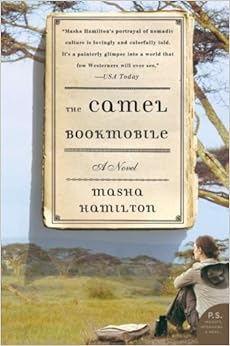
Among the many pleasures to be found in Masha Hamilton's The Camel Bookmobile, reviewed here a couple of days ago, are the observations, generalizations and insights various characters have about books. I thought I would collect a few of them here, adding a few comments of my own.

"Books allowed her vicarious tastes of infinite variety, but they didn't supplant the need to venture out into the big and messy. In fact, just the opposite. Books convinced her that something more existed -- something intuitive, beyond reason -- and they whetted her appetite to find it."

It may be easy enough for readers to bury ourselves in our books, to find our romance and adventure there and to learn all about the world we care to know. Or, as with Fi in Hamilton's novel, our reading can send us out into that world, better equipped and more inspired than we might otherwise be.

"The books are like the night for you, aren't they" she said. "You can hide in the stories, and grow there, and come out different."

Ideally that is the case. It may depend, of course, on what it is we are reading.

"I realized right away that books could take us out of ourselves, and make us larger. Even provide us with human connections we wouldn't otherwise have."

Many people, of course, believe just the opposite. How many young introverted readers have been accused of burying themselves in their books when they should be out playing with other children? Yet books can give these same children something to talk about and more confidence to express it when they are around others. They can even help them seek out those who may share their interests and points of view.

"Books, it occurred to her now, were enduring, even immortal."

A good book, anyway, will outlive most of us.


"My girls need the bookmobile. They need the possibilities it brings."

I like that image, that a bookmobile carries not just books, but possibilities.


"As she read, she became fully human again."

I have always found something restorative about reading. At the very least, it can take one's mind off one's troubles, but perhaps any mediocre TV show can do that. Yet while I may sometimes feel guilty after watching a mediocre TV show, I don't feel that way after a mediocre book.

"But the children were all around and Mr. Abasi was calling out and motioning for her to come, and anyway, he knew now, if he hadn't known before, that there were limitations to words -- words in the air or on a page."

Ah, yes, words do have their limitations. Even the best writers must sometimes feel frustrated in their attempts to say all that they feel. How much more difficult it is for the rest of us.

Monday, December 29, 2014

Overdue library books

In The Camel Bookmobile (2007), Masha Hamilton weaves a fascinating, multi-layered story about some overdue library books. This isn't an ordinary library, however. The books are, in fact, packed on the back of a camel and taken to remote villages in Kenya, where most of the people can't even read, let alone read English, which is the language most of the donated books happen to be in. The camel bookmobile is viewed differently by different people in these villages. To some it represents progress, the way into the modern world. To others it represents evil, a threat to old ways and old wisdom.

Fiona Sweeney, an idealistic 36-year-old American woman, commits herself to this project, and she particularly enjoys visiting Mididma, an isolated village of semi-nomads which includes a teacher, an old woman and her granddaughter who are literate and treasure books, almost any books Fi happens to bring on the camel.

Among the library patrons is a teenager called Scar Boy since being attacked by a hyena and badly disfigured. When the bookmobile returns to Mididma, Scar Boy refuses to return the books he borrowed, thus threatening the village's future as a stop on the bookmobile's schedule. This is a problem even for those who object to the bookmobile because of the shame it will bring to the village. Everyone begins pressuring Scar Boy to return the books, but it turns out he could no longer return them even if he wanted to.

Much else happens in Hamilton's story. The teacher's lovely wife falls in love with Scar Boy's father, while Fi and the teacher discover a strange attraction to each other. The little girl who loves books decides she wants to follow Fi to America to become a teacher, and Scar Boy is discovered to have a rare talent nobody knew about. Meanwhile a drought threatens the very existence of the village.

The camel bookmobile really exists, and has since 1996. Hamilton's novel, besides telling a delightful story about the power of books, brings our attention to that fact and makes us wonder about some of the true stories it must have inspired.