Friday, February 13, 2015

I just loved your book

"I read your book," said the bear, because his publicist had told him to always say that to his fellow authors so no one's feelings would be hurt.
William Kotzwinkle, The Bear Went Over the Mountain

Jess Walter
When Laura Lippman introduced Jess Walter as the keynote reader at the Writers in Paradise in St. Petersburg last month, she mentioned how impressed she had been by his first novel. This seemed to shock Walter, who joked, "Even I didn't know who I was after my first book." He said his first books sold so poorly that Barnes & Noble refused to stock any copies of his third book in any of its stores, even in his home state, and he was pressured to change his name to give himself a fresh start. More recently he was the author of the best seller Beautiful Ruins.

So was Lippman telling the truth when she said she had read Walter's first book, which hardly anyone else had even seen? Perhaps she was. Lippman has something of a reputation at Writers in Paradise, where she is a regular, for seeming to have read everything. But every year when I attend the Writers in Paradise readings I am impressed at how familiar all the authors, not just Lippman, seem to be not just just with one another's books but with just about any other books that happen to be mentioned. Perhaps the key word in this paragraph is "seem."

I was amused by William Kotzwinkle's delicious satire of the publishing industry, The Bear Went Over the Mountain, especially by the passage cited above where the bear, now hailed as a best-selling author, praises other writers' books, and they praise his, even though none of them have actually read the books. Whether or not this is what is going on at Writers in Paradise every January, I suspect it happens frequently when authors get together. Most writers read a lot, but they can't read everything and still get their own writing done. And even if they did read everything, they probably wouldn't admire everything. But they wouldn't want to hurt anyone's feelings.

Most of us, in fact, have probably pretended to read something we haven't read. Students may write their book reports, essays or theme papers after only watching the movie or perhaps skimming through Cliff's Notes. Today's students can probably learn enough about any book to get a passing grade just by spending a few minutes on Google. Students, and perhaps even a few professional writers, have been known to list books as references that they never opened, and perhaps never even found in a library.

Do book reviewers always read the entire book before writing their reviews? How about publishers before they reject manuscripts? And then there are those book clubs, where everyone is supposed to read a particular book each month before it is discussed. How many members actually take the time to do more than read the book jacket and skim a few chapters?

We wish to appear smarter than we really are, and so depending upon which circles we live our lives in, we may just pretend to have read Proust or the current best sellers. When it comes to books, most of us are probably guilty of a little hypocrisy

Wednesday, February 11, 2015

A bear of very little brain

The moral of The Bear Went Over the Mountain,William Kotzwinkle's 1996 comic fantasy novel, is about the same as that of Big Eyes, the new Tim Burton film: Only the precious few can create art, but anyone can pretend to be an artist.

In Kotzwinkle's literary fable, a Maine bear who has become a people watcher and wishes he could become a person himself, gets his chance when he finds a briefcase containing a manuscript for a novel, Destiny and Desire, by Arthur Bramhall. The bear has taught himself to read from the labels on human food, and he thinks it's a pretty good book. The publishing world thinks so, too, and soon Hal Jam (the bear names himself after one of his favorite foods) finds himself the acclaimed author of a best seller.

The story owes a debt to Being There, Jerzy Kosinski's terrific 1970 novel that was made into an equally terrific film. In that book, Chance is the simple-minded gardener who dresses in his employer's hand-me-down clothes. When his benefactor dies, Chance is turned out of the estate, but he looks so fine in his expensive suits he is taken for a wealthy businessman, and his simple statements about gardening and television shows are taken as words of great wisdom. We get a lot of that in The Bear Went Over the Mountain. Hal Jam talks mostly about food and his life in the Maine woods, but his listeners invariably interpret his words as something else entirely.

Kotzwinkle loses his readers' attention a bit whenever his story strays from Hal Jam back to Arthur Bramhall. Even so, it proves interesting when Bramhall turns gradually into a bear while the bear morphs into a human being.

Monday, February 9, 2015

Minds on shelves

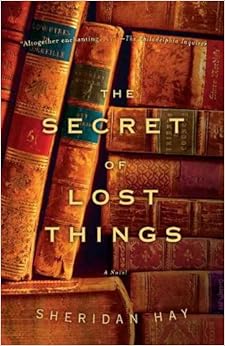
Today I want to share some of my favorite lines from The Secret of Lost Things, the novel by Sheridan Hay I reviewed last week.

(M)emory is a kind of obligation, perhaps the last duty owed anyone.

One of the worst things about the prospect of death is the thought of being forgotten, perhaps totally forgotten within a generation or two. That's why people want their names etched on granite tombstones or, if they can, bequeath large sums of money to universities, churches or whatever that will keep their memory alive for a long time. If we wish to be remembered, we also have an obligation to remember others. We owe nothing else to those who have died before us, but we do owe them that.

Books aren't lumps of paper, but minds on shelves.

I do like that image, that authors, whether of fiction or nonfiction, pour out their minds onto the pages of their books, allowing readers the opportunity to dip into their minds whenever they choose.

(T)he Arcade is itself a city; itself an island.

This idea follows the previous one. If books are minds on shelves, then wherever large quantities of books are gathered, whether it be a large bookstore like the fictional Arcade or a great library, becomes a city. It can also be viewed as an island, separate and isolated as it is from the rest of culture.

Remember, a book is always a gift.

This, too, seems to follow from the minds on shelves idea. Authors bestow their minds on the rest of us in the pages of their books. These are gifts, if we choose to accept them.

To a true collector, the acquisition of an old book is its rebirth.

When it comes to books, I am more an accumulator than a collector. Even so I think I understand what this character is getting at. It's a bit like those parables of Jesus. What was lost has been found. Some Christians call that being born again.

Books were the very source of desire.

I am not at all sure what this means, but I like it anyway. Perhaps it goes back to that first line quoted above, and the desire most found in books is that desire to be remembered, even if just as minds on shelves.

Friday, February 6, 2015

Somebody's watching

Miss Kircher appeared as I examined an astronomical clock. I felt her presence, standing near the automated devil, but didn't turn around.
Sheridan Hay, The Secret of Lost Things

Someone was behind Harold. He could feel it in his spine.
Rachel Joyce, The Unlikely Pilgrimage of Harold Fry

Is there a more tiresome cliche in fiction than the feeling protagonists get that someone is watching them or following them? And they are invariably right. Someone really is watching them or following them. Most often we find this sort of thing in thrillers or detective stories, but the two books cited above are more serious, non-genre novels. I gave each of them a positive review here within the past few days, yet each novel dropped a peg in my estimation when I came across the above lines.

I don't recall ever sensing that someone was following me, perhaps because nobody ever has, at least not in a sinister sense. Yet people do walk behind me, observe me from behind and sometimes walk up behind me and scare the bejeebers out of me. Unless I hear them or notice a shadow or a reflection, I don't sense anything.

So why do so many main characters in fiction get this feeling? And how come, when they are the ones doing the spying or the following, the people they are spying on or following never get this same feeling? This strikes me as laziness on the part of authors, a shortcut way of trying to give readers a chill sort of like that supposedly experienced by the characters. I just don't buy it, especially when one comes across it so often in books.

In real life some people really do sense that somebody is watching them or following them. I think we call them paranoid.

Wednesday, February 4, 2015

Bookstore intrigue

Something there is about a bookstore that makes it an unlikely place to find deceit, betrayal, intrigue and death. All this and more happening in a New York City used bookstore called the Arcade make Sheridan Hay's 2007 novel The Secret of Lost Things an enticing read.

Told in first person by Rosemary Savage, a lonely 18-year-old who leaves Tasmania for New York after her mother dies, the story becomes something of a coming-of-age tale. She finds a mother figure in Lillian, a woman from South America who lives at the same hotel where Rosemary settles. She develops a crush on Oscar, handsome coworker, even though he makes it clear he has no romantic interest in her or anyone else. Because of her youth, beauty and innocence, Rosemary becomes everyone's sounding board at the Arcade. She learns their secrets and, in some sense, becomes their co-conspirator.

She is made the assistant of Walter Geist, a strange man who is losing his vision and increasingly depends on Rosemary to help him do his job. She learns Geist plans to sell to a wealthy collector, without the knowledge of his employer, an unpublished manuscript of a book by Herman Melville. Meanwhile, Oscar wants her to spy on Walter because he thinks the manuscript belongs in a library or museum, not hidden away in somebody's home. Still hoping to win his love, Rosemary goes along with him, betraying both Walter and Mr. Pike, her boss. And, while Oscar may have no romantic interest in Rosemary, it soon develops that Walter does.

The Secret of Lost Things is Sheridan Hay's first novel and, as far as I know, her only book to date. It is partly autobiographical as Hay herself left Australia for New York City, where she worked first for the Strand Bookstore. She now teaches literature. Her passion for literature, books and bookstores shine through in this fine novel.

Monday, February 2, 2015

How not to write a mystery

Some very good, if not great, novels are written by teams of writers. I'm thinking specifically of the mysteries by Charles Todd, actually a mother-son writing team; the mysteries by Claude Izner, actually two Paris booksellers; and the thrillers turned out by Douglas Preston and Lincoln Child. There have been many others. I don't know how they manage it, perhaps one person concocts a plot and the other does the actual writing, but the results often prove successful.

Much less successful are those so-called collaborative novels in which two or more established writers provide alternative chapters, each building on what was written before. This has been tried a number of times. Back in 1991,  Lawrence Block, Peter Lovesy, Donald E. Westlake, Tony Hillerman and others pooled their efforts to produce something called The Perfect Murder. Despite all the talent involved, nobody remembers that as the perfect murder mystery. A few years later, Dave Barry, Carl Hiaason, Elmore Leonard, Edna Buchanan and several others combined for Naked Came the Manatee, a novel best remembered for its title.

I just finished Heads You Lose, a collaborative mystery by just two people, Lisa Lutz, an established mystery writer, and David Hayward, a poet who accepted the job after several other established mystery writers wisely turned down Lutz's proposal. Hayward also happens to be Lutz's former boyfriend.

Whatever lovers' quarrel ended their romantic relationship seems to be continued in their literary relationship. They seem to delight in killing off the other's characters. After Lutz kills one of Hayward's favorites,  he brings him back to life. Then Lutz kills him again, this time with more finality.  So Hayward introduces a new character, a brother, with the same characteristics as the dead man. So Lutz kills him, too. In the end, there are more bodies than suspects.

Meanwhile, although the premise calls for each writer to write alternate chapters, building on what the other has written, Lutz persists, in between-chapter notes, in trying to tell Hayward what he should do with his chapters. Of course, he resents the interference and plows off in his own direction, which angers her.

The basic plot involves a brother and sister, Paul and Lacey Hansen, who grow marijuana on their property. So when they discover a headless corpse on their land, they move it so the authorities won't find their pot. Then the body gets moved back near their house. At this point, both of them get involved in investigating the murder, Lacy more willingly than her brother.

Hayward seems to do better at creating characters and adding color and humor to the plot, while Lutz, the veteran mystery writer, does better with the plot itself. She takes the final chapter and amazingly wraps everything up in a neat, almost logical bundle. It may be the only good chapter in the book.

Friday, January 30, 2015

What's wrong with sentimentality?

Our tears become trophies and emblems of our compassion.
Leslie Jamison, The Empathy Exams

Many years ago I led a series of discussions based on a Dorothy L. Sayers essay about the Seven Deadly Virtues, which she identified as respectability, childishness, mental timidity, dullness, sentimentality, censoriousness and depression of spirits. To Sayers, these were all traits that sometimes pass for virtues but which can easily become vices.

During the discussion on sentimentality, I recall a woman questioning what could possibly be wrong with it. She liked sentimentality, she said. Indeed, we all do to some extent. We like stories with happy endings. We like parades, weddings, patriotic hymns, happy children at play, almost anything that brings good tears to our eyes. So what's wrong with that?

Leslie Jamison wrestles with this very question in her essay "In Defense of Saccharin(e)" in the book The Empathy Exams. "If sentimentality is the word people use to insult emotion -- in its simplified, degraded, and indulgent forms -- then 'saccharine" is the word they use to insult sentimentality," she writes. Jamison admits to having, in her kitchen, a container full of empty artificial sweetener packages hidden from visitors. In the same way she hides her sweet tooth, she hides her taste for sentimentality.

Movies with happy endings usually don't get nominated for Oscars. Novels with happy endings usually don't win National Book Awards. Sweetness is discouraged among true artists. But why?

One answer Jamison hits on is the one quoted above, that tears become trophies. We can view them as evidence of what excellent people we are. We can fire workers during the day, ignore homeless people, cut off other drivers, yell at our children, but if a kiss between two actors at the end of a movie can bring tears to our eyes, we must really be OK.

But then she says, "We reject sentimentality to sharpen a sense of ourselves as True Feelers, arbiters of complication and actual emotion." In other words, rejecting sentimentality can be as much a trophy as sentimentality itself. Anything that makes us feel superior to others can be a vice, however much it may feel like a virtue.

As with sugar or artificial sweeteners, moderation in sentimentality is the key. As Mary Poppins would say, it helps the medicine go down.