Wednesday, March 4, 2015

Bad books

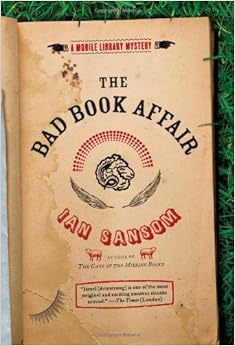
The plot of Ian Sansom's novel The Bad Book Affair revolves around librarian Israel Armstrong's loan of Philip Roth's American Pastoral to a 14-year-old girl, who disappears the next day. Roth's novel is the "bad book" of the title. It is one of the many books called the Unshelved, those kept under the counter only for adult readers who specifically ask for them. The girl's father, Israel's boss and even the local police wonder if Israel, by letting the girl check out the book, is somehow responsible for her disappearance.

Of course, that's just silly. The girl later admits she didn't even read the book. Still the furor gives Israel a reason to play detective and allows Sansom to have a little fun with what some people might consider to be "bad books." Among books kept under the counter by the library board are As I Lay Dying, Brave New World, Bridge to Terabithia, Carrie, Catch-22, The Chocolate War, The Handmaid's Tale, One Flew Over the Cuckoo's Nest and Slaughterhouse-Five, most considered classics and a couple of them even intended for young readers. Israel thinks it's outrageous to keep such books out of the hands of teenagers.

Yet Sansom adds a subtle twist to the narrative about bad books when he has Israel himself make sarcastic comments about some of the books his library patrons and Ted, the driver of the mobile library, choose to read. A true literary snob, Israel has little use for the Harry Potter books, among many others. In the eyes of some, genre novels or anything else not meeting the highest standards are "bad books."

One side applies a high moral standard to books, the other a high artistic standard. In either case, those who designate something a "bad book" may not have even read it.

I would not argue that there is no such thing as a "bad book." If a book can be good, it can also be bad. Yet it can be a mistake to keep books under the counter, so to speak, for either reasons of morality or taste. Exceptions may be made where children are concerned, however. Schools, especially at the secondary and college levels, need to encourage the reading of quality literature. They also need to make choices about which books might be too offensive for young readers. Such choices are never easy, nor should they be.

I spoke with a former school librarian at a supermarket last week. When she noticed I was wearing a Sports Illustrated sweatshirt, she commented that she always hid the swimsuit edition when it arrived. If a brave boy asked about it, she said she would tell him it must have gotten lost in the mail. I would not condone the lie, but was she wrong to hide the swimsuit edition? Might it have caused undue commotion among the schoolboys? Would it have corrupted anyone? Would it have harmed the schoolgirls in any way? We might disagree on where to draw the line, but whether we are talking about American Pastoral or the Sports Illustrated swimsuit edition, we should respect those librarians and educators entrusted to make the right call for their communities.

Monday, March 2, 2015

A mystery for book lovers

If The Bad Book Affair, published in 2009, turns out to be the last of Ian Sansom's Mobile Library mysteries, it makes a terrific conclusion to a terrific series. As Sansom began a new series with the publication of The Norfolk Mystery in 2013, this probably is the series finale.

Calling the four novels in the Mobile Library series mysteries seems a bit of an overstatement, for nobody is murdered in any of the books. Crimes, when there are any, prove minor. Still, Israel Armstrong, a book-loving young Jewish man from London stuck against his will in a job as a mobile librarian in Northern Ireland, gets a chance to play detective in each novel. In one, the library's books are missing. In another, the bookmobile itself is missing. In the other two, individuals go missing.

In The Bad Book Affair, it is a 14-year-old girl named Lyndsey Morris who disappears. Because this happens soon after Israel allows her to check out one of the Unshelved books, both the girl's father and Israel's boss blame him for the disappearance. The Unshelved are books, mostly respected works of literary fiction, considered too mature for young readers. Thus, they are kept under the counter until a patron asks to see them. Lyndsey borrows a novel by Philip Roth. Israel, who likes placing good books in the hands of young readers, sees nothing wrong with what he's done, but others do. He even gets pulled in for questioning by the police. Then he does some investigating on his own.

Sansom's books are more comic novels than mysteries. The conversations -- and the stories consist mostly of conversations -- are priceless. Yet these novels, at their core, are really about literature and about the reading life. Most mystery fans won't like them, but most bibliophiles will.

Friday, February 27, 2015

Born to fit the times

Some people are born to fit the times.
Sharyn McCrumb, If Ever I Return, Pretty Peggy-O

Literary fashion is right about as often as it is wrong, but probably not more often. And the "fashionability" or otherwise of a book is not better -- or worse -- a guide than the length of its title or the colour of its jacket.
Sebastian Faulks, Faulks on Fiction

All writers are, like the rest of us, a product of their times. Had William Shakespeare been born 400 years later, in 1964 instead of 1564, he might conceivably still be regarded as the greatest writer in English ever, but chances are he would not be writing sonnets or plays about English kings. He would instead be writing about themes of interest to 21st century readers and in a 21st century style. Even so, some people, writers included, seem like they might have fit better in some other time.

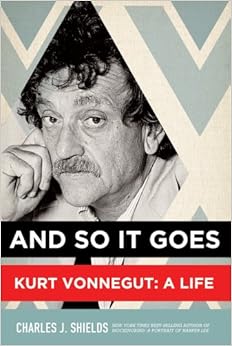
And then there is Kurt Vonnegut Jr., whom I have been thinking about a lot since reading the Charles J. Shields biography And So It Goes. Vonnegut was born to fit his times, yet sadly just a relatively brief window in those times.

He began writing seriously after his discharge from the Army following World War II, and he labored on novels, science fiction short stories and plays for more than two decades without much success. He was getting published, but earned little income and attracted few readers. And then the times caught up with him. The publication of Slaughterhouse-Five in 1969 coincided with the anti-war movement, the hippie generation and the Age of Aquarius. Without trying to, Vonnegut became the voice of that period of American history. His offbeat style, which previously had turned off publishers and readers, suddenly became relevant.

Within a few years, however, the hippies cut their hair and, in most cases, became middle-aged people with middle class values, not unlike their parents. "But novels deeply rooted in concerns of an era -- especially political issues -- don't usually wear well," Shields writes, and Vonnegut's novels began to read like a literary fad that had passed.

This brings me to the comment by Sebastian Faulks regarding literary fashions. He happens to be writing about D.H. Lawrence and Lady Chatterley's Lover, but his words apply to Vonnegut and other writers, as well. Fashion obviously has a lot to do with a book's sales, but it should have nothing to do with a book's literary value. If a book is any good, it is good whether it is in fashion or not.

In a Barnes & Noble store two days ago I noticed a whole shelf of Kurt Vonnegut books, not just his major novels like Slaughterhouse-Five and Mother Night, but some of his lesser known works, as well. So obviously his books remain in print. But are they still being read? Are they being taught in high schools and colleges? Vonnegut died in 2007. How will he be remembered 50 or 100 years from now? Was he a writer only for his times or for the ages?

Wednesday, February 25, 2015

Influences on Vonnegut

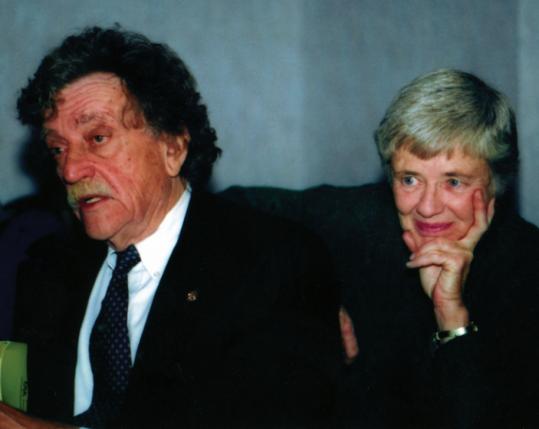
Kurt Vonnegut Jr. and Loree Wilson Rackstraw
One reason I enjoy reading literary biographies and autobiographies is learning about the influences on writers, discovering why they wrote what they did and, in fact, why they wrote at all. Charles J. Shields, in his biography of Kurt Vonnegut Jr., details numerous influences.

The family dinner table

As the third child in the Vonnegut family, Kurt was nine years younger than his brilliant brother, who later became an important scientist, and five years younger than his sister. At dinner, his siblings, especially his brother, got most of the attention. To change the balance of power, Kurt learned to tell stories, mostly funny stories.

His mother

Vonnegut's mother was a frustrated writer who sent story after story to various magazines but never had even one published. Later, more because of the family's changing economic circumstances than her lack of writing success, she killed herself. These memories drove Vonnegut to succeed as a writer.

His sister

Vonnegut later said that when he wrote he always imagined Alice as his reader. Of all the family members, she had most appreciated his youthful wit, and she later supported his writing career. Her premature death affected him hard.

His newspaper career

Beginning on his high school newspaper and later as a student journalist at Cornell, Vonnegut learned to write in short, punchy and witty paragraphs that later became the trademark of his fiction.

Slaughterhouse-Five

Slaughterhouse-Five was an actual place, the underground Dresden slaughterhouse where he was held as a prisoner of war in the later months of World War II when the city was destroyed by fire bombs. That experience later inspired his novel Slaughterhouse-Five.

Billy Pilgrim

One of his fellow prisoners was a private named Joe Crone, who planned to become an Episcopal minister after the war. Awkward and innocent, Crone was as ill-fitted as a POW as he was as a soldier, regularly trading his food rations for cigarettes. It was Crone whom Vonnegut used as a model for Billy Pilgrim. The author later paid to have Crone's grave decorated with flowers every Memorial Day.

Anthropology

Vonnegut never earned a college degree, but he came close in the field of cultural anthropology. Shields writes, "His ironic distance as a novelist, sounding as detached as an entomologist observing insects, can be traced to his days as an anthropology student."

Kilgore Trout

The hapless science fiction writer who floats in and out of many of Vonnegut's novels was patterned originally after science fiction writer Theodore Sturgeon, although the character later seemed to represent Vonnegut himself.

Mary O'Hare

The wife of one of his former Army buddies, Mary O'Hare once accused Vonnegut of trying to write yet another novel glorifying war. "You were just babies then," she told him. That notion stuck with him and led to the phrase "The Children's Crusade," which he used as a subtitle for Slaughterhouse-Five. It also led to the novel becoming anything but another book glorifying war.

Montana Wildhack

Vonnegut is said to have modeled the young porn actress in Slaughterhouse-Five after his mistress, Lora Lee (Loree) Wilson, once one of his writing students.

Ambrose Bierce

Vonnegut, after he became successful, began to model himself after Mark Twain, even to the point of dressing like him and giving humorous lectures for which, like Twain, he was very well paid. Yet Shields argues that Bierce, not Twain, was the greater literary influence on Vonnegut's writing.

Monday, February 23, 2015

The patterns of Kurt Vonnegut's life

What a biographer is looking for is patterns of behavior.
Charles J. Shields, And So It Goes:  Kurt Vonnegut: A Life

That may be true, but it is the exceptions to those patterns, the inconsistencies, that make a life interesting. Charles J. Shields, whose Mockingbird: A Portrait of Harper Lee was such a fine literary biography, equals that with And So It Goes, his 2011 portrait of Kurt Vonnegut Jr. And for all the clear patterns of behavior in Vonnegut's life, the inconsistencies prove just as important.

Shields makes much of the fact that Vonnegut, while the darling of the Left from the time he became a major literary figure in the 1960s, was in many ways a conservative at heart. Like a reactionary, says  Shields, he longed for the good old days. He hated the way his world was changing. Vonnegut may have spoken out against Big Business, yet he invested heavily in the stock market and counted on Big Business to protect his fortune. Vonnegut wrote and spoke often about the importance of family and old-time values, yet his own family life was a mess. He preached the value of friendship and cooperation, yet he betrayed many of his own friends and the people he did business with.

Vonnegut was one of many novelists to come out of World War II, yet it took him decades to write the war novel that would make his reputation, Slaughterhouse-Five. A prisoner of war, he had been in Dresden during the fire bombing that destroyed the city in 1944. He survived by being underground at the time, in Slaughterhouse-Five, yet being underground he wasn't actually a witness to the bombing, so he didn't know how to tell the story. Finally he found a way using science fiction, time travel and aliens from space to create one of the most unique novels of the 20th century.

He continued to write, but none of his subsequent books measured up to his masterpiece, although some of his earlier novels, virtually ignored when first published, later became admired. His shrinking reputation frustrated Vonnegut. He now had fame and fortune, yet with each new novel, critics took him less and less seriously. Many of his books were bestsellers, but he hated being thought a literary fraud.

Had Vonnegut been true to his values; been faithful to Jane, his first and best wife; been a better father and a better friend, he most likely would have had a happier life than he had. But his biography, if anyone even bothered to write one, would have been much less interesting.

Friday, February 20, 2015

Poking fun at the literary world

Before I put William Kotzwinkle's novel The Bear Went Over the Mountain back on the shelf, I wanted to point out a few more of the author's jabs at the world of literature.

On publicists:

The interviewers she'd be wooing wouldn't have time to read the book either; they'd be working from her publicity release. Something so drab as the book itself wasn't much use to anyone.

And later,

In show biz, books were always a question mark, because books were just books, but buzz you could trust.

In my long experience as a book reviewer, my contact with book publicists was mostly by press releases, e-mail and telephone, with only a couple of face-to-face meetings. So I don't really know how committed these people were to the books they were promoting. Had they read them? Did they like them? Who knew? It would not surprise me, however, if Kotzwinkle were not close to the mark in his satire. Publicists, after all, are hired by publishers not because they like books but because they know how to promote them.

On professors of literature:

"Since my last book, the fact that Frost used the word like as a simile .54 times per page is common knowledge." ... "But," continued Settlemire as he stroked his goatee, "it isn't commonly known that he used as if .07 times per page. That's the substance of my new study on him. One needn't tell you the significance of this."

And later,

"Pernod places too much emphasis on the writer," said Ramsbotham. "Any real study of contemporary literature begins with those who teach it."

These pokes at professors and literary critics, if exaggerated, seem on target to me. Some critics, trying to be original when so much has been written about particular novels, do attempt to make mountains of molehills, striving to make significant things the authors themselves probably gave no thought to at all. And literature professors, and even book reviewers like me, often think they know better than the authors how their books should have been written.

Since its publication nearly 20 years ago, The Bear Went Over the Mountain has faded into obscurity. That's too bad. It is hardly a great book, but it deserves to be read, especially by authors, publicists, professors and others in the literary world who may take themselves a little too seriously. 

Wednesday, February 18, 2015

It all started with 'It All Started with Columbus'

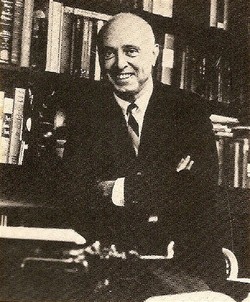
I discovered Richard Armour when I was in high school back in the late 1950s. I knew just enough about history to think It All Started with Columbus was the funniest book I had ever read. Later I enjoyed his humorous take on literature (The Classics Reclassified and other books), art (It All Started with Nudes), libraries (The Happy Bookers) and other subjects. I thought I owned a pretty good collection of Richard Armour books until I stumbled upon a treasure trove of them, mostly first editions, at a library sale in Clearwater, Fla., nearly three weeks ago.

Perhaps someone who admired Armour even more than I did had died and his (probably his) books had ended up in the hands of the local Friends of the Library. Or perhaps Armour's admirer had simply moved into a smaller home where there was less room for books. In any case, I was among those who benefited from the donation. I found four books I didn't previously own: Drug Store Days, Through Darkest Adolescence, Going Around in Academic Circles and Golf Is a Four-Letter Word.

Each of  these is at least partly a memoir, even if his memories are always colored by his humor. In Drug Store Days, about growing up as the son of a druggist, he writes, for example, "I was born in the early hours of morning, and had breakfast in bed."

Through Darkest Adolescence, written when Armour was the father of a teenager, he opines, "Adolescence is a disease.... Like the common cold, there is no cure for it."

An English professor for most of his adult life, Armour lampooned academic life in Going Around in Academic Circles: "Students are advised to apply to several colleges, not merely the college of their choice. This is because each application must be accompanied by a fee, which is non-returnable, and every little bit helps when the budget is tight."

As a writer of light verse, Armour always lived in the shadow of his contemporary, Ogden Nash, but even so his verse was always amusing. In Golf Is a Four-Letter Word, a book about his experiences as a golfer, he includes some of his poems on  the subject. One of these is called "Get Together, Please."

The day my dead-eye putts are falling
My drives are at their most appalling,
And when my drives are simply splendid
My putting streak's abruptly ended.

Richard Armour died in 1989. There are, I now realize, still quite a number of his books I have yet to find. I must stay alert at future used book sales.