Friday, March 20, 2015

So wise, so gentle

... the African lady detective who was so smart, so wise, so gentle, and so patient that she made Nelson Mandela look bad.
Ian Sansom, The Bad Book Affair

When Alexander McCall Smith appeared in Clearwater, Fla., several years ago, he hinted he was thinking of introducing Clovis Andersen as a character in a future installment in his No. 1 Ladies' Detective Agency novels. Andersen's name has appeared in every book in the series, but never as an actual character. He is the American author of The Principles of Private Detection, the book Precious Ramotswe uses as her bible in the detective agency she started in Botswana with the money left to her by her father. Whenever she finds herself at a loss as to what to do, she consults this book.

The Limpopo Academy of Private Detection, published in 2012, is the novel Smith had in mind when I heard him speak in Clearwater to an overflow crowd. (I was a part of the overflow, sitting on the library floor.) Andersen, traveling as he mourns the loss of his wife, happens to wind up in Botswana, where he makes a courtesy call on the little detective agency with the unusual name. He has never dreamed that anyone, especially someone as far away from Indiana as Botswana, would be taking his guide, which has never sold many copies, so seriously.

Soon Clovis Andersen joins Mma Ramotswe as she probes two cases that strike close to home. Mma Potokwane, who has managed  the orphan farm so ably for so many years, has been dismissed from her job by a member of her board whose interests seem to be something other than the welfare of orphan children.

Then Fanwell, one of her husband's young apprentices at Speedy Motors, moonlights as a mechanic for a former classmate, then gets arrested and charged with being part of a stolen-car gang. Mma Potokwane and Fanwell may not be paying clients, but rescuing them, with a little help from Clovis Andersen, becomes her focus in this novel, another winner for the series.

The above Ian Sansom quotation is actually meant as a putdown. Sansom's main character, Israel Armstrong, is a literary snob who remembers with displeasure some of the audio books he has been forced to listen to as he travels about Northern Ireland in the mobile library driven by Ted, whose literary tastes are very different from his own. These include a Harry Potter book, Sebastian Faulks's Birdsong and an unnamed installment in the No. 1 Ladies' Detective Agency series.

Armstrong's description of Precious Ramotswe as being so smart, so wise, so gentle, so patient seems to be in the spirit of children who refer to one of their number as a goody-two-shoes. Many of us tend not to like those who seem morally superior to ourselves. We may prefer fictional detectives who drink too much, smoke too much, have sex with the wrong people and are too quick to use their fists. Their flaws make them seem more human.

Yet Mma Ramotswe strikes me as every bit as human as any of the tough guys. Hardly perfect, she drinks way too much tea and has allowed herself to become "traditionally built." Smith's books about her may not be great literature, but they are good literature that reminds us that kindness and caring can work wonders, even in the detective business.

Wednesday, March 18, 2015

The other side of the story

Imagine if Vladimir Nabokov, having already written one novel from the point of view of Humbert Humbert had written another from the point of view of Delores, the girl we know as Lolita. Or suppose Mark Twain, after giving Huck's version of the raft trip down the Mississippi, had followed that with Jim's version. Would these second novels have been simply retellings of the first or entirely different stories?

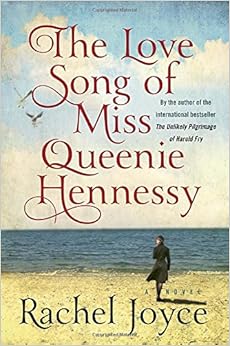
Rachel Joyce doesn't make us wonder. She has followed her successful novel The Unlikely Pilgrimage of Harold Fry with The Love Song of Miss Queenie Hennessy, the story from the other perspective.

In the first novel, Harold Fry is a 65-year-old retiree who gets a letter from a woman he used to work with. Queenie Hennessy tells him she is dying of cancer in a hospice in the northern part of England. Harold immediately writes a note to her, tells his wife he is going out to mail it and sets out walking. Instead of mailing the letter, however, he keeps on walking, deciding that as long as he walks toward Queenie, she will continue to live.

The new novel finds Queenie, after hearing about Harold's odd pilgrimage, struggling to hang on because she thinks of Harold, though he doesn't know it, as the love of her life. While he walks, she composes her letter for him to read when he arrives, her confession of her love.

The earlier novel hints of a relationship between Queenie and David,  Harold's son. This novel provides the details. David, though a brilliant boy, is deeply troubled. He steals from Queenie, lies to her, humiliates her and imposes himself on her when she'd rather be alone, yet she puts up with him only because he is Harold's son. She has never, until now, told Harold about even knowing David.

While Queenie thinks back on her life and her unrequited love (although Harold's long walk suggests it is not entirely unrequited), she also tells about life and death in the hospice. There is a stirring passage where other patients vow to stay alive and, like Queenie, wait for Harold to arrive. Sadly, the others don't make it. Yet Queenie, the woman who loves him, does.

I liked the earlier novel better, but I'm glad Joyce gave us readers the other side of the story, for it turns out to be entirely different.

Monday, March 16, 2015

Inscribed by the author

At the Florida Antiquarian Book Fair in St. Petersburg last Saturday, I was admiring the array of signed first editions in one of the booths when I entered into a conversation with the dealer. She told of the difficulties faced in acquiring all those signed copies. The difficulties lie not in getting the books themselves but in getting the signatures by living authors. Whenever an author of note comes to their city, they strive to get as many signatures as they can. Sometimes they travel to other cities or make arrangements with booksellers in those cities to get the signatures they desire. On rare occasions, she said, they will mail a book to the author to get a signature, the problem being to know for sure the signature is actually that of the author.

As she was talking, the phrase "penny-wise, pound-foolish" came to mind. Are not book dealers, by building up inventories of so many signed books, deflating the value of the very books they are trying to sell at inflated prices?

A signature of the author can enhance the value of a book, yet other factors are also important. Is it a first edition? Does it still have a dust jacket? What kind of condition is it in? And then there is the matter of supply and demand. How many similar copies are out there and how many people want them? At the book fair Saturday I saw a three-volume first edition of Jane Austen's Sense and Sensibility, published in 1811, with an asking prices of $30,000. Were it signed by Jane Austen, it might be priceless, but it is still worth a lot because of its rarity.

Over the past number of years, virtually every bookshop has brought in authors for book signings. Customers who buy the book can get it signed for free. Sometimes, if they buy a book, they can bring in copies of books they already own to have signed, too. (That's how dealers like the one mentioned above can get so many signed copies.) Popular authors may sign dozens, even hundreds, of their books each day on book tours. Literary festivals and book fairs are also places where many books get signed.

I have never counted how many signed books I own, but there must be scores of them. Are any of them worth more than I paid for them? Probably not. Few are first editions, and those that are are mostly books nobody collects by authors few people have heard of. I have two signed books in front of me, both paperbacks. On the title page of Emily, Alone, novelist Steward O'Nan wrote, "These quiet moments alone, with much hope." Inside Beautiful Ruins, Jess Walter wrote to me, "One of my former tribe," a reference to the fact that we were both journalists in our former lives. These inscriptions mean something to me, but they aren't going to make my son rich when he inherits my books someday.

Were I famous, that might be different, however. Sometimes who owned the book can be more significant than who wrote it. A catalog I picked up Saturday includes a listing for a first edition of a book called Recollections of a Baseball Junkie by former sportscaster Art Rust Jr, signed by the  author. Why would this book be worth $850? Not because Rust signed it but because he inscribed it to Joe DiMaggio. The book comes with a letter from DiMaggio's granddaughters attesting that it was actually found in the slugger's library. That makes it one of a kind and worth something to baseball collectors and DiMaggio fans. Most of the many signed volumes at the fair last weekend are better books by better authors, but with so many other books out there, the same books signed by the same authors, they are, in most cases, worth much less. And many of them are going to be worth less and less all the time as their authors keep signing more books.

Friday, March 13, 2015

The books that shaped our lives

Most of us retain a certain nostalgic affection for our first books, those read to us when we were small children and those we read ourselves when we were a few years older. Roy Peter Clark of Poynter Institute in St. Petersburg, Fla., took these warm feelings to the extreme. He decided to form a library of all the books he remembers as being important to him during his formative years, "from cradle to college." His collection, now complete, includes some 300 books.

Clark seems like the ideal choice to lead a discussion called "The Secrets of Formative Reading" yesterday afternoon at Poynter Institute. Thirty or 40 people gathered to listen to him talk about the important books from his youth and to share something about the books that influenced their own lives.

Among the books Clark spoke about were Mr. Blue by Myles Connolly, a book familiar to many Catholic school students of his generation; My Greatest Day in Baseball, a beloved book given to him by his uncle; Nuremberg Diaries by G.M. Gilbert, a book he thinks he may have stolen in his youth; Parnassus on Wheels, a classic by Christopher Morley; and Assignment in Space by Blake Savage, the pen name of Hal Goodwin. Clark said the most difficult book to find was one with the generic title of Children's Stories. Yet he tracked it down, recognizing it by the cover illustration he remembers from his childhood.

One woman, now a teacher, still has the worn copy of Bunnicula she read repeatedly as a child three decades ago. She told of getting the author, James Howe, to sign it for her in 2011 and how much that meant to her.

Two women had copies of A Wrinkle in Time with them. Other attendees spoke of The Velveteen Rabbit, Dan Frontier and Travels with Charley.

One of my most vivid memories of my youthful reading finds me stretched out on my bed glued to Journey to the Center of the Earth by Jules Verne. As I remember that day, I just couldn't turn the pages fast enough. I reread the novel decades later and found the story hardly stirred me at all. I guess that illustrates what Clark said about books changing as we change. And sometimes it is the books themselves that change us.

Wednesday, March 11, 2015

Filling in the blanks

In an author's note at the end of The Autobiography of Mrs. Tom Thumb, author Melanie Benjamin writes, "I believe that every novel is either a mystery, a tragedy, or a love story -- some are all three -- and it became clear to me that this is a love story."

The key figures in the love story in her 2011 novel are not, as one might suppose, Lavinia Bump (or Vinnie Warren, as she called herself) and General Tom Thumb, one of the most famous couples in America during the Civil War and for a number of years afterward. No, the love of Vinnie's life, as Benjamin tells the story, is P.T. Barnum, the show business impresario of the period who discovered Tom Thumb and soon incorporated Vinnie, and later her even smaller sister, Minnie, into the act. Barnum, not the General, is the one man whom she can speak frankly with and pour her heart out to. Vinnie and her husband are never particularly close, except on the stage. He remains at heart ever a child, while she, despite her size, is very much a woman.

Tragedy haunts this story, as well, when Minnie dies in childbirth. Later Tom Thumb (Charles Stratton) dies, from shame in Benjamin's telling, after a hotel fire..

Yet the novel also offers mystery, the mystery being how much of this tale is true and how much is fiction. As she did in Alice I Have Been, her novel about Alice Liddell (Lewis Carroll's inspiration for Alice in Wonderland), Benjamin fills in the blanks left by biographers. And there are always blanks, sometimes significant blanks.

Vinne really did write an autobiography, but it has little to say about her personal life, her motivations or her passions, and certainly nothing about her feelings for either her husband or Barnum. Benjamin has a gift for reading between the lines and inventing plausible explanations for what the biographers can tell us.

She has also written a novel about Anne Morrow Lindbergh, The Aviator's Wife, which I am eager to read to see how she fills in the blanks in that life.

Monday, March 9, 2015

Slow Motion

The New World, Andrew Motion's second sequel to Robert Louis Stevenson's Treasure Island, reminds me somehow of the chase scene near the end of Robert Altman's Popeye. I rather like the movie as a whole, but I have fallen asleep at least twice during that chase scene, which involves slow-moving boats. The frantic actions and speech of the characters on the boats are apparently supposed to provide the tension, but it just doesn't work. I fall asleep, or wish I could, whenever I watch the last 20 minutes of the movie.

Motion's novel is mostly one long chase, mostly in slow motion. Jim and Natty, offspring of the two key Treasure Island characters, survive the loss of their ship on the Gulf Coast of Texas, but they are soon captured by a band of Indians. Led back to the Indian village, they expect to be killed in the most painful way they can imagine. With a little help, they manage to escape, but not before stealing a silver necklace from Black Cloud, the chief.

Jim and Natty take off across the American frontier with Black Cloud in pursuit. They take refuge with a peaceful tribe, join a group of entertainers heading west (in 1805?) and eventually climb aboard a boat floating down the Mississippi to New Orleans. Black Cloud follows them all the way.

The novel has its moments, yet for an adventure tale it is surprisingly easy to put down. At least it didn't put me to sleep.

Friday, March 6, 2015

How to teach writing

Kurt Vonnegut Jr. was a successful writing teacher before he became a successful writer. Usually it works the other way around. Writers gain critical success, but usually not financial success, so they supplement their incomes by teaching in creative writing programs. They teach relatively few classes, leaving themselves plenty of time to do their own writing.

When Vonnegut was offered a job as a writer-in-residence at the prestigious Iowa Writers' Workshop in 1965, he was still considered mostly a hack writer of science fiction short stories. He had written some novels, but few people had read them. Novelist Nelson Algren, not Vonnegut, was considered the star of the workshop faculty. Yet Vonnegut soon became the more popular instructor, both because he was a good teacher and because he was simply a lot more fun than Algren and others on the faculty. Among his students at Iowa were future novelists John Irving, James Crumley, Nicholas Meyer and Gail Godwin.

Vonnegut developed some definite ideas about how to run a successful writing program, ideas that strike me as pretty good.

First, he favored weeding out those students who, however much they may wish to be writers, simply don't have what it takes. I myself was weeded out of the applicants for the Iowa Writers' Workshop in 1966, while Vonnegut was teaching there. I must admit I deserved to be weeded out. Despite one published short story, I really didn't have the skills to be a successful writer of fiction.  Few applicants for creative writing programs do. Why waste their time and money?

Second, writing programs need to last at least two years for them to be of any use to developing writers.

Third, Vonnegut thought it vital that instructors not just focus on the short story. Short stories, although hardly easy to write, nevertheless can be written in a relatively brief amount of time so that a student might be able to produce several stories in a semester. They are short enough to be read and discussed in class, and they put less demand on the time of instructors, who must read and grade them all.

Yet today relatively few short stories get published and few people actually read them. Vonnegut thought writing programs should also encourage the writing of novels, poetry, essays, plays, scenarios for television and movies and other kinds of writing. Of course, not all writing teachers feel qualified to teach and grade all these forms. Vonnegut, who had written stories, novels, essays, plays and even news articles was probably more versatile than most of his colleagues.