Friday, June 5, 2015

Hard reading

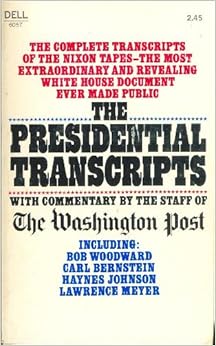
One of the books in my library I have never read and never expect to read is The Presidential Transcripts, a transcription of the Nixon tapes that, perhaps more than anything, forced President Nixon to resign. Countless copies of this book were sold back in the 1970s -- my copy was part of the third printing -- but I can't imagine anyone reading all 693 pages who didn't have to.

I took the book down from its shelf this week after reading what Steven Pinker says about it in The Language Instinct. Pinker writes that the Nixon transcripts shocked Americans in three ways. A few were shocked that the president had taken an active part in covering up a crime. A few more were shocked that "the leader of the free world cussed like a stevedore." But what shocked most people was how difficult to read transcribed conversation can be. Surely Richard Nixon, John Dean, H.R. Haldeman and the others understood what they were talking about, but understanding what they said by reading it can be a challenge.

One of group of people who, better than most others, could understand the transcripts were journalists, Pinker says. That's because journalists must, as part of their job, train themselves to convert ordinary speech into a written form that anyone can understand.

Listen closely to a conversation and you will discover that people tend to talk in incomplete sentences, throwing in a lot of "uhs," "likes" and "you knows." They also use a lot of facial expressions and gestures that are impossible to put into a transcription. Simply the manner in which something is said tells a listener whether the speaker is serious, sarcastic or whatever. You can't always tell when those words are put down on paper.

Yet reporters are expected to insert direct quotes into their stories. That can mean converting jumbled, incomplete sentences into something readers can understand while still being faithful to what the news source said. During my days as a reporter I once had a city council member tell me, "You know what I mean. Put it in your own words." While I appreciated his vote of confidence, I was not about to make up a quote just to have one. Polishing a quote and making it read better than it otherwise would have is another matter, however. Journalists do that all the time, although sometimes I'm sure they take too many liberties with their quotes.

Pinker recalls when former Red Sox pitcher Roger Clemens complained the Boston Herald always misquoted him. So the newspaper started reproducing the ball player's postgame comments word for word, making Clemens look ridiculous in the process.

Clemens, Nixon, Haldeman, et al, were not alone. Most of us would be embarrassed if our everyday speech were put into writing and distributed to the world.

Wednesday, June 3, 2015

Queenan quotations

I like to play with my books, to mark them up, to give them a lived-in look.
Joe Queenan, One for the Books

Thirty or 40 years ago I underlined frequently in my books, especially nonfiction books. It seemed like the best way to find the lines most worth returning to later. Then I became obsessed with keeping my books as pristine as possible. I started making notes on 3-by-5 cards that doubled as bookmarks and avoided any marking in books. I removed dust jackets before reading a hardback book, and I tried keep paperbacks looking like new, however impossible that task turned out to be. Dog-eared pages is something I have always tried to avoid.

Reading Joe Queenan's essays about his reading life in One for the Books inspired me to lower my standards a bit, at least for this book. If he likes to mark up his books, perhaps I should let myself mark up his book, too. The book has so many good lines in it that I am likely to keep it, not give it away. So why not mark it up? Here are a few of the lines I allowed myself the pleasure of underlining in One for the Books:

"From the moment I own a book, even before I open it to the first page, I feel that it has in some way changed my life."

"Great writers say things that are so beautiful, the very act of repeating them makes life itself more beautiful."

"Books as physical objects matter to me, because they evoke the past, because I find their presence emotionally enriching."

"...the single most feared creature on the planet: the self-published poet."

"The people I know who attend book clubs are generally intelligent, but they are rarely what I would call interesting."

"Libraries provide cost-free reading material so that tightwads and misers can tell local writers that they borrowed their books and then expect them to be grateful."

"Most people read drivel."

"Sometimes I think that I am reluctant to finish books because I want to let the joy of reading them go on and on forever."

"I do not ever want to reach the point where I have nothing left to read but Middlemarch."

"Well, I've already gotten to Ulysses. I've been getting to Ulysses for the past thirty years."

"I think it is important to have goals in life, as long as you understand that achieving those goals will not make you happy."

"Only the greatest books can withstand the damage inflicted on their reputations by bad movies."

"Staff recommendations are pitifully generic -- Fight Club, Outliers, Infinite Jest. It's like soliciting dessert tips from four-year-olds."

"Purchasing a secondhand book does absolutely nothing for a writer. Less than nothing."

"Some, like Arrowsmith and Manhattan Transfer, were books that I was actually looking forward to not reading."

"Indeed, one of the reasons I became a book reviewer was that it gave me the opportunity to read a steady stream of hopelessly  moronic books and get paid for it."

"Shockingly bad books have an important place in our lives, because they keep our brains active. Good books don't make you think, because the author has already done all the thinking for you, but a terrible book can really give your brain a workout."

"The Bridges of Madison County is a corn shucker's Madame Bovary."

"Reading books may make you smarter than other people. It does not make you better."

Now those are some lines worth marking up a book for.

Tuesday, June 2, 2015

Handed the solution

Inspector Robert Colbeck, the hero of Edward Marston's Railway Detective mystery series, does his best work in Railway to the Grave  detecting who didn't kill Miriam Tarleton, not who did.

In this otherwise excellent seventh entry in the series, published in 2010, Colbeck gets called in when Colonel Aubrey Tarleton, Miriam's husband, takes a stroll right into the path of an oncoming train. Tarleton was a close friend of Superintendent Tallis, Colbeck's boss, who wants his man not only to solve the mystery of the strange suicide and the missing wife but also to prove that Tarleton was of sound mind at the time, that he did not kill his wife and that, in fact, the Tarletons were a happily married couple. It's a big job, made all the more difficult when Tallis, at first, insists upon leading the investigation. Only when their ill-tempered superior returns to London can Colbeck and his associate, Sgt. Victor Leeming, get down to the business of discovering what really happened.

The climax of this enjoyable murder mystery proves disappointing when Colbeck is simply handed a package of letters discovered by a maid that reveal a previously unknown motive for murder, and these letters lead to a quick confession. A reader wants fictional detectives to work a little harder than this to solve perplexing cases.

Yet Colbeck does shine in dismissing three other suspects, all which whom Leeming is ready to slip the handcuffs on. Colbeck deduces that while they may be guilty of other crimes and other sins, none of them killed Mrs. Tarleton.

The novel is filled with interesting characters, most of whom have something to hide, and interesting subplots, including one of Colbeck trying to work up the nerve to tell Tallis of his plans to be married. With a satisfying solution to the mystery, this book would have been top-notch.

Thursday, May 28, 2015

Happy places

The notion that happiness can be found somewhere else is at least as old as the saying that the grass is always greener on the other side of the fence. It is why immigrants still flock to the United States, why pioneers went west and why retirees head south. But are some places really happier than other places? Eric Weiner, a self-confessed grump, seeks to find out in his 2009 book The Geography of Bliss.

Weiner's unscientific research takes him to 10 countries, including the Netherlands, the center of truly scientific research into happiness; Iceland, Switzerland, Bhutan and Thailand, where people really do appear to be happier than those in most places, if for very different reasons; Moldova, where unhappiness abounds; Great Britain, where a project was conducted to attempt to make one town, Slough, happier; and the United States, where people may think they are happier than they really are. He also traveled to Qatar, one of the wealthiest nations on earth per capita, to see if money really can buy happiness, and to India, which despite its great poverty, draws people seeking happiness.

People in different cultures, Weiner finds, view happiness differently. Trust plays a big role in whether one feels happy or not. "Trusting your neighbors is especially important," he writes. "Simply knowing them can make a real difference in your quality of life." Diversity, while considered among the greatest virtues in today's world, tends not to enhance happiness. Most people feel happier among others like themselves, he discovers.

He concludes, "Money matters, but less than we think and not in the way that we think. Family is important. So are friends. Envy is toxic. So is excessive thinking. Beaches are optional. Trust is not. Neither is gratitude." Notice that his summary, except for the mention of beaches, ignores geography.

Weiner writes with such wit and charm that you will feel happier, at least temporarily, just for reading his book.

Wednesday, May 27, 2015

Despite discouragement

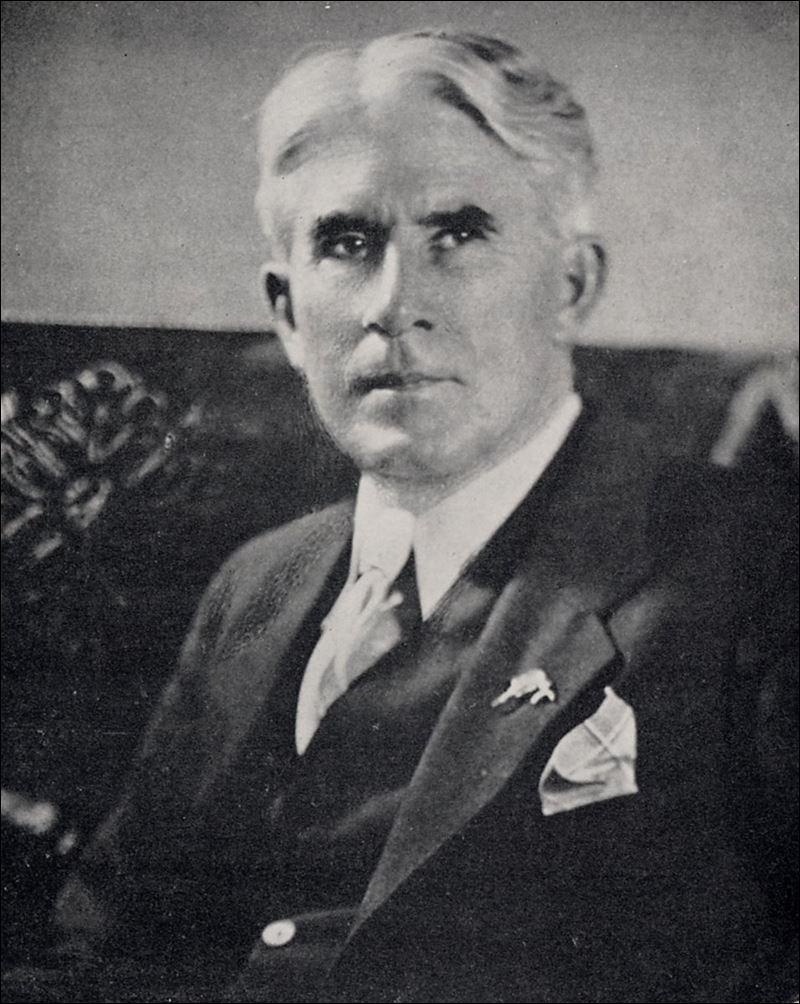
My father-in-law, who grew up in Paulding, Ohio, loved reading the novels of Zane Grey in his youth. Near the end of his life, after his vision failed him, his eldest daughter, my wife, read to him some of these stories, both the westerns and the hunting and fishing tales.

I don't recall ever reading even one of Grey's books, but I was interested in a brief article about him I found in an old issue of Smithsonian (December 2001). Several things in this biography intrigued me.

He was born, Pearl Zane Gray, in Zanesville, Ohio, in 1872.

An outstanding baseball player in college (University of Pennsylvania), he was among the first pitchers to master the curveball.

"Grey has been credited with establishing the shape of the 20th-century western novel," Jake Page writes in the article.

Among his 89 books was one western set in Australia.

More than 100 movies have been based on his stories, and he formed his own production company to make western movies.

He had a strong dislike for Tom Mix, the star of several Zane Grey movies, because Mix was a noisy neighbor on Santa Catalina Island.

Grey once sailed to Tahiti in his yacht.

Yet one fact about Zane Grey's life has stuck with me most over the past several days. His father, a dentist, did his best to discourage his son's passion for writing stories, going so far as to tear up an early story and give the boy a thrashing. Young Pearl Gray surrendered to his father and became a reluctant dentist himself. That is, until he was 33 and broke free to follow his own dream.

The same issue of Smithsonian contains an excerpt from a book by paleontologist Michael Novacek, Time Traveler: In Search of Dinosaurs and Ancient Fossils. Novacek recalls attending a Catholic school, where the nuns disciplined him for reading concealed science books in class.

I wonder how many children, especially gifted children, have had their passions discouraged by parents, teachers or friends, however well-meaning these parents, teachers and friends may have been. Many people graduate from high school or college without knowing what they want to do with their lives, but others find their passions very early in life. For some kids it's computers. For others it's art. For others, like Novacek, it's science or, like Grey, writing.

Not all such discouragement is necessarily a bad thing. Children, left to themselves, would probably devote all their time to only those activities that most interest them, to the neglect of other things that will help them develop into a healthy, more rounded adult. My mother was always trying to get me to go outside, away from the books I wanted to read and the stories I wanted to write. Yet today I don't really regret those hours spent playing and working outdoors.

In some cases, discouragement may even be beneficial. I caught a couple of minutes of a TV show this week about ice skater Tonya Harding. Tonya spoke of how her mother discouraged her and made her childhood extremely difficult. Her mother's version was that Tonya was the kind of child who responded to reverse psychology: Tell her she couldn't do something and she became determined to do it anyway.

Most people, like Grey and Novacek and even Tonya Harding, seem to manage eventually to do, or at least to attempt to do, what they wanted to do all along.

Monday, May 25, 2015

Reading habits

In my adult life I cannot remember a single time when I was reading fewer than fifteen books, though at certain points this figure has spiraled far higher.
Joe Queenan, One for the Books

I can relate to Joe Queenan on this one. I haven't always been this way. There was a time when I read just one, maybe two books at a time. Over the years that number has somehow multiplied until, when I did a rough tally last night, I numbered at least 20 books in progress. Some of these have been "in progress" for a number of years. The count is imprecise because there are unfinished books throughout the house, as well as in both of our cars and in our Florida condo. Some books have been untouched for so long I'm sure I have forgotten them. I'm not sure whether to classify some books as unfinished or just abandoned.

"Like any addiction," writes Queenan, "the habit of ceaselessly starting new books provides me with immense pleasure." Yes, opening a new book and reading those first few pages can be irresistible. Reading the last few pages can also bring intense pleasure. It's those vast middle sections of most books, when plots bog down and when nonfiction books get clogged with uninteresting detail, that are the problem. Of course, stretching the reading of a book out over several years doesn't help matters. Queenan says he can remember what he has read before, but I am not always that lucky.

Reading so many books at one time means it can take a long time to finish a book. Yet it can mean finishing several books at about the same time, sometimes as many as three in a single day. So the numbers add up, even though progress seems slow. I consider it a good reading day when I have read a portion of at least 10 different books.

Juggling so many books at one time allows me to enjoy more diversity in my reading than most readers can boast. I try to maintain a balance between fiction and nonfiction, although I tend to read the novels more quickly. I like to be reading at least one mystery or thriller and at least one more serious work of literature at any one time, and I always have at least one book of short stories in progress. Currently I'm reading three.

I also like to be reading a biography, something about history, something about science, something about language, something about religion and something about literature. I also like to be reading something, such as a book of quotations, that I can pick up to read for just a couple of minutes at a time, such as during television commercials.

"My reading habits are unusual, perhaps counterproductive," Queenan says. So are my own, but reading habits, like any habits, are not easily broken. That's assuming I even wanted to break them.

Friday, May 22, 2015

Why so many books?

"If anyone asks you if you've read all those books," he said, "it means you don't have enough books."
Harold Rabinowitz, "They Don't Call It a Mania for Nothing"

If you have more than a few books in your personal library, you have probably heard the question, "Have you read all these books?" Probably you have heard it more times than you can count. The question may be more revealing than the answer.

What it reveals, first, is that the questioner lacks imagination and may even be humor-challenged. It's a bit like asking a tall man, "How's the weather up there?" It may have been amusing once, but that once was a long, long time ago.

The second thing the question reveals about the person asking it is that this person lacks a passion for books, A Passion for Books being the title of the book from which the essay quoted above is found. Those who feel at all passionate about books never wonder why someone else shares that passion. They are more likely to be amazed that someone else does not.

As for the answer to that question, it being a yes or no question, there are just two basic answers. If the answer is yes, the owner of the library has read all those books, then maybe he or she really doesn't have enough books. Yet much can be said, especially when one has reached a certain point in life, for just rereading the books one has already enjoyed through a long lifetime. If a book is any good at all, reading it again and again is hardly a waste of time. Yet to the person asking the silly question, an affirmative answer may lead to yet another silly question, "If you've read them, why do you still have them?" To many people, including some who read a lot, a book is regarded as being much like facial tissue: When you're done with it, get rid of it.

Most likely, however, the person with a large library will not have read all those books. Some of those books may have been sitting on the shelf a long time waiting to be read. Some may never be read.

In truth, how this question is answered doesn't matter. It may not sound like it, but it is really a rhetorical question to which no answer is necessary. The person asking it is simply expressing amazement that anyone in his right mind would want to have so many books cluttering his home. Other people's passions can be difficult to comprehend.