"Franny," the J.D. Salinger short story first published in The New Yorker in 1955, begins with a stereotypical college romance and ends with a spiritual crisis. In between, as a transition between the two, Salinger gives us an unusual literary discussion between the story's two characters, Franny, a student at one college, and Lane, a student at another. They meet at the train station in apparent rapture at the prospect of spending the weekend together. I love this line early in the story: "Lane spotted her immediately, and despite whatever it was he was trying to do with his face, his arm that shot up into air was the whole truth."
Little things often develop into big things in Salinger stories. The prime example has to be "A Perfect Day for Bananafish" in which Seymour Glass, Franny's older brother, talks with a four-year-old girl on a Florida beach, then goes back to his hotel room and kills himself. What happens to Franny in this later story proves almost as dramatic. And the change begins with that literary discussion so common among college students.
Franny makes two observations. First she accuses Lane of "talking like a section man." This is a graduate student who temporarily takes over a professor's literature class and begins spouting his narrow views about a particular author, thereby ruining that author for the students, or at least one as sensitive as Franny Glass. Lane, naturally, does not take this criticism well.
Then Franny complains about those who write poetry but in her mind are not true poets. "If you're a poet, you do something beautiful," she says. "I mean you're supposed to leave something beautiful after you get off the page and everything. The ones you're talking about don't leave a single, solitary thing beautiful."
From there Franny goes on to tell Lane about a book she's reading called The Way of the Pilgrim and about the value of meditating on the phrase, "Lord Jesus Christ, have mercy on me." Within minutes she has fainted and is last seen lying still, her lips "forming soundless words."
Any good story opens itself to a multitude of interpretations, and "Franny" is no exception. Is Franny having a mental breakdown, an emotional breakdown or a spiritual breakdown? Is Lane a part of the crisis or just an interested observer? What is really going on in her life? I like the way Salinger uses his story to make connections between artistic things and spiritual things, between idealism and reality, between literature and life, between the ordinary and the extraordinary.
Monday, June 22, 2015

Friday, June 19, 2015
Been there, done that, so what?
How many thrillers can you reread? They are disposable, open and shut, throwaway, leave-on-a-train books. To stand up to years of repeated readings, there has to be more than blood and thunder, especially as, once you know what happens next, you lose the element of surprise.
That, anyway, is how most of us feel about thrillers, and about murder mysteries, too. If you've read them once, you might be interested in seeing the movie, especially if it's something like Gone Girl, but you never want to open the book again. My wife will often pick up a John Grisham or David Baldacci novel and ask me if she has read it, as if I can remember what books she has read. I usually tell her, "If you can't remember reading it, there's no harm in reading it again," but she doesn't feel that way. If she's already read it, she doesn't want to read it again whether she remembers anything about it or not.
Yet Susan Hill goes on to explain why she enjoys rereading James Bond novels. She loves revisiting the villains, the settings, characters like Miss Moneypenny and the exciting chases and escapes. The stories, she says, give pleasure whether you know what's going to happen or not.
 Wait long enough and you almost certainly won't remember what happens in a thriller or who the murderer is in a mystery. Recently I read James Grady's Six Days of the Condor for the first time in 40 years and it was like reading it for the first time. Last year I again watched the movie, 3 Days of the Condor, starring Robert Redford and Faye Dunaway, and it was that that was in my mind as I read. But after the initial scenes, the movie, as the change in title suggests, is totally different from the novel, so I was in for a lot of surprises. It made be glad I had kept that paperback all these years.
To open up more shelf space, I removed several fat Robert Ludlum thrillers with the intention of donating them to the Friends of the Library for their book sale. That was a year ago. The books still sit on the floor of my library, along with other books I can't quite decide whether I really want to part with or not. I was never a big Ludlum fan. I have so many of his books because I was sent them for review. Yet I keep thinking I may want to return to them someday. As with Six Days of the Condor, I've seen the film version of The Bourne Identity and may want to see how they compare.
Susan Hill, Howards End Is on the Landing
Yet Susan Hill goes on to explain why she enjoys rereading James Bond novels. She loves revisiting the villains, the settings, characters like Miss Moneypenny and the exciting chases and escapes. The stories, she says, give pleasure whether you know what's going to happen or not.

To open up more shelf space, I removed several fat Robert Ludlum thrillers with the intention of donating them to the Friends of the Library for their book sale. That was a year ago. The books still sit on the floor of my library, along with other books I can't quite decide whether I really want to part with or not. I was never a big Ludlum fan. I have so many of his books because I was sent them for review. Yet I keep thinking I may want to return to them someday. As with Six Days of the Condor, I've seen the film version of The Bourne Identity and may want to see how they compare.
Wednesday, June 17, 2015
Reading recommendations in a mystery
Literary references in murder mysteries are not unheard of. Laura Lippman occasionally tosses one into her novels, as do other writers, and Robert Parker named his hero, Spenser, after the poet. But I was particularly interested in those in Susan Hill's fine mystery The Shadows in the Street because just a few months earlier I had read another of Hill's books, Howards End Is on the Landing, about the year she devoted to rereading books in her home, rather than acquiring new books. It turns out that both books were published in 2010, meaning she must have been working on both of them at the same time. It shows.
Howards End Is on the Landing has one chapter called "Reading for the Soul," much of which Hill devotes to discussing the books of Michael Mayne. I was so impressed by what she wrote about Learning to Dance that I bought the book. So I sat up a little straighter when in The Shadows in the Street Mayne's Learning to Dance is announced as the book for discussion at a book club's October meeting. Hill seems to be recommending Mayne's work a second time in a second book.
Hill makes several references to P.G. Wodehouse in Howards Ends Is on the Landing. At one point she writes, "Humour in books is a very personal thing and not a subject about which to be superior. I am always overjoyed when my recommendation of P.G. Wodehouse is successful. Only recently when I recommended a friend start with The Mating Season, the next e-mail I got from him was headed 'What ho!' But it ain't always so. Another friend said he couldn't see the point of spending time with such silly asses. You can't convert someone like that, you just have to let it be."
She makes much the same point in her novel.
"He gave her a sharp glance but ignored the comment, saying instead: 'I have started my grandson on his first book by The Master.'
"'Wodehouse? Bit old and dated for Sam, isn't he?'
"'Neither. We shall see. I heard promising chuckles coming from his bedroom. I decided Lord Emsworth was the right place to start rather than Jeeves.'
"'Maybe it's skipped a generation. Neither Simon nor Ivo ever took to him.'"
In other words, Wodehouse, or any other humorist, isn't for everyone.
Hill also makes reference to Marilynne Robinson's Gilead in her novel, yet I haven't been able to find any mention of that book in Howards End Is on the Landing, although the lack of an index makes it difficult to be sure it's not in there somewhere. There is a chapter devoted to female writers Hill admires, including Margaret Drabble, Penelope Fitzgerald, Willa Cather and Virginia Woolf, but I have no idea why Hill thought highly enough of Robinson to mention her in one book, but not the other.
Monday, June 15, 2015
Padded mysteries
Novel, n. A short story, padded.
After a mystery writer passes the 200-page mark, it's all ballast.
So when is the last time you read a mystery novel that wasn't more than 200 pages long? I looked back at some I have read over the past six months and found just one under Joe Queenan's arbitrary 200-page limit. That is The Lolita Man by Bill James, which came in at just 158 pages. Nothing seemed to be missing. Others I've read include Live from New York by Dick Belsky (a fellow I worked with on the Ohio University Post back in the Sixties), 248 pages; A Great Deliverance by Elizabeth George, 412 pages; Murder on the Eiffel Tower by Claude Izner. 292 pages; Railway to the Grave by Edward Marston, 348 pages; Moonlight Mile by Dennis Lehane, 324 pages; Wings of Fire by Charles Todd, 294 pages; Through the Evil Days by Julia Spencer-Fleming, 355 pages; The Limpopo Academy of Private Detection by Alexander McCall Smith, 257 pages; If Ever I Return, Pretty Peggy-O by Sharyn McCrumb, 316 pages; and The Girl on the Train by Paula Hawkins, 323 pages. George's book is 200 pages times two, and A Great Deliverance is one of her shorter novels.
 Then there's the book I just finished, The Shadows in the Street by Susan Hill, which is 372 pages long in the trade paperback edition. This mystery in the Chief Superintendent Simon Serrailler series involves a serial killer preying on street prostitutes. Does the novel seem padded, as Ambrose Bierce would say, or full of ballast, as Queenan might prefer? Well, yes. Hill includes several tedious chapters where not much happens that seems to advance the story. She throws in a lot about church politics, the home life of prostitutes with children and Serrailler's love life.
Yet I see reasons for all this padding and ballast, not just in Hill's mystery but in the others, as well. One is character development. In some of the shorter classic mystery novels Queenan praises, including those by Agatha Christie, Ruth Rendell and Georges Simenon, the heroes sometimes seemed to have no private lives. What did we know about Jane Marple's life when she wasn't solving mysteries or before she started solving mysteries? Not much. Alexander McCall Smith could easily tell his mystery stories in fewer than 100 pages. His novels are mostly about the personal lives of his main characters. We read his novels for the padding, not for the mysteries.
The ballast in mystery novels also serves to misdirect the reader. Not knowing until the end who the murderer is, we don't know which of the seemingly unimportant bits of the story might prove to be important after all. The killer is usually hiding in those pages and pages of details. One reason the Bill James novel was so short was that the plot involved just finding a killer, not in picking the killer out of a number of possible suspects. To do the latter in a convincing way requires a few pages, and a lot of apparent padding.
Finally, Susan Hill, like so many other contemporary mystery novelists, strives to be a "serious writer." That is, her novel purports to be something more than just a murder mystery. Hill uses her book to comment on changes occurring in the Church of England and on programs for helping prostitutes improve their lives and the lives of their families. The mystery may interest her readers, but the padding may be what most interested Hill.
Ambrose Bierce, The Devil's Dictionary
After a mystery writer passes the 200-page mark, it's all ballast.
Joe Queenan, One for the Books

Yet I see reasons for all this padding and ballast, not just in Hill's mystery but in the others, as well. One is character development. In some of the shorter classic mystery novels Queenan praises, including those by Agatha Christie, Ruth Rendell and Georges Simenon, the heroes sometimes seemed to have no private lives. What did we know about Jane Marple's life when she wasn't solving mysteries or before she started solving mysteries? Not much. Alexander McCall Smith could easily tell his mystery stories in fewer than 100 pages. His novels are mostly about the personal lives of his main characters. We read his novels for the padding, not for the mysteries.
The ballast in mystery novels also serves to misdirect the reader. Not knowing until the end who the murderer is, we don't know which of the seemingly unimportant bits of the story might prove to be important after all. The killer is usually hiding in those pages and pages of details. One reason the Bill James novel was so short was that the plot involved just finding a killer, not in picking the killer out of a number of possible suspects. To do the latter in a convincing way requires a few pages, and a lot of apparent padding.
Finally, Susan Hill, like so many other contemporary mystery novelists, strives to be a "serious writer." That is, her novel purports to be something more than just a murder mystery. Hill uses her book to comment on changes occurring in the Church of England and on programs for helping prostitutes improve their lives and the lives of their families. The mystery may interest her readers, but the padding may be what most interested Hill.
Friday, June 12, 2015
Believing in libraries
Broun has never believed in libraries -- he keeps books all over the house, and whenever he finishes with one, he sticks it into the handiest bookcase. I offered once to organize the books, and he said, "I know where they all are."
I am drawn to the word libraries in that passage from the Connie Willis novel. It doesn't seem to refer to the public libraries found in virtually every American town of any size. Why wouldn't Broun believe in those? Nor does it seem to refer to those rooms filled with books some people, mostly wealthy people, have in their homes. No, the word appears to refer to an organized collection of books, not the haphazard collection Broun has in the novel. Under one of the definitions of the word library in the dictionary I have before me is the phrase "especially when systematically arranged." Organization turns a collection of books into a library, although this obviously doesn't apply to bookstores or book warehouses, no matter how well their books may be organized.
As someone begins to accumulate books, there usually comes a time when some kind of organization becomes needed. You may do this to make books easier to find or simply so they will look better on the shelves. I first started arranging my books when at the age of 13 or 14 I joined the Doubleday Science Fiction Book Club. Within a matter of months I had already had a nice collection of books, but I wanted to keep the sci-fi books separate from my other books. For one thing, they were all the same size and looked very nice shelved together. All these years later, these same books remain sitting side by side.
Jacques Bonnet devotes a chapter to organizing books in Phantoms of the Bookshelves. He credits Georges Perec with this list of the various ways one might classify books:
alphabetically
by continent or country
by color
by date of acquisition
by date of publication
by size
by genre
by literary period
by language
by frequency of consultation
by binding
by series
Often we may use two or more of those systems at the same time. For example, those old science fiction books of mine, which at one time were shelved in order of acquisition, are now arranged alphabetically by author. Most of my novels are arranged alphabetically, but I also keep mass market paperback novels apart from the novels in hardback or trade paperback editions. Some unusually large works of fiction, such as an annotated collection of Ring Lardner's baseball stories and a copy of The Wizard of Oz illustrated by Michael Hague, are kept on a shelf with mostly nonfiction books of large size. Few of my bookshelves are large enough to hold big books, so I don't want to waste that space on books of ordinary size.
As for most of my nonfiction, I have separate areas for history, natural history, religion, show business, sports and so forth. It helps me to find what I am looking for, at least most of the time.
Organizing my books has become more challenging as I have run out of shelf space and been forced to just pile books on the floor of my attic library. Yet I attempt to keep these piles somewhat organized, unread books in this pile, for example, and those I've read in that one. The novels in stacks are still organized by the names of their authors. There is an M stack and an R stack and so on.
Bonnet has a telling phrase in another chapter of his book: "they are classified somewhere in my mind, as they are in my library." I see this in reference to the Willis character, Broun. He claims to know where all his books are despite their apparent lack of organization. In the same way, I resist my wife's offers to organize my desk, fearful I may not be able to find anything ever again. Perhaps it is really in our minds, not on our shelves, where collections of books turn into libraries.
Connie Willis, Lincoln's Dreams
 |
| Jacques Bonnet |
Jacques Bonnet devotes a chapter to organizing books in Phantoms of the Bookshelves. He credits Georges Perec with this list of the various ways one might classify books:
alphabetically
by continent or country
by color
by date of acquisition
by date of publication
by size
by genre
by literary period
by language
by frequency of consultation
by binding
by series
Often we may use two or more of those systems at the same time. For example, those old science fiction books of mine, which at one time were shelved in order of acquisition, are now arranged alphabetically by author. Most of my novels are arranged alphabetically, but I also keep mass market paperback novels apart from the novels in hardback or trade paperback editions. Some unusually large works of fiction, such as an annotated collection of Ring Lardner's baseball stories and a copy of The Wizard of Oz illustrated by Michael Hague, are kept on a shelf with mostly nonfiction books of large size. Few of my bookshelves are large enough to hold big books, so I don't want to waste that space on books of ordinary size.
As for most of my nonfiction, I have separate areas for history, natural history, religion, show business, sports and so forth. It helps me to find what I am looking for, at least most of the time.
Organizing my books has become more challenging as I have run out of shelf space and been forced to just pile books on the floor of my attic library. Yet I attempt to keep these piles somewhat organized, unread books in this pile, for example, and those I've read in that one. The novels in stacks are still organized by the names of their authors. There is an M stack and an R stack and so on.
Bonnet has a telling phrase in another chapter of his book: "they are classified somewhere in my mind, as they are in my library." I see this in reference to the Willis character, Broun. He claims to know where all his books are despite their apparent lack of organization. In the same way, I resist my wife's offers to organize my desk, fearful I may not be able to find anything ever again. Perhaps it is really in our minds, not on our shelves, where collections of books turn into libraries.
Wednesday, June 10, 2015
Failure to communicate

Parkhurst's novel has more to do with the communication between species, namely between humans and dogs. Paul Iverson is a linguist who comes home to find that his wife, Lexy, has fallen from the top of a tree and died. Was it an accident or suicide? Why would she have climbed a tree? The only witness was her dog, Lorelei. In his grief, Paul, a student of languages, determines to try to find a way for Lorelei to tell him what happened. His research gets him involved with an underground group of amateur scientists attempting to use surgical means to enable dogs to talk. One thing Lorelei is able to communicate to Paul is her extreme fear of these strange people.
Things get a bit weird, but fortunately Paul has his memories of his life with Lexy, a strange, tortured artist who specialized in masks, plus a bookcase in which she had apparently rearranged all the books just before her death. Might there be a message here more revealing than anything Lorelei might be able to communicate?
All three of these books are about communication, whether from one person to another, one animal to another or one species to another. Yet Parkhurst's novel is not just about what is said but also, perhaps more significantly, about what could be said but isn't.
Monday, June 8, 2015
More equal than others
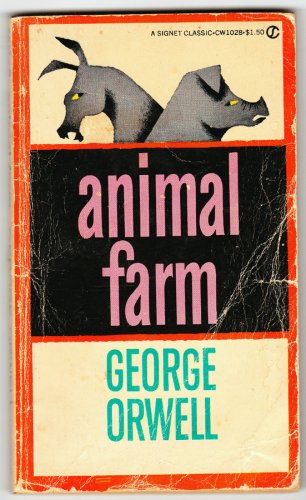
Yet the story of animals who take over a farm, only to have their revolution taken over by a pig more ruthless than the farmer ever was, seems no less timely today, long after the collapse of the Soviet empire. Orwell speaks of the corruptive nature of power in general, whether it's power in government, power in corporations or power in the playground. Those with power tend to use it to gain even more power.
What interests me most about the book is how language is used as a tool for manipulation. Early in the revolution the animals write on a wall the Seven Commandments of Animalism, their constitution, in effect. These seem simple enough, "No animal shall wear clothes," "No animal shall kill any other animal," and "All animals are equal," among them. Yet in time the ruling pigs, led by Napoleon, rephrase or reinterpret each of these commandments to make them mean something entirely different from what they meant originally. The most famous of these restatements is when "All animals are equal" becomes "All animals are equal, but some some animals are more equal than others." Anyone who feels powerless in a society where everyone is supposedly equal can identify with that.
Subscribe to:
Posts (Atom)