Wednesday, June 15, 2016

Bill Murray in alphabetical order

The Big Bad Book of Bill Murray by Robert Schnakenberg proves to be a show business biography in the form of a reference book. Schnakenberg tells the life of the popular actor, a star since he appeared on Saturday Night Live in the late '70s, not in chronological order but in alphabetical order, from About Last Night, a play in which he almost appeared, to Zombieland, a 2009 movie in which he had a cameo. Reading the book from cover to cover gives you Bill Murray's life story, but with the details shuffled like a deck of cards.

Bill Murray fans will love this book, although they may not love Murray himself quite as much after reading it, for Schnakenberg presents Murray warts and all. And there is no shortage of warts. Murray can be the most charming, most caring, most generous man in the world. Or he can be the most difficult, most obnoxious, most rude. It just depends on the mood he happens to be in, and with his fame and his talent, he can afford to follow his moods wherever they take him. He will continue to be in demand as an actor, whether for starring roles or for small supporting parts, however he choose to behave. He is said to be almost impossible to reach, yet somehow he still manages to appear in several movies each year.

Schnakenberg's entries tend to be brief and nicely illustrated, mostly with movie stills. Every so often he presents "Tales from Murrayland," a series of 28 episodes from Murray's life that describe the man behind the movie screen. In 2010, for example, Murray attended a festival in Austin and took over bartending duties, while refusing to serve anything but shots of tequila.

The book is jammed with such Bill Murray trivia, perhaps even more than one could find in a more traditional biography.

Monday, June 13, 2016

Revisiting Panama Red

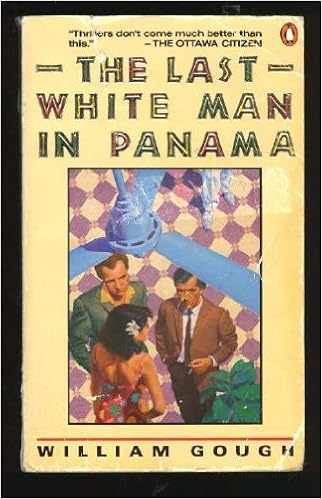
During a visit to Sault Ste. Marie in the late 1980s, I purchased a paperback copy of The Last White Man in Panama by Canadian writer William Gough. I enjoyed the thriller, then placed it on a shelf and gave it little thought until a few days ago when I decided it was time to reread it.

The story tells of Red Williams, a con man operating in Panama whose prostitute girlfriend is tortured and murdered. The men Red believes responsible turn out to be a couple of brothers working for an American television network whose head aspires to become president of the United States.

Coming to Red's aid as he tries to avenge her death are Jack, an older man (actually Red's father, who abandoned the family when Red was still a boy) with amazing survival skills, and Karen, a beauty who recently lost her broadcasting job in the same city where the ambitious network executive is located. Yes, happy coincidences play a big part in Gough's novel. Yet for all the rough stuff in the story, the whole thing has a light-hearted feel to it that makes a reader more willing to accept the unlikely. After all, it is not a novel to take very seriously anyway. But it is fun to read, and then reread 30 years later.

Returning to the novel after so many years made me wonder what happened to William Gough. Why have I never seen another book of his? An Internet search finds he's written some poetry, some children's books and assorted e-books. The only book I found anything like The Last White Man in Panama turned out to be The Last White Man in Panama but with a different title, Panama Red. I prefer the original title, even if it doesn't make sense. The novel, which had a major publisher (Penguin) when it first appeared, seems to have been the high point of a long, varied and ultimately disappointing literary career.

Friday, June 10, 2016

Read the book first

A scene from Brooklyn
Browsing in a bookstore earlier this week, I noticed I passed over Emma Donohue's Room, Andy Weir's The Martian and Colm Toibin's Brooklyn without a second glance. I wondered why I had no interest in reading any of them even though I had seen and loved the movies based on each of those novels. Then I realized it was because I had seen the films that I had no interest in reading the books. But why would this be so?

Most people agree that when movies are based on novels, the novels are almost always better. There are notable exceptions, such as The Godfather, but in most cases the book is superior. Novelists can just pack more story into 300 or 400 pages than a director can in a two-hour movie. They can also put us inside the characters' minds and provide us with backgrounds and other details that directors can only hint at. So you would think that watching a movie would make a person more eager to read the book and get the rest of the story. With me at least, that doesn't seem to be the case.

Yet when I like a book I am usually eager to see the movie adapted from it. I loved Bill Bryson's memoir A Walk in the Woods, but I took my wife to the Robert Redford film as soon as it came out. I enjoyed the movie and later purchased the DVD even though it does not compare with Bryson's book. So what's going on? Two possible explanations occur to me.

One can watch a movie in much less time than one can read a book. If you have already read the book, or even if you have already watched the movie, you don't mind investing a couple of hours to watch a story you already know. Yet books may take a person days or even weeks to get through. That's a big investment of time when you already know the story.

A scene from A Very Long Engagement
A second, possibly better explanation may be that the images we see on a screen are stronger, more vivid, than those we imagine when we read a book. Can you read To Kill a Mockingbird without seeing Gregory Peck in your mind? Not if you've watched the movie. Movies have a way of ruining books for us. Joe Queenan once commented, "It seemed like the entire planet was talking about Dan Brown's The Da Vinci Code until Ron Howard's Da Vinci Code came out. Then the planet stopped talking about it." So it goes with other best-selling novels made into films.

Sometimes I put off watching a movie until I have read the book. Or I may let a few years pass before I read the novel, as I did with Sebastien Japrisot's A Very Long Engagement. Of course, I still saw Audrey Tautou in my mind as I read it. Not that I minded.

Wednesday, June 8, 2016

Not your ordinary novel

Alice Hoffman
Alice Hoffman's Skylight Confessions (2007) is a multi-generation novel that is surprisingly short, a ghost story that doesn't give goosebumps, a love story in which the dominant emotions are hate and resentment, and a fairy tale that is all too real. In other words, this is not your ordinary novel.

It begins when a recently orphaned teenage girl, Arlyn, decides the next man she sees is the one she will marry. That man is an aspiring young architect named John Moody, who does marry Arlyn but remains resentful ever after. They have two children, Sam and Blanca, before Arlyn's untimely death. They live in a spectacular house made of glass, the Glass Slipper. They shouldn't throw stones, but everyone does, it seems.

Hoffman's attention then turns to Meredith, a young woman hired to mind the two children and who, like John, can see Arlyn's ghost following him everywhere. Though she cares deeply for Sam, her devotion cannot prevent his becoming hopelessly addicted to drugs and eventually running away.

The third section of the novel puts the focus on Blanca, now grown up and living unhappily in London. She returns home after her father dies and learns some surprising secrets from his will.

I usually hate it when authors turn mystical and slip the supernatural into their novels, but I always seem to like Alice Hoffman best when she does that very thing. Skylight Confessions, while by no means her best work, pleased me very much.

Monday, June 6, 2016

Willing to listen

Complaining is cathartic -- except when it's poorly received. Then suffering tends to beget suffering.
Barbara Wallraff, Word Fugitives

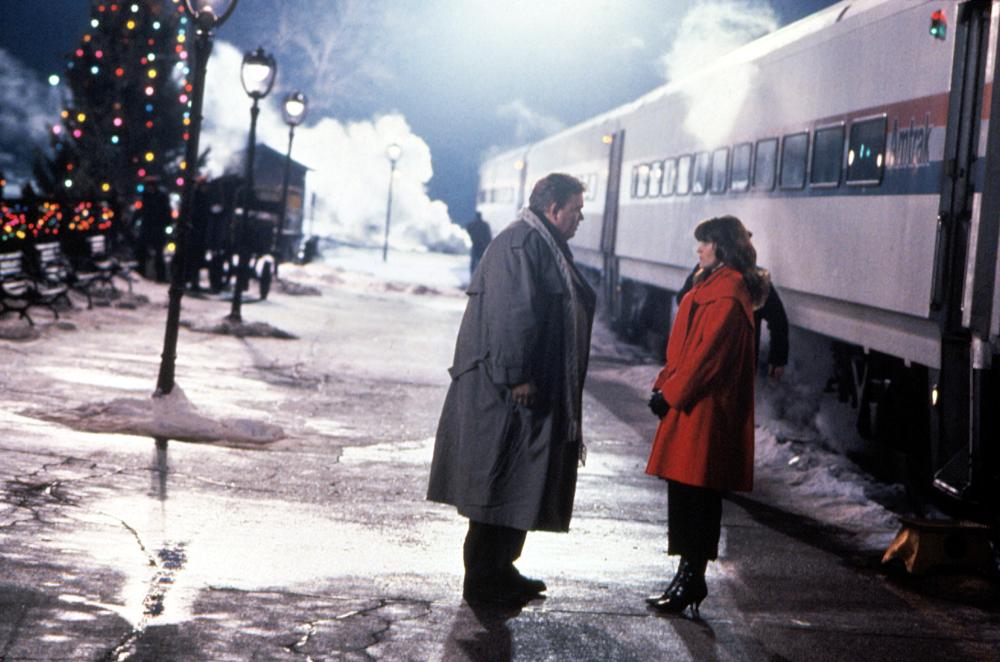
Last night I watched, for the first time since it was in the theaters in 1991, the romantic comedy Only the Lonely starring John Candy, Ally Sheedy and Maureen O'Hara. Each plays a lonely person whose complaints are, in Wallraff's phrase, "poorly received." O'Hara is a widow who lives with a son (Candy) grown tired of listening to her intolerant rants. Candy plays a cop whose partner (Jim Belushi) thinks every problem revolves around sex. Sheedy, the loneliest of them all, works as a cosmetologist in a funeral home. The only audience for her complaints are dead people. The story, in effect, tells how these three each finds someone willing to listen.

In her book, Wallraff identifies some other ways in which complaints are poorly received.

1. "What you get back is what you should have done to avoid the problem." Usually we already know what we should have done differently. We should have read the contract before we signed it. We shouldn't have left the key in our car. We should have closed the windows when the forecast called for rain. We realize that now. Yet we would still appreciate a little sympathy.

2. "A puzzled look and a put-down like 'You let that kind of stuff upset you?'" Different things bother different people. Being told we shouldn't let something get to us, when it so clearly does, may be the worst response of all. It causes us to hold our troubles inside and not tell anyone.

3. "Or else someone might say, 'Oh, yes, that happened to me once too ...,' and launch into an irrelevant anecdote, leaving you feeling misunderstood as well as unburdened.'

4. "Or sometimes the listener might put a name to what happened to you, summing up your whole story in a word or phrase: 'So you got a hangover.' 'You tripped." 'Oh -- a flat tire!'" This may seem like sympathy, but it really isn't. It's more being placed in a category and then dismissed.

5. "A bit better is when the person says, 'That happened to me,' and then tells a story relevant to the one you told. This may not be sympathy, but it can pass for empathy." Too often, of course, the other person tries to top your tale of woe with one of his own. "You think your surgery was bad, wait until you hear about mine." They may even launch into their stories before you have finished yours.

My wife had Stephen Ministry training, which seems to center around listening to other people talk about what's troubling them. The hardest part, I gather, is simply avoiding responses like those above.  Sometimes the less one says, the better. As unsatisfying as Ally Sheedy's audience was in that funeral home, it could have been worse.

Friday, June 3, 2016

Showing off

I guess a guy bearing up under such a chestload of hardware -- and pretty ribbons in a variety of decorator colors -- can't be expected to speak like ordinary mortals, for example, you and me.
Dick Cavett, Talk Show

Dick Cavett's columns for the New York Times, which ran from February 2007 to December 2009, are collected in his deceptively titled 2010 book Talk Show. The above line comes from his April 11, 2008, column in which he ridicules the speech of Gen. David H. Petraus. I have no problem with ridiculing Petraus, or anyone else, for what Cavett calls sesquipedalianism , or "using foot-and-a-half-long words. (As if using the word sesquipedalianism were not itself an example of sesquipedalianism.) Those who use long words to impress and overuse euphemisms are fair game, as far as I am concerned. But Cavett goes too far in his commentary on the general's array of medals. His first comment is witty, his second, quoted above, is OK, but then, having just warmed up, he writes a second column on the subject, published April 25.

"I guess what bothers me about it is the ostentation," Cavett writes. "General Petraeus is greatly accomplished. So is a brilliant actor, but the actor doesn't walk around with an Oscar, an Emmy, a Tony, and a cluster or rave reviews affixed to his tunic." No, he doesn't, but I'll bet many actors would if they could. But they really don't have to. For the rest of their lives they will be introduced or mentioned in ads and articles as "Academy Award winner" or "Tony Award winner" or whatever.

Doctors and and lawyers hang their impressive-looking degrees on the walls of their offices, where patients and clients can be sure to see them. Athletes have trophy cases. Some people, lacking medals, trophies or degrees, just have to brag about what they have accomplished. Cavett himself falls into this category. In his Times columns, and thus in this book, he writes about his many successes in life, from his skills as a young gymnast to defeating a lie detector test administered to him on his talk show by attorney F. Lee Bailey. He also drops a good many names of prominent people he has known.

Is there anything wrong with any of this? Not much that I can see, and that goes for Gen. Petraeus, too. Military officers, when in dress uniform, display their medals. Successful athletes win trophies. If Cavett didn't write about his accomplishments, why would we want to read his book?

At times some people do go overboard in self-promotion, of course, and we usually know it when it happens, just as we know when Cavett goes overboard complaining about Petraeus and his medals.

Wednesday, June 1, 2016

A visit to Universe B

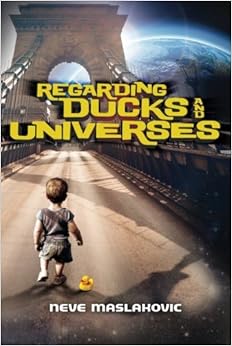
There is much to like about Neve Maslakovic's 2010 sci-fi novel Regarding Ducks and Universes. That title, for example. And I love the cover illustration, uncredited in the book, showing a little boy and a toy duck on the Golden Gate Bridge.

I also love the premise of the story. Thirty-five years ago something happened to cause the universe to split, creating a duplicate of itself. This means that everyone alive on that date also has a duplicate, or an alter. It is possible to travel from one universe to another to see how different they have become, even after just 35 years. One universe, more environmentally conscious than the other, has eliminated books printed on paper. Microwave ovens don't exist in one universe. One universe has fewer hurricanes.

Felix Sayers, born just months before "Y-day," decides to take a vacation to Universe B. Regulations supposedly forbid looking up one's alter in the other universe, but who can resist? Felix, an aspiring writer, wonders if Felix B has already written a book. "I was afraid of finding out he'd done a better job of living my life," Felix says.

Complications multiply as soon as Felix enters the other universe, and it seems that someone is trying to kill him. He becomes involved with a team of researchers trying to discover why the universe split. They think Felix himself, though just an infant at the time, may have been responsible. Perhaps something to do with that duck.

This sounds fascinating, right? Sometimes it is, but too often Maslakovic's prose just bogs down and takes some time to get moving again. Multiple universes would naturally be complicated, but sometimes the plot seems just more complicated than it needs to be. I enjoyed the book, but not nearly as much as I thought I would.