When I read George Orwell's Nineteen Eight-Four in the early Sixties, the year 1984 still seemed far in the future. More than three decades after 1984, Orwell's novel is still being read, yet I wonder if its impact has somehow declined as 1984 has faded into the past. Has his choice of a title, plus the passage of time, turned a futuristic novel into, at least in some readers' minds, a historical novel?
This thought follows from my post of two days ago about time-related words like modern and new. You might also include the words contemporary, present, now, current, today, yesterday and tomorrow, among others. The passage of time can change the meaning of these words to the reader. In a similar way, dates mentioned in stories, especially in stories set in the future, can make those stories seem dated as time passes.
When setting a story in some future time, it might be wise to keep that time ambiguous, or at least put it far enough in the future that it will be a very long time before that future becomes past. When Orwell's novel was published in 1949, he probably didn't imagine people would still be reading it in the 21st century.
In the late Nineties I read a novel about the terrible things that happen on Jan 1, 2000, when the world's computers fail. I doubt anyone bothered to read that novel after that date, when nothing terrible happened at all.
Before Orwell wrote his visionary novel, Aldous Huxley wrote Brave New World, a book to which Nineteen Eight-Four is often compared. I don't think Huxley wrote the better book, but I do think he chose the better title. Brave New World will always suggest the future, something Nineteen Eight-Four can never do again.
Friday, July 1, 2016

Wednesday, June 29, 2016
Thoroughly modern
Modern Judo had, despite its title, been published in 1918.
Washington was a modern city, alive with sounds: streetcars rattling, horses whinnying, shopkeepers showing their prices through half-open windows, machinery thudding and pumping in the factories ...
The word modern is a relative term, as the above lines discovered in my recent reading reveal. When Modern Judo, a book that fascinated Dick Cavett in his youth, was published, it may in fact have been modern, at least the book itself if not the ancient form of self-defense it described. Nearly a century later, as Cavett implies, the title strikes us as amusing. Stephen L. Carter's novel is set in the late 1860s, so his use of the word suggests that at that time in history, the city of Washington was indeed thoroughly modern, as opposed to Richmond, described later in the book, which still showed signs of desolation caused by the Civil War that had ended two years before.
Word Histories and Mysteries, a book written by editors of the American Heritage dictionaries, has this to say: "The word modern, first record in 1585 in the sense 'of present or recent times,' has traveled through the centuries designating things that inevitably must become old-fashioned as the word itself goes on to be applied to the next modern thing."
My American Heritage dictionary defines Modern English as "English since about 1500" and Modern Greek as "Greek since the early 16th century." A Wikipedia article, meanwhile, describes modern art as artistic work produced roughly from the 1860s to the 1970s, suggesting that at least in some contexts the word modern itself implies something old-fashioned. Since 1949 the word postmodern has been popular, yet by now even that seems dated.
Other time-related words, too, can strike us as amusing years later. I can recall touring Edinburgh in 2005 and being told the city is divided between Old Town and New Town. New Town was built between 1767 and 1850. American tourists may find that funny, but then what's so new about New York, New Jersey and New Mexico? Just as modern can eventually come to mean "once modern," so new can come to mean "once new."
Dick Cavett, Talk Show
Stephen L. Carter, The Impeachment of Abraham Lincoln
 |
| Washington D.C. a modern city in the 1860s. |
The word modern is a relative term, as the above lines discovered in my recent reading reveal. When Modern Judo, a book that fascinated Dick Cavett in his youth, was published, it may in fact have been modern, at least the book itself if not the ancient form of self-defense it described. Nearly a century later, as Cavett implies, the title strikes us as amusing. Stephen L. Carter's novel is set in the late 1860s, so his use of the word suggests that at that time in history, the city of Washington was indeed thoroughly modern, as opposed to Richmond, described later in the book, which still showed signs of desolation caused by the Civil War that had ended two years before.
Word Histories and Mysteries, a book written by editors of the American Heritage dictionaries, has this to say: "The word modern, first record in 1585 in the sense 'of present or recent times,' has traveled through the centuries designating things that inevitably must become old-fashioned as the word itself goes on to be applied to the next modern thing."
My American Heritage dictionary defines Modern English as "English since about 1500" and Modern Greek as "Greek since the early 16th century." A Wikipedia article, meanwhile, describes modern art as artistic work produced roughly from the 1860s to the 1970s, suggesting that at least in some contexts the word modern itself implies something old-fashioned. Since 1949 the word postmodern has been popular, yet by now even that seems dated.
Other time-related words, too, can strike us as amusing years later. I can recall touring Edinburgh in 2005 and being told the city is divided between Old Town and New Town. New Town was built between 1767 and 1850. American tourists may find that funny, but then what's so new about New York, New Jersey and New Mexico? Just as modern can eventually come to mean "once modern," so new can come to mean "once new."
Monday, June 27, 2016
Annoying the critics
Paul looks over the "maritime novels" of his older brother to make sure that they are technically accurate, thereby annoying the literary critics.
Everyone, it seems, takes devilish pleasure in pointing out the mistakes of others, even while realizing how painful it can be when others point out our own failings. Literary critics don't just take pleasure in it, but that is their job. Oh, sure, their job is also to praise the praiseworthy, but their compensation, if any, is the same whether they praise or find fault. And finding fault is so much more fun. "One cannot review a bad book without showing off," W.H. Auden once said. Sadly, that is true.
.jpg) I was amused by the side comment Gonzague Saint Bris makes in his brief, illustrated biography of Jules Verne. Verne was himself a sailor, so when he wrote about the sea, he knew what he was writing about. Still, his brother, Paul, knew the sea even better than he did, so Verne made sure his brother read his manuscripts before publication, "thereby annoying the literary critics," who would have loved to point out discrepancies.
I was amused by the side comment Gonzague Saint Bris makes in his brief, illustrated biography of Jules Verne. Verne was himself a sailor, so when he wrote about the sea, he knew what he was writing about. Still, his brother, Paul, knew the sea even better than he did, so Verne made sure his brother read his manuscripts before publication, "thereby annoying the literary critics," who would have loved to point out discrepancies.
Even today whenever Verne is talked about or written about, it is usually in terms of what he got right and what he got wrong. The stories themselves are often ignored. Verne wrote about technology, much of it speculative technology. He wrote about long-distance undersea travel long before it was possible and about space flight long before that was possible. Of course, as with all visionaries, he got much wrong, but it is amazing how much he got right. He understood the technology of his own day and used that knowledge, plus his own vivid imagination, to envision what might be possible in some future day. To this day he still annoys the critics.
Gonzague Saint Bris, The World of Jules Verne
Even today whenever Verne is talked about or written about, it is usually in terms of what he got right and what he got wrong. The stories themselves are often ignored. Verne wrote about technology, much of it speculative technology. He wrote about long-distance undersea travel long before it was possible and about space flight long before that was possible. Of course, as with all visionaries, he got much wrong, but it is amazing how much he got right. He understood the technology of his own day and used that knowledge, plus his own vivid imagination, to envision what might be possible in some future day. To this day he still annoys the critics.
Friday, June 24, 2016
The cowboy way
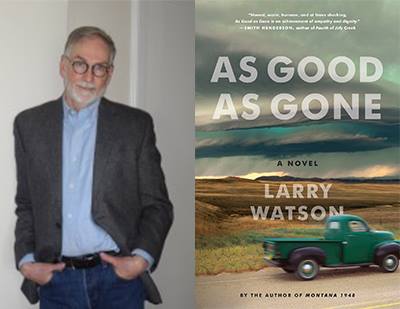
Before taking his wife to Missoula for an operation, Bill Sidey asks his father, Calvin, to move into their basement and keep an eye on his grandchildren, 17-year-old Ann and 11-year-old Will. Calvin spent years working as a cowboy after the death of his wife, Bill's mother, whom he had met in France during World War I. Now he lives as a recluse in a trailer, an ex-cowboy who reads books in Latin. The year is 1963, and Watson beautifully captures that time in history.
What Bill and Marjorie, his wife, don't know as they leave for the distant hospital is that Ann and Will are each in trouble. Ann is being stalked by an aggressive ex-boyfriend. Will hangs out with a couple of boys he doesn't like but doesn't know how to avoid. They want him to help them find a way for them to see his sister naked. Without actually understanding these problems, Calvin takes action, but his way of solving problems involves tough words, fists, knives and, as a last resort, guns.
Meanwhile he becomes involved with Beverly, a neighbor woman with a grown son who lives with her and takes advantage of her. This son also has an eye for lovely Ann, which may help explain why Beverly wasn't the first choice to watch the Sidey children. She realizes Calvin is trouble, but he also makes her feel like a desirable woman for the first time in many years.
Watson develops his plot in such a way that it could turn in many different directions, and it does, surprising the reader at every turn. As Good as Gone is a Clint Eastwood movie waiting to happen, but before it does, be sure to read this incredible novel.
Wednesday, June 22, 2016
Conversation fillers
I call them conversation fillers, those meaningless sounds, words and phrases that most of us use frequently in conversation. They serve a variety of purposes. They give us time to think of what we want to say next. They tell the other person you are still listening and following what is being said. They can even make it seem you are actively participating in a conversation when you have nothing significant to say.
At a pool party yesterday a man told a story and paused frequently with a prolonged "sooooooo..." This seemed not just to give him time to gather his thoughts, but it also marked his place, alerting others he was not finished. At one point he said, "Soooooooo........." then stopped to take a drink of water before resuming. Nobody jumped in to take over the conversation because he had made it clear there was more to come.
Such things are much more common in real life than in fiction because it can be annoying to read dialogue in which the characters aren't actually saying anything of substance. Yet some authors are quite good at inserting conversation fillers into their stories. One is humorist P.G. Wodehouse, who often has Bertie Wooster using expressions like "What ho!" repeatedly, especially when greeting an old pal.
Rereading Winnie-the-Pooh I noticed that another British writer, A.A. Milne, was also excellent at this sort of dialogue. Here are some lines from the story about trying to catch a Heffalump. Christopher Robin tells Winnie-the-Pooh and Piglet that he has seen a Heffalump.
"What was it doing?" asked Piglet.
"Just lumping along," said Christopher Robin. "I don't think it saw me."
"I saw one once," said Piglet. "At least, I think I did," he said. "Only perhaps it wasn't."
"So did I," said Pooh, wondering what a Heffalump was like.
"You don't often see them," said Christopher Robin carelessly.
"Not now," said Piglet.
"Not at this time of year," said Pooh.
There you have three characters conducting a conversation about something they may know nothing about but nevertheless they want to give the appearance of being on top of things. Sound like any real conversations you've been a party to? That Milne was able to satirize such a conversation so successfully in a book aimed at children is amazing.
At a pool party yesterday a man told a story and paused frequently with a prolonged "sooooooo..." This seemed not just to give him time to gather his thoughts, but it also marked his place, alerting others he was not finished. At one point he said, "Soooooooo........." then stopped to take a drink of water before resuming. Nobody jumped in to take over the conversation because he had made it clear there was more to come.
Such things are much more common in real life than in fiction because it can be annoying to read dialogue in which the characters aren't actually saying anything of substance. Yet some authors are quite good at inserting conversation fillers into their stories. One is humorist P.G. Wodehouse, who often has Bertie Wooster using expressions like "What ho!" repeatedly, especially when greeting an old pal.
 |
| A.A. Milne |
"What was it doing?" asked Piglet.
"Just lumping along," said Christopher Robin. "I don't think it saw me."
"I saw one once," said Piglet. "At least, I think I did," he said. "Only perhaps it wasn't."
"So did I," said Pooh, wondering what a Heffalump was like.
"You don't often see them," said Christopher Robin carelessly.
"Not now," said Piglet.
"Not at this time of year," said Pooh.
There you have three characters conducting a conversation about something they may know nothing about but nevertheless they want to give the appearance of being on top of things. Sound like any real conversations you've been a party to? That Milne was able to satirize such a conversation so successfully in a book aimed at children is amazing.
Monday, June 20, 2016
A novel for Sunday morning
In Wheeler's western novel, Truman Jackson is a rancher in Utah who, though he has said little about himself, has won the respect of his fellow ranchers and the residents of the town where he does business and where he attends church with his family. Then one day he stands up at a community gathering and confesses that his real name is Will Dowd and that as a teenager he was part of a gang of robbers operating in Wyoming. While other gang members, mostly relatives, stole the money, he held their horses. The others were all caught or killed, but he escaped and was never pursued by the law. Now he believes that as a Christian he must both publicly confess his sins and, as much as possible, return whatever money was stolen by the gang.
His confession affects different people in different ways. Some admire Truman Jackson and his wife, Grace, all the more. Some wonder if the family can still be trusted. A neighbor, who also happens to own the bank and run the cattlemen's association, sees an opportunity to take ownership of the Jackson ranch. The local sheriff, a stickler for following the letter of the law, decides to check to see if anyone in Wyoming is still interested in Will Dowd., especially since someone was murdered in one of the gang's holdups.
Late in the novel one of the characters says, "This makes me wonder about Jackson. People who are flamboyantly good, usually aren't." Well, Jackson isn't so much flamboyantly good as humbly good, and his goodness is both sincere and instructive. This makes for a good Sunday school lesson, but a less than ideal novel.
Friday, June 17, 2016
A believable Ripley

Among the oddities one learns about his life: Ripley traveled often to faraway places, but he was afraid of flying. As a young man, he was a handball champion. He also tried out for a major league baseball team. He played a key role in the adoption of The Star-Spangled Banner as the national anthem. Barry Goldwater, who later ran for president, as a young man took Ripley down into the Grand Canyon for a radio broadcast. And a dog belonging to the aforementioned Charles Schulz, then 14 years old, once appeared in one of Ripley's cartoons. The dog ate pins, tacks, screws and razor blades.
One of the curious things about his life that Ripley kept secret was that while he was making as much as $350,000 a year during the Depression for drawing his cartoons, he paid a man named Norbert Pearlroth just $75 a week to dig out most of the oddities that appeared in those cartoons. Pearlroth didn't seem to mind, for he loved spending long hours in the library looking through books.
Ripley drank too much, and although an athlete as a young man, he turned fat and flabby in middle age. He died at 59.
Thompson's fine biography turns this "curious man" into someone who was flesh and blood, and even believable.
Subscribe to:
Posts (Atom)