While listening to my car radio recently, I heard the host of a local talk show say he was celebrating 50+ years on radio. When the subject of gifts for the occasion came up, his immediate response was, “Don’t give me any books. I already have six books I haven’t read.”
Just six books he hasn’t read? I must have at least 600 books I haven’t read. Probably a lot more. I know I won’t live long enough to read them all, but that doesn’t keep me from acquiring more. I suspect the real reason he doesn’t want any gift books is that he just doesn’t like reading that much.
Yet I must agree with him, for I wouldn't want gift books either, not because I already have so many books to read but because nobody else can know what I might want to read. And I hate feeling obligated to read books other people think I should read or might like. Rarely have I enjoyed books given to me as gifts, unless I had previously expressed an interest in them. Bookstore gift cards are another matter. I always enjoy book shopping with other people’s money.
Now as for all those unread books, I see them as an incentive to live a long, long time. Some people will themselves to live to celebrate their 90th birthday or to see their grandchildren graduate from high school. I want to live long enough to read Bleak House. And I’m in no hurry to read Bleak House.
Monday, September 16, 2019

Friday, September 13, 2019
What our books say about us
Creating a library is a psychically loaded enterprise. In gathering their bounty, book-lovers have displayed anxiety, avarice, envy, fastidiousness, obsession, lust, pride, pretension, narcissism, and agoraphobia — indeed every biblical sin and most of the pathologies from the American Psychiatric Association manual.
Books, like knickknacks on a shelf or clothes in a closet, tend to accumulate over time. On rare occasions someone might set out with a plan — to collect William Faulkner first editions, for example, or books on railroading — but most of us acquire a book here and another there. A library book sale brings in a boxful. In time we may have a bookcase full of books, and some of us may even find ourselves with a rather large personal library.
So is this really as random as it seems, or does it, as Stuart Kells suggests in The Library, reveal much about our personalities, our passions, our history and our sins? I think our books are, or at least can, be revealing. I'm sure there are some people who have shelves full of books but never read them and never even purchased them in the first place. They are just books given to them or perhaps left behind by parents or a former roommate. So books can be misleading, but in most cases I believe our books do say something about us.
So what do my own books say about me?
Above me to my right is a shelf of books about time: philosophy books, psychology books, science books, self-help books, history books, you name it. All about time.. A casual observer might wonder about this. In truth, the books date from when I worked on an eventually aborted book on the Judeo-Christian perception of time, a straight line as opposed to a circle.
Over to my left is another shelf full of books about submarines, both fiction and nonfiction. Other books about submarines are scattered here and there throughout my library. So why submarines? This collection might be confusing to people who know me, misleading to those who don't. I don't know exactly, but I suspect these books stem from the fact that I am a bit claustrophobic. I don't read horror stories. When I want a good scare, I read a book about submarines.
My large collection of books about Christianity, especially works by and about C.S. Lewis, says something about my faith. My shelves full of aging classic novels and collections of short stories may suggest I studied literature in college, and their publication dates may reveal my approximate age.
My nonfiction books cover a broad spectrum of topics, while my fiction collection includes a multitude of genres, as well as books that might be considered both high-brow and low-brow. I own a lot of novels written by and mostly read by women. What I hope all this says about me is that I am someone with broad interests, diverse tastes and no insecurities about my sexual identity.
Stuart Kells, The Library
 |
| Stuart Kells |
So is this really as random as it seems, or does it, as Stuart Kells suggests in The Library, reveal much about our personalities, our passions, our history and our sins? I think our books are, or at least can, be revealing. I'm sure there are some people who have shelves full of books but never read them and never even purchased them in the first place. They are just books given to them or perhaps left behind by parents or a former roommate. So books can be misleading, but in most cases I believe our books do say something about us.
So what do my own books say about me?
Above me to my right is a shelf of books about time: philosophy books, psychology books, science books, self-help books, history books, you name it. All about time.. A casual observer might wonder about this. In truth, the books date from when I worked on an eventually aborted book on the Judeo-Christian perception of time, a straight line as opposed to a circle.
Over to my left is another shelf full of books about submarines, both fiction and nonfiction. Other books about submarines are scattered here and there throughout my library. So why submarines? This collection might be confusing to people who know me, misleading to those who don't. I don't know exactly, but I suspect these books stem from the fact that I am a bit claustrophobic. I don't read horror stories. When I want a good scare, I read a book about submarines.
My large collection of books about Christianity, especially works by and about C.S. Lewis, says something about my faith. My shelves full of aging classic novels and collections of short stories may suggest I studied literature in college, and their publication dates may reveal my approximate age.
My nonfiction books cover a broad spectrum of topics, while my fiction collection includes a multitude of genres, as well as books that might be considered both high-brow and low-brow. I own a lot of novels written by and mostly read by women. What I hope all this says about me is that I am someone with broad interests, diverse tastes and no insecurities about my sexual identity.
Wednesday, September 11, 2019
Saved by fun
 Fun saves us from political dictatorship.
P.J. O'Rourke, Driving Like Crazy
Conservative political humorist P.J. O'Rourke has always regarded cars in general and driving cars in particular as fun. Thus the above line from his 2009 book Driving Like Crazy nicely combines two of the main themes of his writing life into one pithy declaration.
Although the book includes a few digs at the likes of Sarah Palin, Barack Obama and the Bushes, his main focus throughout is cars and how much fun they are.
Besides being a political writer, O'Rourke has also written frequently for car magazines and for other magazines on the subject of cars. Most of the chapters in his book originally appeared as magazine articles or are based on articles he has written. He gives readers no notice of this beforehand, which could cause some readers to get no further than the first chapter, a celebration of the youthful pleasures of driving fast while drinking to excess, doing drugs and having wild sex. This is a satire he wrote years ago for National Lampoon, but he doesn't tell us this until later.
Most chapters concern test drives or endurance races through difficult areas, such as India and Baja California. In each case there are problems aplenty, sometimes mechanical and sometimes not, and there would be a sameness to these accounts except that O'Rourke's jokes are always different. And if O'Rourke drives cars for fun, we read his books for fun.
Here's a sample of his wit about the Jeep: "My personal theory about the visceral appeal of the Jeep is that it is purposeful-looking while having no clear purpose. The Jeep is inadequate as a pickup, drafty as a sedan, oversized as an ATV, and lacks sufficient cargo space to be an SUV. True, Jeeps will go almost everyplace but, if you think about it, Jeeps mostly go everyplace there's no reason to go."
Then there's this comment he makes, in an interview at the end of the book, about the federal government subsidizing General Motors: "Governments have monopolies on certain things, like eminent domain and deadly force. What's another example of an organization that gets into the same business that you're in, except that their guys have got guns? That would be the Mob."
There he goes again. Cars and politics.
Monday, September 9, 2019
Libraries before books, after books and in books
 Not to be confused with The Library Book by Susan Orlean, The Library by Stuart Kells (2017) is more interesting in parts than as a whole. That's probably because it reads more like an encyclopedia of library history than a single narrative about the history of libraries. Some entries just appeal more than others. A reader may be tempted to skip around in the book as its author does in his history of the library.
Libraries go back a long time. They even, Kells says, predate books. He counts the practice of preliterate tribes of remembering the legends of their culture as early libraries. In some cultures this still goes on. The film The Good Lie shows Sudanese children drilling each other on the names of ancestors they never knew so they would never forget them
From there Kells goes on to talk about libraries before paper or printing, when books were written on a variety of materials, including papyrus, palm leaves ivory, wood, stone and even such exotic materials as silk, bamboo, copper, turtle shells, antlers and the intestines of elephants. He writes about how books were stored (they haven't always been placed on shelves), organized, copied, preserved, treasured, censored and, too often, destroyed.
Fictional libraries get a surprising amount of attention. Kells calls Umberto Eco's creation in The Name of the Rose "the most captivating library in fiction" and, just two pages later, "the most enchanting library ever captured in words." He gives attention, too, to libraries described in The Lord of the Rings and other books.
There is much to like about The Library, but there are also times when the reader may be tempted to find a good library and pick out a better book to read.
Friday, September 6, 2019
Buying it here
Northwest Michigan has Lake Michigan, lighthouses, Earl Young’s mushroom houses, lots of trees, lots of nice people and lots of good restaurants, all of which I have been enjoying this week, but mostly I have been appreciating its surprisingly active and arty downtowns and the independent bookstores located in those downtowns.
I’m from Ohio, where most people ignore their downtowns and shop at Walmart. If they buy books, they get them at Barnes and Noble or from Amazon. Independent bookstores? What are they? I think there’s a Barnes and Noble in Traverse City, but I’ve never seen it in three trips to this area. But I know the city has Brilliant Books on Front Street, which is where I stopped again yesterday.
Smaller towns in the area each has its own bookstore, and each seemed to have a steady stream of customers when I was there this week. Charlevoix has Round Lake Books, Harbor Springs has Between the Covers and Petoskey has McLean & Eakin, not just the best bookstore in the area but one of the best you’ll find anywhere. At least author Ann Patchett thinks so, and she has her own bookstore in Nashville (which is good, but not this good).
McLean & Eakin is a deep, narrow, beautifully designed bookshop that has everything, or so it would appear. I saw books there I’ve seen nowhere else, and I bought some of them. Here and at least one other bookstore in the area I saw a sign that read, “Find it here. Buy it here. Keep us here.” That alludes to the curse of independent bookstores: people find it there, then buy it cheaper somewhere else. I like book bargains as much anyone else, but I decided to follow the spirit of that slogan on this trip in hopes all four stores will still be here on my next trip north.
At McLean & Eakin I purchased Miss Kopp Just Won’t Quit by Amy Stewart, I Shot the Buddha by Colin Cotterill, Rise & Shine, Benedict Stone by Phaedra Patrick and The Care and Feeding of an Independent Bookstore by Ann Patchett. Three of the four I haven’t seen, or even seen mentioned, anywhere else.
During my stop in Harbor Springs, a charming town I hadn’t visited before, I found So Much Life Left Over by Louis de Bernieres. In Charlevoix I bought The First Love Story: Adam, Eve and Us by Bruce Feiler. Then yesterday at Brilliant Books I came away with Nicholas Nickleby by Charles Dickens. I paid full price for all but the Feiler book, which was on the half-price table.
Do I feel guilty for spending so much money? Yes, I do, but not nearly as guilty as I would if I had found the books here then bought them from Amazon.
I’m from Ohio, where most people ignore their downtowns and shop at Walmart. If they buy books, they get them at Barnes and Noble or from Amazon. Independent bookstores? What are they? I think there’s a Barnes and Noble in Traverse City, but I’ve never seen it in three trips to this area. But I know the city has Brilliant Books on Front Street, which is where I stopped again yesterday.
Smaller towns in the area each has its own bookstore, and each seemed to have a steady stream of customers when I was there this week. Charlevoix has Round Lake Books, Harbor Springs has Between the Covers and Petoskey has McLean & Eakin, not just the best bookstore in the area but one of the best you’ll find anywhere. At least author Ann Patchett thinks so, and she has her own bookstore in Nashville (which is good, but not this good).
McLean & Eakin is a deep, narrow, beautifully designed bookshop that has everything, or so it would appear. I saw books there I’ve seen nowhere else, and I bought some of them. Here and at least one other bookstore in the area I saw a sign that read, “Find it here. Buy it here. Keep us here.” That alludes to the curse of independent bookstores: people find it there, then buy it cheaper somewhere else. I like book bargains as much anyone else, but I decided to follow the spirit of that slogan on this trip in hopes all four stores will still be here on my next trip north.
At McLean & Eakin I purchased Miss Kopp Just Won’t Quit by Amy Stewart, I Shot the Buddha by Colin Cotterill, Rise & Shine, Benedict Stone by Phaedra Patrick and The Care and Feeding of an Independent Bookstore by Ann Patchett. Three of the four I haven’t seen, or even seen mentioned, anywhere else.
During my stop in Harbor Springs, a charming town I hadn’t visited before, I found So Much Life Left Over by Louis de Bernieres. In Charlevoix I bought The First Love Story: Adam, Eve and Us by Bruce Feiler. Then yesterday at Brilliant Books I came away with Nicholas Nickleby by Charles Dickens. I paid full price for all but the Feiler book, which was on the half-price table.
Do I feel guilty for spending so much money? Yes, I do, but not nearly as guilty as I would if I had found the books here then bought them from Amazon.
Wednesday, September 4, 2019
What mattered to Krauthammer
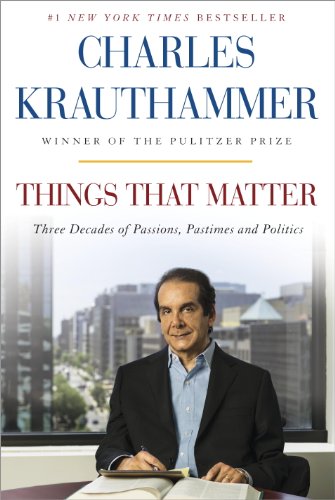 Politics is the moat, beyond which lie the barbarians.
Charles Krauthammer, Things That Matter
The late Charles Krauthammer had originally intended this collection of columns and articles to focus on the things that mattered most to him, things other than politics, things like baseball, chess, science, medicine and family. Then he realized that ultimately everything that mattered most to him depended on politics. Consider how the political change that created Nazi Germany affected every aspect of life in Germany, and the rest of Europe as well.
So Krauthammer did include political commentary in Things That Matter, although these essays now seem the most dated, at least those that relate specifically to issues that were hot topics during the Clinton years or either of the Bush administrations. Obama discussions seem a bit more topical. The book predates the Trump administration.
When writing about politics in general terms, however, it sounds like it could have first appeared in print yesterday. One example is when he writes, “Conservatives think liberals are stupid. Liberals think conservatives are evil.” Krauthammer wrote this in 2002, but today conservatives are ranting about the stupidity of the open borders and Medicare-for-all advocated by left-wing politicians, while liberals use any excuse to call conservatives Nazis or racists.
Still he is at his best when writing about subjects more dear to his heart — why religion should be taught in the schools (“A healthy country would teach its children evolution — and the Ten Commandments.”), why Winston Churchill was the most important figure in the 20th century, why turning the border collie into a show dog is likely to ruin its most important quality — its intelligence, and so on.
This is good stuff, stuff that will matter to most readers as it mattered to Charles Krauthammer.
Monday, September 2, 2019
The disappearance of whom
Popular Science is not a magazine where one would expect to find an article on language usage, especially if the subject is not even scientific language. Yet the fall issue has a page dedicated to the word whom.
The two most interesting points are these.
1. A study found that men who use whom in their profiles on dating sites get 31% more messages in reply. It doesn’t explain why, so we can only guess. Perhaps the word suggests a man is more educated, more refined and more prosperous, whether or not that word is actually used correctly.
2. There has been a steady decline in the use of whom in literature since 1800, and literature is produced by people who actually are educated and refined (if rarely prosperous). In 1800 .050 percent of words in literature written in English were whom. Today it’s only about .010 percent.
This decline in usage among those who know the language best is echoed among the rest of us. We rarely if ever say or write the word whom. We seem a bit hoity-toity when we do. Most of us don’t even remember why we were supposed to use the word or when.
I am old enough to remember when Johnny Carson hosted a daytime television game show called “Who Do You Trust?” There were protests from grammarians that it should properly be called “Whom Do You Trust?” Today I doubt anyone would complain.
Whom isn’t quite an obsolete word yet, but it gets little attention anymore. Except, apparently, from women looking for date.
The two most interesting points are these.
1. A study found that men who use whom in their profiles on dating sites get 31% more messages in reply. It doesn’t explain why, so we can only guess. Perhaps the word suggests a man is more educated, more refined and more prosperous, whether or not that word is actually used correctly.
2. There has been a steady decline in the use of whom in literature since 1800, and literature is produced by people who actually are educated and refined (if rarely prosperous). In 1800 .050 percent of words in literature written in English were whom. Today it’s only about .010 percent.
This decline in usage among those who know the language best is echoed among the rest of us. We rarely if ever say or write the word whom. We seem a bit hoity-toity when we do. Most of us don’t even remember why we were supposed to use the word or when.
I am old enough to remember when Johnny Carson hosted a daytime television game show called “Who Do You Trust?” There were protests from grammarians that it should properly be called “Whom Do You Trust?” Today I doubt anyone would complain.
Whom isn’t quite an obsolete word yet, but it gets little attention anymore. Except, apparently, from women looking for date.
Subscribe to:
Posts (Atom)