Friday, January 7, 2022

Chance and coincidence

You swam in a river of chance and coincidence. You clung to the happiest accidents — the rest you let float by.

David Wroblewski, The Story of Edgar Sawtelle

One unhappy accident that Edgar Sawtelle cannot let float by is his inability to talk. He learns sign language at an early age in David Wroblewski's 2008 novel The Story of Edgar Sawtelle. His parents make their living by breeding, training and selling dogs — the famous Sawtelle dogs — and when Edgar is old enough to train his first litter of dogs, he teaches them using sign language.

Edgar's idyllic life begins to become unsettled when Claude, his father's brother, moves in with them. The brothers argue frequently, and when his father dies mysteriously, Edgar suspects his uncle of murder. Then when Claude moves into his mother's bedroom and the boy overhears his uncle plotting with the veterinarian who owns a small share of the family business, Edgar begins acting strangely, unable to control or communicate his feelings. Then the vet dies in an accident in which the boy plays a role. Edgar flees into the Wisconsin wilderness with three of his dogs, while the vet's son, the county sheriff, searches for him.

This is a long novel, and this brief synopsis hardly gives the full picture. But then Wroblewski doesn't give the full picture either, being one of those writers who prefers ambiguity to clarity at key moments in the story. Ambiguity makes for art, but too much ambiguity just makes for confusion, and the author often comes too close to that line.

Still this is a powerful novel that offers the reader many rewards, chief among them being the main character and his dogs. The details about living with an inability to speak, training dogs and surviving for weeks in a national forest are excellent, as is the story itself. Such a story does not happen by chance and coincidence.

Wednesday, January 5, 2022

How to sell books

My publisher said they don't advertise my books because word of mouth sells books. But, unfortunately, my readers were intellectual recluses without friends and ... they had nobody to tell, hence no word of mouth.

Ross Thomas, quoted in The Armchair Detective, No. 2, 1986

Ross Thomas
Ross Thomas, the late author of suspense novels, was hardly the only writer to complain about publishers failing to advertise their books. In fact, book advertising seems to have declined significantly over the years, while publishers pressure authors to sell their own books with signings at bookstores and appearances at book fairs. Advertising dollars are spent mostly on books that don't need them, novels by top authors whose books become bestsellers on the day they are published.

Publishers may be right, however, that advertising may not be the best way to sell books. I frankly cannot think of any instance when I purchased a book because of an advertisement. There must surely have been at least one, but I can't remember it.  So what does sell books? Let us consider some possibilities.

Word of mouth: Thomas was probably correct that many readers are introverts with few friends, yet when these introverts do engage in conversation with those few friends, books are more likely to be a topic that comes up. My own reading has been influenced by friends, and in some cases virtual strangers, over the years. This was especially true in college, where I discovered C.S. Lewis, A.A. Milne and Paul Tourier thanks to friends. I just finished a book recommended by a neighbor. I'm sure I must have led others to some of my own favorite books and authors.

Book events: Book fairs, book signings, public readings, etc., do seem to have become more common than they once were, and that's because they sell books. Hearing an author speak or simply talking with an author across a book table can sometimes make us want to buy his or her book. This has happened to me many times with such writers as Jess Walter, Gary Shteyngart, Dani Shapiro, Russell Banks, Laura Lippman, Amor Towles and Peter Roy Clark. Writers may resent it, but many of them are the best salesmen for their books. But they can be only in one place at one time, and the more time they devote to selling their last book, the less time they have to devote to writing their next one.

Covers: Maybe we are not supposed to judge books by their covers, but we all do. Many of the books in my own library were purchased mainly because of alluring titles and cover illustrations. An ugly cover, rightly or wrongly, gives a negative impression about the book behind the cover. Attractive covers do the opposite. Those people who design book covers are the unsung heroes in the publishing industry.

Blurbs: If there's one thing most authors hate more than having to sell their own book it's having to sell other writers' books. After they achieve a certain level of success, writers are often sent advanced copies of upcoming books and asked to write a line or two of praise to place on the cover. Sometime just a choice adjective will do. Novels I purchased most recently include praise from Neil Gaiman, Diane Setterfield and Craig Johnson. None of these persuaded me to buy the books, and in fact I didn't read them until after I made the purchases. But sometimes a kind word from an admired writer can influence a purchase.

Reviews: The decline of newspapers has led to a corresponding decline in the influence of book reviews, simply because there aren't as many of them anymore. When I wrote newspaper reviews on a weekly basis, I know they helped sell a few copies of certain books (and they probably discouraged a few sales, too), but on the whole I doubt book reviews have ever been a major factor in book sales. They sometimes influence me, however. When I read a review of a book that sounds appealing, I write down the title and author. Sometimes I will actually buy the book.

Best seller lists: I rarely concern myself with what other people are reading, but some people do. So popular books tend to become more popular once they make the list.

Books in stores: The best way to sell books, I'm convinced, is simply to get them out there where people can see them. Either they sell themselves or they don't. The bookstore is where all the other influences listed above come together and shoppers decide whether to pull out their wallets. Many people walk into bookstores just looking for something to read. Maybe they have a certain kind of book in mind, a certain topic, a certain genre, a certain author. Once at the store, however, they see an array of books. They pick them up, see how they feel in their hands, open them and look inside, read the cover flaps or back covers to see what the book is about, read the opening lines perhaps, then make their decisions. Books on tables sell better than books on shelves, simply because front covers work better than spines to draw someone's attention.

Monday, January 3, 2022

Literary history, one day at a time

During 2021 I read, at a rate of a page a day, Tom Nissley's A Reader's Book of Days, and I recommend it to other serious readers.

Published in 2014, the book the lists events that took place in the literary world on each day of the year. Some of these are major, such as the publication of George Orwell's 1984 on June 8, 1949; others quite insignificant, such as Tennessee Williams mentioning in his diary on April 29, 1940, that he "saw a silly picture called 1,000,000 Years B.C."

Nissley includes fictional events in his calendar as well. Scarlett O'Hara marries Charles Hamilton on April 30, for example.

In addition, Nissley gives us a couple of writers who were born and a couple of writers who died each day of the year. We discover, for example, that J.R.R. Tolkien was born on Jan. 3, 1892, or 130 years ago today, and that cartoonist Will Eisner died on this same date in 2009.

The research required for such a book must have been imposing. How does one discover that Arthur Rimbaud's right leg was amputated on May 27th or that Orwell made two pounds of blackberry jelly on Oct. 10? By reading lots of books and taking lots of notes, I suppose.

Nissley's years of research gives his readers three minutes of pleasure a day. Just the idea of Tennessee Williams watching One Million B.C. (the actual title of the 1940 movie he saw) or George Orwell making blackberry jelly gave me pleasure.

Friday, December 31, 2021

Best novels of the year

Matt Haig
My last post awarded superlatives to a dozen books read during this year, yet without mentioning some of the best novels I read in 2021. So I want to mention them here.

I have become a big Richard Russo fan in recent years, and Everybody's Fool did nothing to dampen my enthusiasm for his work. A sequel to Nobody's Fool, it shifts the focus to different characters, especially the hapless police chief obsessed with discovering the identity of his late wife's lover.

Rules of Civility by Amore Towles is a wonderful novel about pretense and how manners can give a person something to hide behind.

Colm Toibin's Brooklyn is a stunning and subtle novel about a young Irish woman's struggle to free herself from the influences of others to discover her own path.

A Spool of Blue Thread by Anne Tyler makes a house a character in a story about the people who live in it.

May Doria Russell's Epitaph won't be the last word on the Gunfight at OK Corral, but the novel is good enough to be.

Ann Patchett. like Anne Tyler, puts a house at the center of her novel in The Dutch House. But while Tyler's house brings people together, Patchett's house divides them.

Beaming Sonny Home by Cathie Pelletier tells of a woman who watches her son's life unravel on television, while her own life begins to come into focus.

All these are terrific novels, yet were I to choose a Novel of the Year it would have to be one I did mention in my last post, Matt Haig's The Humans. It sounds like science fiction, a new variation on Jack Finney's Body Snatchers theme, but in fact the novel becomes a beautiful mediation on what it means to be human.

Wednesday, December 29, 2021

2021 superlatives

Next time I may write about some of the best books I read this year, but today I want to focus on other superlatives, some of those suggested by J. Peder Zane in his book Remarkable Reads.

Most Enchanting Book: That would have to be Undermajordomo Minor by Patrick DeWitt. Here's a witty, moving novel that reads like a fairy tale, something akin to The Princess Bride. There's a giant, a castle, true love and a Very Large Hole.

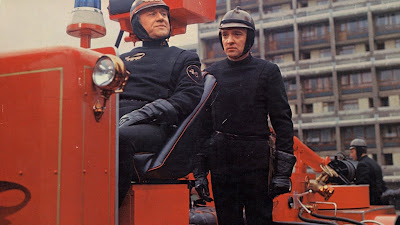
A still from the film version of Fahrenheit 451
Most Important Book: Ray Bradbury's Fahrenheit 451, published in 1951, seems as important as ever.  In Bradbury's vision, firemen don't put out fires but start them, especially for the purpose of burning books. In 2021 in America, there were hints that his vision might actually be coming true, with even Dr. Seuss books being stripped from shelves for being politically incorrect.

Most Daunting Book: Edward Dolnick's Down the Great Unknown is daunting only in the sense that to read it is to accompany John Wesley Powell, at least in one's mind, on the first boat ride down the Colorado River through the Grand Canyon. It's interesting to consider that the only members of his team to die were those who abandoned the expedition because it was too dangerous.

Wisest Book: This title goes to Malcolm Gladwell's David and Goliath. Gladwell makes the case that the weak sometimes have the advantage over the strong because their weakness forces them to look for unconventional ways to win.

Most Familiar Book: I read Saul Bellow's Henderson the Rain King for the third time this year, so by now it is a very familiar book. It's the story of a wealthy man who knows something is missing from his life, and he goes to central Africa to try to discover what it is.

Most Incomprehensible Book: Sam Taylor's The Amnesiac turned out to be too surrealistic for my taste.  There's a chunk of his life that James Purdue cannot remember, and the novel is about his search to discover the missing pieces. S.J. Watson explores a similar plot in Before I Go to Sleep but with greater success.

Most Beautiful Book: I purchased a copy of William Trevor's short story collection A Bit on the Side when I visited England in 2005, but didn't read it until early this year. I was amazed by the beauty and tenderness of these stories.

Most Fearless Book: Because of its subject matter, Lolita was a fearless book when it was published in 1958, and a new collection of essays about the novel, Lolita in the Afterlife, seems no less fearless.

Most Surprising Book: I expected  Larry Watson's short novel Montana 1948 to be a good book. What I didn't expect was a great book.

Most Disappointing Book: The Fine Art of Literary Mayhem has been around for a number of years, so I thought this collection of stories about literary feuds and arguments would be more entertaining than it turned out to be.

Most Unpleasant Book: Usually I discard unpleasant books long before I finish reading them, so I have to interpret unpleasant in a different way. My choice is The Terrible Hours by Peter Maas, which is about the crew of an American submarine stranded at the bottom of the sea. Sounds terribly unpleasant to me.

Most Luminous Book: My vote here goes to Matt Haig's incredible novel The Humans, which is about a monstrous being from another planet who takes the form of a human in order to destroy all traces of a dangerous mathematical formula. This requires him to learn to be a human, and in so doing he becomes a better human than the man he replaced. This was a contender for the wisest book of the year.

Monday, December 27, 2021

Game for readers (2021 edition)

For more several years now I have played a game at year's end where I pose a series of questions — the same questions each year — and answer them by using only the titles of books read that year. It's a game any reader can play, although it helps to read a lot of books and keep a list of them. True answers are, of course, optional. Because of my move to Florida, I read 20 or 30 fewer books than usual in 2021, but let's see how I do.

Describe yourself: Everybody's Fool

How do you feel: Something to Live For

Describe where you currently live: Sun Going Down (I live near the Gulf Coast of Florida, which is where, in Florida at least, the sun goes down)

If you could go anywhere, where would you go: The Kingdom by the Sea

Your favorite form of transportation: Mystery Ride

Your best friend is: Moonwalking with Einstein (OK, that's weak)

You and your friends are: All My Friends Are Going to Be Strangers (at least that's what I fear, having left so many of them back in Ohio)

What's the weather like where you are: A Clearing in the Distance (Unbelievable would also work, this being Florida in December)

What is the best advice you could give: Accidence Will Happen (yes, that spelling is correct)

Thought for the day: We'll Always Have Casablanca (or maybe Anything Goes)

How would you like to die: Before I Go to Sleep

Your soul's present condition: Surprised by Paradox (or perhaps Imponderables)

Friday, December 24, 2021

Ghosts of Christmas Past

We all inhabit multiple time zones. We have the world of our daily present, which usually claims most of our attention, but we are also wrapped in shadowy bands of the past.

Sven Birkerts, The Gutenberg Elegies


This observation by Sven Birkerts may be especially true at Christmastime. Ebenezer Scrooge is not the only one haunted by Christmas Past. This haunting may for most of us be a good thing, as we are flooded with memories of Christmas mornings spent with parents and siblings, Christmas meals shared with our extended family and Christmas parties enjoyed with friends and co-workers. The older we get the more Christmas Past dwells on our minds, even as Christmas Present demands our full attention.

Birkerts makes the point in The Gutenberg Elegies, as I have often thought myself, that each of us is not just the age we happen to be, but every age we have ever been. We can be a helpless baby, a pouting child, an awkward teenager, a responsible adult and, if old enough, a fretful senior citizen, all in the span of a single day

Our memories enable us to dwell in the now, while at the same time being an excited child discovering an array of gifts under a brightly lit tree, a young lover thrilled at spending our first Christmas with the one we love, a parent giving joyful memories to our own children just as our own parents did for us and a grandparent doing it all again with grandchildren. Not everyone's memories are that pleasant, but in any case we can return in our minds to the person we once were, experiencing again how we felt, what we thought and what we did.

This is all true every day of the year, but perhaps especially true at Christmas.