Monday, April 17, 2023

The heroic pigeon

Many novels have been written about World War II heroes. In The Long Flight Home (2019), Alan Hlad's first novel, that hero is a pigeon.

In the autumn of 1940, German planes bomb London and other British targets nightly, and a Nazi invasion is expected at any time. The British look for anything that might give them an advantage, and somebody thinks of homing pigeons. The National Pigeon Service quickly organizes and enlists pigeon owners throughout the nation.

Among these are Bertie Shepherd and his granddaughter Susan, who own some of the best racing pigeons in England. Yet Bertie's age and infirmities make his participation difficult, so Susan takes over the operation. The plan calls for dropping pigeons into France in hopes that members of the French Resistance will find them and and use them to send messages about German activities back to England. (Instead, most of the pigeons are eaten by hungry Frenchmen.)

Meanwhile an American pilot named Ollie Evans suddenly loses both his parents and their farm and decides to go to England to try to join the Royal Air Force. But after he assaults an RAF officer he sees offending Susan, he winds up helping her with the pigeon project as an alternative to prison. They quickly fall in love.

The hero pigeon is Susan's pet, Duchess, not actually part of the pigeon drop. Yet through a comedy of errors both Duchess and Ollie, not to mention the RAF officer Ollie struck, find themselves on the same plane that's shot down over France.

Homing pigeons normally fly in just one direction — toward home — yet Duchess has two homes — with Susan and with Ollie — and thus carries messages back and forth between the two lovers.

Hlad keeps the tension high as Ollie and the British officer, both injured in the crash, elude Germans in their struggle to find a way back to England. The bittersweet ending may not be the one readers hope for, but it is one they will remember.

Friday, April 14, 2023

Nobody's perfect

Patricia T. O'Conner's advice for writers seems like good advice for us all: We all make mistakes. The 10 Commandments aren't for achieving perfection but rather for recognizing imperfection.

In her 1999 book Words Fail Me, itself an admission of imperfection, O'Conner reminds readers that even the greatest writers in their greatest books fall short of the ideal.

• Anthony Trollope has too many lengthy digressions in his novels.

• Antonia Fraser's The Wives of Henry VIII "has too damn many dashes."

• Herman Melville "introduces interesting characters, only to drop them," in Moby-Dick.

• The plot of Emily Bronte's masterpiece Wuthering Heights "is ridiculously improbable."

One could, of course, discover similar flaws in every book ever written. Error, like beauty, often lies in the eye of the beholder. Some of us may enjoy Trollope's digressions or not mind Fraser's dashes in the least. Still there is probably something about these books and others that bothers us. They are too long. They don't move along quickly enough. There's a typo on page 198. We are annoyed by different things, but any annoyance suggests imperfection. You just can't please everyone.

Why is this good advice? We could never leave our home if we feared the wind might mess up our hair. We could never open our mouth if we feared saying the wrong thing. We could never eat anything if we thought everything might be bad for us.

And for writers it means they will never get anything published if they never declare their work finished and stop looking for ways to improve it. There's probably something in this blog post I will later regret, but I am going to post it anyway.

Nobody's perfect.

Wednesday, April 12, 2023

Magical reading

I do believe something very magical can happen when you read a good book.

J.K. Rowling

J.K. Rowling
J.K. Rowling speaking about the magic of reading seems apt. Her Harry Potter novels are about magic. Her series of books magically turned a generation of youngsters into committed readers, each of them eager for the next one in the series. Her stories magically carried these readers into another world. But how do her words apply to other other books by other writers?

Rene Descartes told us one way: "The reading of all good books is like a conversation with the finest minds of the past." A reader can magically converse with Emily Dickinson, Thomas Hardy, Victor Hugo, Thomas Paine, Jane Austen or even Rene Descartes himself. It is not even a one-way conversation, for readers contribute their own ideas.

Jhumpa Lahiri told us another way: "That's the thing about books. They let you travel without moving your feet." My own recent reading has taken me to Spain in the 1950s (April in Spain), to Paris with the great detective Maigret (Maigret and the Nahour Case), to an elite fishing lodge in the Rockies (The Guide), to mid-19th century London (Bleak House), to the American South during the Depression (The Heart Is a Lonely Hunter) and to a distant planet in the distant future (All Systems Red). All this while barely leaving my condo. That's magic.

Malcolm X told us another: "People don't realize how a man's whole life can be changed by one book." Yes, books do change lives. Not all of them, of course. Not even most of them. Yet certain books can change lives, especially if we read them in our youth. Even when they don't change lives, they can change minds and attitudes. And that too can be magic.

Monday, April 10, 2023

The tricks in 'Bleak House'

Weeks ago I reviewed The Artful Dickens ("Breaking the rules," Feb. 17, 2023), John Mullan's book about "the tricks and ploys" Charles Dickens uses in his novels. Most of these are evident in Bleak House, which I recently read.

My review of the Bleak House ("Love conquers all," March 31, 2023) mentioned the fact that it has two narrators, one who writes in past tense and another who uses present tense. Mullen notes that when Dickens experimented with present-tense narration in this novel "there had been nothing like in the English novel before." Today, of course, use of present tense is commonplace. It was Dickens who showed that it could be done.

Dickens was apparently sensitive to odors, and Bleak House, like most of his other novels, is filled with smells. The odor of cooking food, of death, of burning wood, etc, get frequent mention.

The speech peculiarities that Dickens often used to give his characters unique personalities are certainly apparent here. My favorite is a man who always refers to his wife as "old girl." He knows her to be much smarter, but he tells others he must "maintain discipline" by pretending to be in charge. So we frequently find him saying something like, "tell him what I think about that, old girl." Thus he gives the orders, while she leads the way.

I have previously written about the odd names in Bleak House ("Names to remember," Feb. 20, 2023). He also uses coincidences to his advantage in this novel. And he frequently employs one of his favorite phrases: "as if." We read, for example, that Mr. Vholes looks at Richard Capstone "as if he were making a lingering meal of him with his eyes," and, later, "he gave one gasp as if he had swallowed the last morsel of his client." Such fantasies enhance the reality of his fiction.

Friday, April 7, 2023

Under another name

John Banville's April in Spain (2021) turns out to be a sequel to Benjamin Black's Elegy for April (2010). What does this mean, other than that April Latimer, the troubled young doctor presumed murdered at the end of the earlier novel, remains alive? It means that respected Irish novelist John Banville has finally gotten wise

Banville may have been respected for his many literary novels, but he wasn't making much money. Thus he turned to writing mysteries, which he may have thought beneath him, under the name of Benjamin Black. The mysteries, also beautifully written, feature Quirke, a troubled pathologist who manages to uncover mysteries when he isn't drunk. Now Banville, apparently realizing that his mystery novels aren't really as bad as he thought they were, is putting his own name on them.  Good.

April in Spain opens with Quirke vacationing in northern Spain with Evelyn, the wise and patient woman he has married since the earlier novel. He still drinks, but not nearly as much as he once did. But is he drunk when sees a doctor named Angela Lawless when he goes to a hospital after an injury and the doctor reminds him of his daughter Phoebe's friend, April Latimer? Isn't she supposed to be dead? He calls Phoebe and asks her to join them in Spain.

Unfortunately Phoebe first speaks with Bill Latimer, April's uncle and a powerful government official with a sinister reputation. This triggers a series of events that lead to the novel's exciting conclusion.

Quirke, once he telephones Phoebe, fades into the background. The spotlight falls mostly on Phoebe, who was an adult before she learned that Quirke is her real father, and on Terry Tice, a killer for hire. The novel is actually more a thriller than a mystery.

Banville leaves so much hanging at the end that readers will feel compelled to grab up the next book in the series. That's something that probably never happens with his literary novels.

Wednesday, April 5, 2023

A shy robot

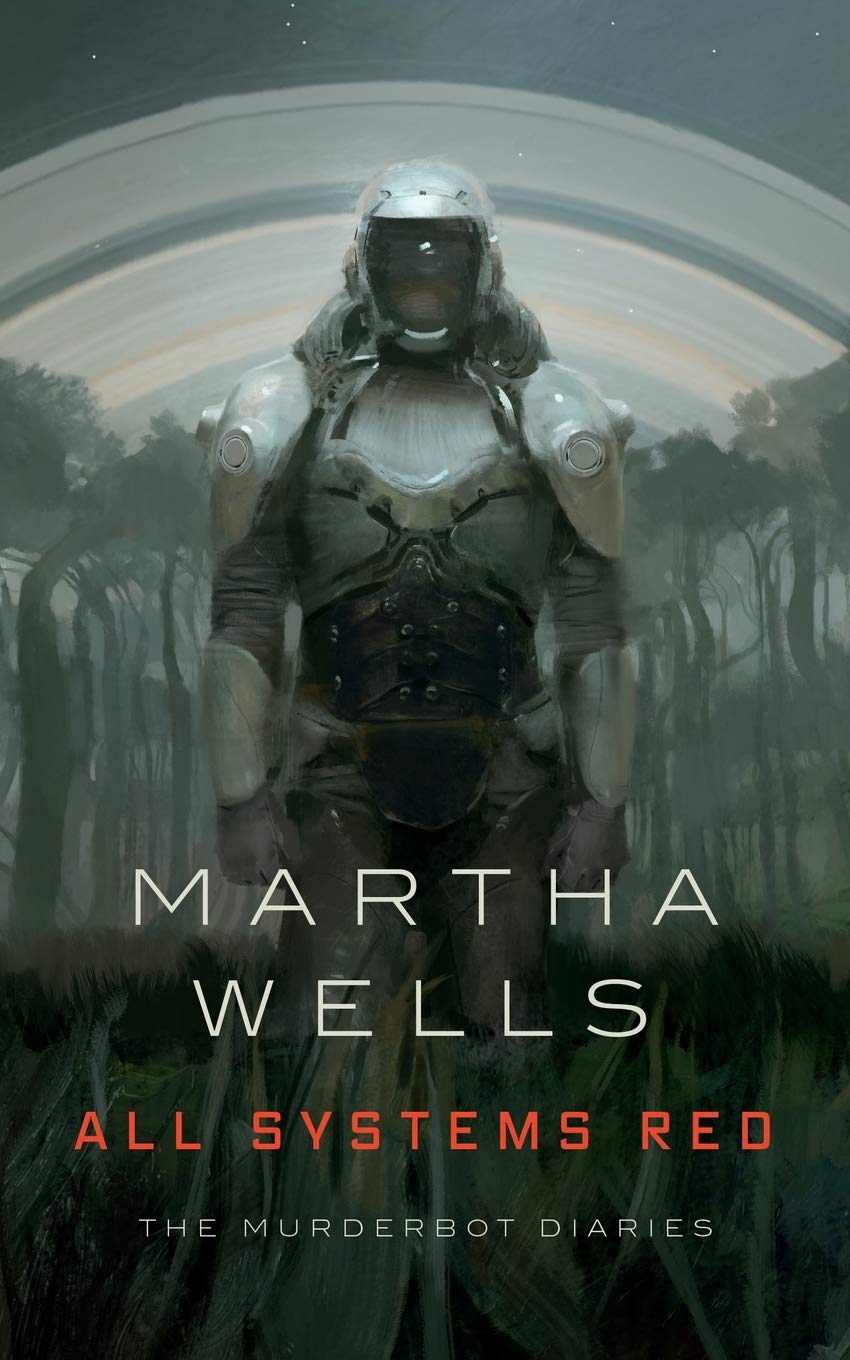
Both my son and grandson loved "The Murderbot Diaries," a series of short sci-fi novels by Martha Wells, so I took their advice and read the first in the series, All Systems Red (2017). Now I'm all aboard.

Can robots be introverted? Well, they can, apparently, if they are part human. And just as the Bionic Man of the old TV series was mostly human with a little bit of electronics filling in the gaps, so this SecUnit has a bit of humanity mixed in with his electronics and metal.

Although officially called a SecUnit, available for rent like a U-Haul truck, our narrator calls himself a murderbot because killing is his purpose when defending his humans.

What his humans don't know is that their SecUnit has a broken governor, meaning that it is actually an independent agent. It follows orders because it wants to, not because it has to. What's more, it is capable of giving orders, which it does when necessary to save lives from a murderous foe on a distant planet.

The adventure of eluding and eventually conquering this unknown enemy proves exciting enough, yet the novel's real appeal lies with its central character. The shy murderbot prefers isolating itself from humans so it can watch the thousands of hours of secretly downloaded video episodes about fictional interplanetary adventures.

When it writes, "Now they knew their murderbot didn't want to be around them any more than they wanted to be around it. I'd given a tiny piece of myself away," our hearts melt, as if it were 100 percent human.

Monday, April 3, 2023

Read the notes

You don't want to read Bleak House, or any other Dickens novel, without also reading the footnotes.

Written in the middle of the 19th century, the novel shows us a very different world than what we know today. Customs have changed. Geography has changed. Language has changed. Perhaps most significantly cultural references have changed.

An old woman has a pet bird named Gammon. The name means nothing to me, and perhaps not to you. A note tells us the word means nonsense or humbug. (A few weeks ago I did a blog post about odd words meaning nonsense. I missed this one.)

A character is given a glass of negus. What's that? It turns out to be a mixture of hot water, port, sugar and lemons.

"I am in the Downs," a character says. That turns out to be an expression meaning depression.

Reading the novel, one feels the original readers must have much more literate than we are today, for they didn't need footnotes to understand all the many references to Shakespeare, Milton, the Bible and a variety of poets. Did people read more then than they do now? Perhaps, or perhaps they just read different things. In today's world cultural reference are more likely to be movies and popular music or television shows. A few politicians and movie stars may sometimes gain mention in today's novels. If anyone should read these novels two centuries from now, those readers will also certainly need footnotes.