I have long believed literature to be important, but I've never been clear on why it's important. Religions, cultures and even families pass down their wisdom through stories, so maybe that's part of the answer. But still, why should students study Macbeth or Moby-Dick? What of lasting value is actually being learned?
Now I've read David Denby's new book Lit Up: One Reporter, Three Schools, Twenty-four Books That Can Change Lives, and if I am still not entirely clear why literature is important I am at least more certain than ever that it is. I can witness dramatic changes in the lives of several high school sophomores through literature classes taught by challenging teachers given the freedom to teach outside the confines of textbooks and state testing guidelines.
"At that age, the brain still has a genuine capacity to change," Denby writes in his introduction. "Fifteen is a danger spot and a sweet spot... They can be reached. Their moral education, as well as their literary education is a stake; the two may be inseparable." And so he decided to monitor classes in three public schools, including a troubled inner-city school. The racially diverse students, while unusually bright, were not readers when the year began. Their lives were chained to their handheld devices, and they seemed to believe that was all they needed to lead successful, rewarding lives.
Then they met their teachers, including Sean Leon, who teaches at the Beacon School in Manhattan and whose assigned reading would be too demanding for most college sophomores. Books he required included Aldous Huxley's Brave New World, George Orwell's 1984, Herman Hesse's Siddhartha, Kurt Vonnegut's Slaughterhouse-Five, Fyodor Dostoevsky's Notes from Underground, Jean-Paul Satre's No Exit and Samuel Beckett's Waiting for Godot.
Teachers Jessica Zelenski and Mary Beth Jordan were less challenging, but still they taught works by William Shakespeare, Kurt Vonnegut, Harper Lee, John Steinbeck, Ernest Hemingway and Alice Walker, among many others. These lit teachers lit fires in their students, most of whom were non-readers when they began ninth grade and are now in college.
Denby follows these classes month by month and book by book, and you can observe the progress made as students become more animated, more caught up in their discussions and more committed to actually reading these books rather than just reading about them in study guides. One class was told to write an essay ranking the books they had read and explaining why they judged one better than another. "They justified their taste," Denby writes. "Suddenly they had taste in books, a new idea for many."
The difficulty of the these books, especially those assigned by Leon, was an advantage, not a disadvantage, Denby believes. "Curious and ambitious teens always read things that are too hard for them and fail to understand half of what they read. But frustration only makes them eager to find out more."
One advantage literature has over such other typical high school subjects as biology and geometry is that it allows for interpretation and argument. What does 1984 mean in 2016? Well, it means something a little different to everyone who reads it. It gives us something to think about and talk about, and thinking and talking about it and other great books helps young minds develop in ways that biology, geometry and those handheld electronic devices cannot do.
Friday, April 29, 2016
Wednesday, April 27, 2016
Entertaining stories
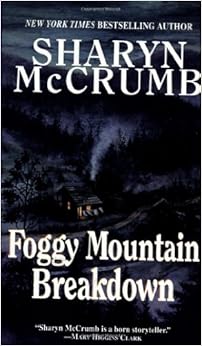
There's nothing arty or pretentious about Sharyn McCrumb's short stories in her 1997 collection Foggy Mountain Breakdown, with the possible exception of "Gerda's Sense of Snow," the least successful of these stories. The tales, first published mostly in detective magazines, were meant to entertain, and that is what they do.
Mostly crime stories, as one would expect, they vary a great deal in tone, style, locale, characters and points of view. Some of them, like "Typewriter Man" and "Autumn Migration," flirt with the supernatural. Several are humorous, while others are as serious as death. Her surprise endings truly surprise. One never gets the feeling that if you have read one Sharyn McCrumb story, you have read them all.
In "Remains to be Seen," one of the more lighthearted stories, a couple of old women buy a mummy at an army surplus store. In "A Predatory Woman," a murderess released from prison turns out not to be the title character at all. "The Matchmaker" tells of a dating service that finds the perfect mate for a killer. The murder story in "Gentle Reader" is told entirely in a series of letters between an author and a fan. The title story, one of the best in the collection, tells of a bully who gets his just deserts, and then some. And so it goes, one gem after another.
Mostly crime stories, as one would expect, they vary a great deal in tone, style, locale, characters and points of view. Some of them, like "Typewriter Man" and "Autumn Migration," flirt with the supernatural. Several are humorous, while others are as serious as death. Her surprise endings truly surprise. One never gets the feeling that if you have read one Sharyn McCrumb story, you have read them all.
In "Remains to be Seen," one of the more lighthearted stories, a couple of old women buy a mummy at an army surplus store. In "A Predatory Woman," a murderess released from prison turns out not to be the title character at all. "The Matchmaker" tells of a dating service that finds the perfect mate for a killer. The murder story in "Gentle Reader" is told entirely in a series of letters between an author and a fan. The title story, one of the best in the collection, tells of a bully who gets his just deserts, and then some. And so it goes, one gem after another.
Monday, April 25, 2016
The popularity of mysteries
I was able to attend the Ohioana Book Festival in Columbus on Saturday. It was the tenth year this fine event has been held, bringing together under one roof dozens of Ohio's authors and, of course, their books displayed on tables. Because I had to leave early, I attended just two of the many panel discussions held during the day, but they were good ones. The first featured five mystery writers and the second the three writers responsible for recent biographies of Franklin D. Roosevelt, the country's only four-term president, and James A. Rhodes, Ohio's only four-term governor. These politicians had more in common than you might think, although the real surprise, at least for me, was Douglas Brinkley's list of things Franklin Roosevelt had in common with Theodore Roosevelt.
Yet mostly today I want to reflect on responses made by the mystery writers about why mysteries are so popular with readers. This popularity was evident at the book festival, where at least 15 of the 40-some novelists present were mystery writers. Shelley Costa, author of Practical Sins for Cold Climates (a book I'd like to read just for its title), suggested mysteries are popular because they are "moral fiction." In other words, murderers get caught, and justice prevails. Most readers prefer unambiguous endings. Sam Thomas, author of The Midwife and the Assassin, spoke about how "the social fabric is torn by crime," and a mystery story is about its repair.
I have heard this explanation before, and I'm sure there must be some truth in it, yet I wonder if another, simpler explanation might have been suggested earlier in the discussion when Thomas commented that when he was trying to get his first book published, the publisher asked if it were part of a series. He said he knew enough to answer yes, even though he had no idea for a second novel featuring the same character.. Other authors echoed much the same thing. To get that first novel published, they had to commit themselves to writing a series.
Why do publishers like series? Because readers like series, and once they become familiar with the characters in one novel, they want to follow them into other books. One reads Jane Marple mysteries at least as much for Jane Marple as for the mysteries themselves. As good as Sherlock Holmes stories are, it is the character that readers love, which is why Sherlock Holmes stories continue to be written long after the death of his creator, Sir Arthur Conan Doyle. One could write similar mysteries featuring other characters, but it is Holmes readers want to read about.
Series of books are popular in other genres, such as romance, westerns and science fiction. Readers even like to revisit beloved characters in more serious fiction. Consider the recent avalanche of books featuring the beloved characters in Jane Austen's Pride and Prejudice. Yet more than other kinds of books, mysteries are ideally suited to series treatment. There can always be another murder that needs to be solved by our favorite fictional detective.
I bought just one book on Saturday, but that was a mystery, Bookmarked for Murder by Dan Andriacco, another of the panelists that morning. If I like it, and especially if I like the characters, I will probably seek out other novels in that series. That's what readers do, and that's one reason so many mysteries are sold.
Yet mostly today I want to reflect on responses made by the mystery writers about why mysteries are so popular with readers. This popularity was evident at the book festival, where at least 15 of the 40-some novelists present were mystery writers. Shelley Costa, author of Practical Sins for Cold Climates (a book I'd like to read just for its title), suggested mysteries are popular because they are "moral fiction." In other words, murderers get caught, and justice prevails. Most readers prefer unambiguous endings. Sam Thomas, author of The Midwife and the Assassin, spoke about how "the social fabric is torn by crime," and a mystery story is about its repair.
I have heard this explanation before, and I'm sure there must be some truth in it, yet I wonder if another, simpler explanation might have been suggested earlier in the discussion when Thomas commented that when he was trying to get his first book published, the publisher asked if it were part of a series. He said he knew enough to answer yes, even though he had no idea for a second novel featuring the same character.. Other authors echoed much the same thing. To get that first novel published, they had to commit themselves to writing a series.
Why do publishers like series? Because readers like series, and once they become familiar with the characters in one novel, they want to follow them into other books. One reads Jane Marple mysteries at least as much for Jane Marple as for the mysteries themselves. As good as Sherlock Holmes stories are, it is the character that readers love, which is why Sherlock Holmes stories continue to be written long after the death of his creator, Sir Arthur Conan Doyle. One could write similar mysteries featuring other characters, but it is Holmes readers want to read about.
Series of books are popular in other genres, such as romance, westerns and science fiction. Readers even like to revisit beloved characters in more serious fiction. Consider the recent avalanche of books featuring the beloved characters in Jane Austen's Pride and Prejudice. Yet more than other kinds of books, mysteries are ideally suited to series treatment. There can always be another murder that needs to be solved by our favorite fictional detective.
I bought just one book on Saturday, but that was a mystery, Bookmarked for Murder by Dan Andriacco, another of the panelists that morning. If I like it, and especially if I like the characters, I will probably seek out other novels in that series. That's what readers do, and that's one reason so many mysteries are sold.
Friday, April 22, 2016
What makes a book a book?
A "text" existing only on a screen and in the mind is not, to me, a book.
If you or I were to say something like that, it wouldn't mean much. Nobody would take us seriously. But when celebrated poet and novelist Wendell Berry says it, it's worth paying attention to.
I have sometimes used the phrase "real book" to distinguish between something printed on paper and something, even if it's the same something, reproduced on a Kindle, iPad, CD or whatever. Every month LibraryThing presents a list of newly published books that will soon be available for members to review. You can indicate those that appeal to you and, if you are lucky, you might win a copy. Those at the bottom of this list are identified as ebooks. I always ignore these. If I'm going to win a book, I want it to be a real book, something I can hold in my hand and, later, put on a shelf. I have read a few ebooks and listened to quite a number of books on CD and, years ago, on tape. These were books in my mind, but yet not quite. They are like artificial Christmas trees. They serve the purpose, but are not quite the real thing.
Hear what else Berry has to say on the subject: "To me, it is not enough that a book is thought realized in language; it must also be language further realized in print on paper pages bound between covers. It is a material artifact, a thing made not only to be seen but also to be held and smelled, containing language that can be touched, and underlined with an actual pencil, with margins that can be actually written on. And so a book, a real book, language incarnate, becomes a part of one's bodily life."
Wendell Berry uses the phrase "real book." too, I'm glad to see. Other phrases that catch my eye are "thought realized in language," which is true even of any spoken sentence, and "language incarnate," which refers to words taking physical form. It was a big step when mankind moved from just "thought realized in language" to "language incarnate." To many, especially younger generations, it seems like another big step to be moving on to language on screens.
David Denby's new book Lit Up, one of the recent review books I've received through LibraryThing, examines the difficulties faced by teachers trying to teach literature to today's teenagers. He quotes one boy, perhaps speaking for his generation, saying, "Books smell like old people." Thanks to an inspired teacher, this same boy was soon not just reading real books but engaging in literary discussions with classmates. Even so, it would appear that those of us who agree with Wendell Berry on what makes a book a book are in a dwindling minority.
Wendell Berry, My Bookstore
I have sometimes used the phrase "real book" to distinguish between something printed on paper and something, even if it's the same something, reproduced on a Kindle, iPad, CD or whatever. Every month LibraryThing presents a list of newly published books that will soon be available for members to review. You can indicate those that appeal to you and, if you are lucky, you might win a copy. Those at the bottom of this list are identified as ebooks. I always ignore these. If I'm going to win a book, I want it to be a real book, something I can hold in my hand and, later, put on a shelf. I have read a few ebooks and listened to quite a number of books on CD and, years ago, on tape. These were books in my mind, but yet not quite. They are like artificial Christmas trees. They serve the purpose, but are not quite the real thing.
Hear what else Berry has to say on the subject: "To me, it is not enough that a book is thought realized in language; it must also be language further realized in print on paper pages bound between covers. It is a material artifact, a thing made not only to be seen but also to be held and smelled, containing language that can be touched, and underlined with an actual pencil, with margins that can be actually written on. And so a book, a real book, language incarnate, becomes a part of one's bodily life."
Wendell Berry uses the phrase "real book." too, I'm glad to see. Other phrases that catch my eye are "thought realized in language," which is true even of any spoken sentence, and "language incarnate," which refers to words taking physical form. It was a big step when mankind moved from just "thought realized in language" to "language incarnate." To many, especially younger generations, it seems like another big step to be moving on to language on screens.
David Denby's new book Lit Up, one of the recent review books I've received through LibraryThing, examines the difficulties faced by teachers trying to teach literature to today's teenagers. He quotes one boy, perhaps speaking for his generation, saying, "Books smell like old people." Thanks to an inspired teacher, this same boy was soon not just reading real books but engaging in literary discussions with classmates. Even so, it would appear that those of us who agree with Wendell Berry on what makes a book a book are in a dwindling minority.
Wednesday, April 20, 2016
Revisiting the past
In my early teens I developed a passion for Popular Mechanics and Popular Science magazines. Never mind that I had no aptitude for mechanics or, as it turned out when I later took high school chemistry, for science. These magazines just seemed exotic to me. They seemed to offer a peek into the future, while at the same time revealing an exciting present. I especially loved those issues devoted to new cars. The release of new models of automobiles has not interested me much since I stopped reading the magazines in the early 1960s.
A few months ago I reclaimed a portion of my youth by purchasing three issues of Popular Mechanics from the era when I still read the magazine. (I have no idea what happened to all those issues I had stacked in my room back home.) Last night I poured over the September 1957 issue, the one that announced the new Edsel on the cover.
"There's no market for cars that look alike," says the article inside. No one ever accused the Edsel of looking like other cars. The article points out that the Edsel was vertical in the front, where most cars were horizontal, and horizontal in the back, where most cars then had vertical lines. Of course we know the Edsel failed miserably. And today, or so it appears to me, most cars look pretty much alike.
Another fascinating article, "What's Happening to the Weather," interviews a panel of experts about the recent warming trend in the world's climate, including a noticeable melting of polar ice. Sound familiar? The meteorologists blamed the changing climate on sunspots.
The magazine has two articles about sports cars designed to look like jet planes. Another article describes inventive games played by people on horseback, including a polo match played with brooms instead of mallets and a ribbon race in which two horsemen attempt to complete a course with a strip of crepe paper between them without dropping or tearing the paper. "Pupils Study Math With Calculators" says one headline. The photograph shows children with machines on their desks the size of small typewriters. Another article is about "The Organ That Plays Stalactites" and yet another announces, "You Can Make a Plant Do Tricks."
I can remember devoting as much time to the ads in these magazines as the articles. This particular issue has ads for a 75X telescope for $3.98, a hot-air-balloon kit for a dollar, a "lifetime" radio for $2, 6-foot government surplus balloons for just 59 cents each, a vest-pocket sized adding machine for $2.95 and 12 "disgustingly potent" stink bombs for a dollar. What boy wouldn't love to get his hands on any of these things? But they were just too expensive for me. I was lucky just to get the magazine, which cost 35 cents an issue back then.
"There's no market for cars that look alike," says the article inside. No one ever accused the Edsel of looking like other cars. The article points out that the Edsel was vertical in the front, where most cars were horizontal, and horizontal in the back, where most cars then had vertical lines. Of course we know the Edsel failed miserably. And today, or so it appears to me, most cars look pretty much alike.
Another fascinating article, "What's Happening to the Weather," interviews a panel of experts about the recent warming trend in the world's climate, including a noticeable melting of polar ice. Sound familiar? The meteorologists blamed the changing climate on sunspots.
The magazine has two articles about sports cars designed to look like jet planes. Another article describes inventive games played by people on horseback, including a polo match played with brooms instead of mallets and a ribbon race in which two horsemen attempt to complete a course with a strip of crepe paper between them without dropping or tearing the paper. "Pupils Study Math With Calculators" says one headline. The photograph shows children with machines on their desks the size of small typewriters. Another article is about "The Organ That Plays Stalactites" and yet another announces, "You Can Make a Plant Do Tricks."
I can remember devoting as much time to the ads in these magazines as the articles. This particular issue has ads for a 75X telescope for $3.98, a hot-air-balloon kit for a dollar, a "lifetime" radio for $2, 6-foot government surplus balloons for just 59 cents each, a vest-pocket sized adding machine for $2.95 and 12 "disgustingly potent" stink bombs for a dollar. What boy wouldn't love to get his hands on any of these things? But they were just too expensive for me. I was lucky just to get the magazine, which cost 35 cents an issue back then.
Monday, April 18, 2016
Novels about books
Those of us who love books, and I mean really love books, tend to love books about books. That phrase, "books about books," usually refers to nonfiction works, such as Joe Queenan's One for the Books or Wendy Welch's The Little Bookstore of Big Stone Gap. Yet there are numerous novels, more every year it seems, that are also books about books. That is, books or authors or the characters from famous novels are vital to the plots. Whether or not these novels qualify as literature, they are nevertheless read avidly by those who love literature.
As examples of this genre, I have chosen 10 novels from the past 15 years. Most of these books I have written about previously in this blog.
Mr. Timothy by Louis Bayard (2003) - Tiny Tim, from the famous Charles Dickens Christmas story has grown up in Bayard's novel and struggles to discover who has been killing young girls in London. B
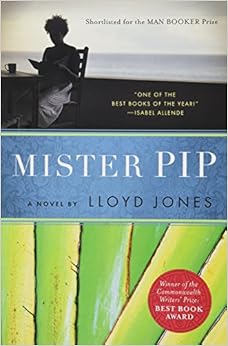
Mister Pip by Lloyd Jones (2006) - Great Expectations is his only textbook when a white man reluctantly becomes the teacher of children on a tropical island during wartime. A
Finn by Jon Clinch (2007) - Clinch revisits Huckleberry Finn, but this time from the perspective of his no-good father. A
The Camel Bookmobile by Masha Hamilton (2007) - Fiona Sweeney loads books on the back of a camel and takes them to villagers in an arid part of Kenya. A
An Arsonist's Guide to Writers' Homes in New England by Brock Clarke (2007) - Sam Pulzifer accidentally burned down Emily Dickinson's house, so now he's a suspect when the homes of other writers are torched. B+
The Bad Book Affair by Ian Sansom (2010) - The last, so far, of Ian Sansom's Mobile Library mysteries, this one finds librarian Israel Armstrong having to prove a Philip Roth novel he loaned to a teen-age girl has nothing to do with her disappearance. To do that, he needs to find the girl. A
Mr. Penumbra's 24-Hour Bookstore by Robin Sloan (2012) - A bookstore employee discovers there is much more going on in Mr. Penumbra's store than just the sale of books. B
The Bookman's Tale by Charles Lovett (2013) - A young bookseller thinks he may have found a book that will prove William Shakespeare was actually the author of those plays bearing his name. B
The Storied Life of A.J. Fikry by Gabrielle Zevin (2014) - A small-town bookstore, a rare collection of Poe poetry, an abandoned baby and a little romance are combined in a winning novel with chapters themed by famous short stories. A-
The Swans of Fifth Avenue by Melanie Benjamin (2016) - Author Truman Capote's literary career reaches it zenith and then plummets downward while he hangs out with some famous New York City socialites. A
You don't have to be a book nut to enjoy any of these novels, but it sure helps.
As examples of this genre, I have chosen 10 novels from the past 15 years. Most of these books I have written about previously in this blog.
Mr. Timothy by Louis Bayard (2003) - Tiny Tim, from the famous Charles Dickens Christmas story has grown up in Bayard's novel and struggles to discover who has been killing young girls in London. B
Mister Pip by Lloyd Jones (2006) - Great Expectations is his only textbook when a white man reluctantly becomes the teacher of children on a tropical island during wartime. A
Finn by Jon Clinch (2007) - Clinch revisits Huckleberry Finn, but this time from the perspective of his no-good father. A
The Camel Bookmobile by Masha Hamilton (2007) - Fiona Sweeney loads books on the back of a camel and takes them to villagers in an arid part of Kenya. A
An Arsonist's Guide to Writers' Homes in New England by Brock Clarke (2007) - Sam Pulzifer accidentally burned down Emily Dickinson's house, so now he's a suspect when the homes of other writers are torched. B+
The Bad Book Affair by Ian Sansom (2010) - The last, so far, of Ian Sansom's Mobile Library mysteries, this one finds librarian Israel Armstrong having to prove a Philip Roth novel he loaned to a teen-age girl has nothing to do with her disappearance. To do that, he needs to find the girl. A
Mr. Penumbra's 24-Hour Bookstore by Robin Sloan (2012) - A bookstore employee discovers there is much more going on in Mr. Penumbra's store than just the sale of books. B
The Bookman's Tale by Charles Lovett (2013) - A young bookseller thinks he may have found a book that will prove William Shakespeare was actually the author of those plays bearing his name. B
The Storied Life of A.J. Fikry by Gabrielle Zevin (2014) - A small-town bookstore, a rare collection of Poe poetry, an abandoned baby and a little romance are combined in a winning novel with chapters themed by famous short stories. A-The Swans of Fifth Avenue by Melanie Benjamin (2016) - Author Truman Capote's literary career reaches it zenith and then plummets downward while he hangs out with some famous New York City socialites. A
You don't have to be a book nut to enjoy any of these novels, but it sure helps.
Friday, April 15, 2016
You make the call
Leading storytelling workshops, I often compared the well-told story -- written or spoken -- to a coloring book; there are guidelines, but you create the details for yourself. A television does most of the work for you; one need not even think, only watch. Some writers are like TVs, but the best ones offer you sovereignty.
I like that comparison, stories to coloring books. Movies adapted from novels so often disappoint because the "colors" in the films don't match those in our imaginations when we read the stories. Our minds fill in the blanks one way, while directors fill them differently..
I also like Wendy Welch's use of the word sovereignty. As a reader you have sovereignty, at least some sovereignty, over the stories you read. The better the story, the greater your sovereignty. The best stories have ambiguity and subtlety. You decide what they mean and, in some cases, even what takes place. You also have control over any detail the author chooses not to describe. In terms of what takes place in your mind, reading a story is not at all like watching a story, even if it happens to be the same story.
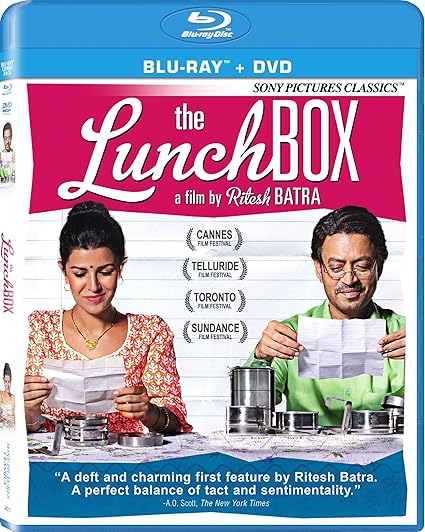
Yet I think the best movies and television shows, like the best written stories, can offer a degree of sovereignty. They allow some measure of interpretation and choice in the hands of the viewer. A case in point is the 2013 Indian film The Lunchbox, the subject of a movie discussion I will be leading tonight. The story is about an office worker, soon to retire, who mistakenly each day gets a lunchbox intended for another man. This leads to a series of notes between this man and the much younger woman who packs the lunch.
In the film, the two never come face to face, although they write about running away together. At the end we see the woman, with her daughter, preparing to leave her unfaithful husband, while the man sets out to track her down. Will he get there in time? Will they really go to Bhutan together? Are they even suited for each other in view of their different ages and different religions? It's left to the viewer to decide. And that's just one of the many things the story gives us to talk about tonight.
Wendy Welch, The Little Bookstore in Big Stone Gap
I also like Wendy Welch's use of the word sovereignty. As a reader you have sovereignty, at least some sovereignty, over the stories you read. The better the story, the greater your sovereignty. The best stories have ambiguity and subtlety. You decide what they mean and, in some cases, even what takes place. You also have control over any detail the author chooses not to describe. In terms of what takes place in your mind, reading a story is not at all like watching a story, even if it happens to be the same story.
Yet I think the best movies and television shows, like the best written stories, can offer a degree of sovereignty. They allow some measure of interpretation and choice in the hands of the viewer. A case in point is the 2013 Indian film The Lunchbox, the subject of a movie discussion I will be leading tonight. The story is about an office worker, soon to retire, who mistakenly each day gets a lunchbox intended for another man. This leads to a series of notes between this man and the much younger woman who packs the lunch.
In the film, the two never come face to face, although they write about running away together. At the end we see the woman, with her daughter, preparing to leave her unfaithful husband, while the man sets out to track her down. Will he get there in time? Will they really go to Bhutan together? Are they even suited for each other in view of their different ages and different religions? It's left to the viewer to decide. And that's just one of the many things the story gives us to talk about tonight.
Subscribe to:
Posts (Atom)