Friday, August 30, 2024

The wisdom of subtitles

Are subtitles really necessary?

Good question.

When it comes to fiction, the answer is clearly no. A number of famous novels have had subtitles that have been all but forgotten. Thomas Hardy called his classic novel Tess of the d'Urbervilles: A Pure Woman. Nobody uses the subtitle when discussing the book. I would even call the subtitle a mistake. Let the reader decide whether Tess is a pure woman or not. Kurt Vonnegut called his famous novel Slaughterhouse-Five, or, The Children's Crusade. Again the subtitle has been mostly ignored, although it does give scholars something to write about. 

And of course the original title of Robinson Crusoe is The Life and Strange Surprizing Adventures of Robinson Crusoe, of York, Mariner: Who lived Eight and Twenty Years, all alone in an un-inhabited Island on the Coast of America, near the Mouth of the Great River of Oroonoque; Having been cast on Shore by Shipwreck, wherein all the Men perished but himself. An Account how he was at last as strangely deliver'd by Pyrates. Written by Himself. Who needs all that?

Most novels published today have the same subtitle: A Novel. It's not really a subtitle, of course, yet it is found under the title of most novels, letting readers know that they are holding fiction in their hands. That may not be necessary, but I am grateful for those words sometimes when it would not otherwise be clear if a book is a novel, a memoir or something else.

Subtitles are much more common in nonfiction, and for good reason. Nonfiction titles are often clever, but ambiguous. The subtitle usually gives a clearer picture of what the book is actually about. In that sense, it is a good thing.

The Great Bridge by David McCullough, which I reviewed here two days ago, carries the subtitle: The Epic Story of the Building of the Brooklyn Bridge. For those who do not recognize the bridge in the cover illustration, that subtitle serves a valuable purpose.

When biographies don't include the name of the subject in the title, a subtitle seems necessary. For example: American Mirror: The Life and Art of Norman Rockwell. That subtitle, in fact, seems more necessary than the title. When the subject's name is in the title, biographers often use the standard subtitle A Life, which serves much the same purpose as A Novel.

Objects of Our Desire makes a provocative title, but what is the book about? The subtitle gives us a better, if still obscure, idea: Exploring Our Intimate Connections with the Things Around Us.

When Witold Rybczynsi wrote City Life, he didn't think a subtitle was necessary. The two words in the title tell us enough, he apparently thought, although at first glance the book might be taken as a novel.

For most nonfiction books, subtitles are all but essential.

Wednesday, August 28, 2024

Building the Bridge

The late historian David McCullough built an impressive career writing big books about big people (John Adams and Harry Truman), big events (the American Revolution and the Johnstown Flood) ) and big structures (the Panama Canal). His early book The Great Bridge (1972) helped established the pattern.

Nearly 150 years after it was completed, the Brooklyn Bridge still stands, still fills a necessary purpose and still impresses everyone who sees it. 

The suspension bridge was the brainchild of John Roebling, an engineer who built bridges and who also owned a wire business, wire being essential for the construction of suspension bridges. For many years he was credited by many with building the great bridge over the East River, connecting Brooklyn with New York City. Yet he died while the bridge was still in its early stages, and the actual construction was supervised by his son, Washington Roebling, a Civil War hero.

Yet Washington was himself absent during most of the bridge construction because of a disabling injury caused by the bends. He, like many of his workers, came to the surface too quickly from a caisson deep under the river. He supervised the construction from his bed, his gifted wife Emily learning about bridge engineering at his bedside and passing down instructions to supervisors.

The chief engineer's absence did not become controversial until late in the construction when there was an unsuccessful attempt to oust him. Other controversies, however, had a bigger impact. The project became involved in political corruption because of Boss Tweed and others. Because it was thought the Roebling wire company should not supply the wire for the bridge, the contract went to a supplier who substituted inferior wire for the specified wire after it was inspected and approved. The bridge cost much more than estimated, not only because the graft. And, of course, some people didn't approve of Emily Roebling's prominence in the project.

Men died during the construction, and later people died jumping from the bridge.

Yet the bridge was eventually completed and opened in 1883 to a massive celebration.

McCullough may tell you more about bridge-building than you really want to know, yet his book also tells a fascinating human story.

Monday, August 26, 2024

Breaking the rules

Charles Dickens
In her book Blurb Your Enthusiasm, Louise Wilder says Charles Dickens committed the three cardinal sins of commercial fiction: He liked plots, he was popular and he was funny.

I think she meant to say "literary fiction," not "commercial fiction." Most readers love novels with strong plots and that provide a few laughs, and they also enjoy reading what other people are reading. The intellectual elite, however, views things differently.

The books most favored by literary critics and high-brow readers tend to have weak plots, or even no plots at all. Laughs, or even happy endings, are frowned upon. And if the masses like something, it must not be very good.

Yet Dickens was taught in literature classes when I was in college, and perhaps he still is, even though he is a dead white man. The literary elite seems more forgiving of pre-20th century novels guilty of the three cardinal sins than the work by more recent writers. Thus Pride and Prejudice and Adventures of Huckleberry Finn, despite their humor, strong plots and popularity, are still recognized as great. The snobbiest critics are much less sure about To Kill a Mockingbird, The Catcher in the Rye, All the Light We Cannot See and other 20th and 21st century novels that break one or more of those rules.

Just as I wish more movie comedies won Academy Awards, I wish more light-hearted, plot-driven novels won literary prizes. Just because people like something doesn't make it inferior.

Friday, August 23, 2024

Cleaning up messes

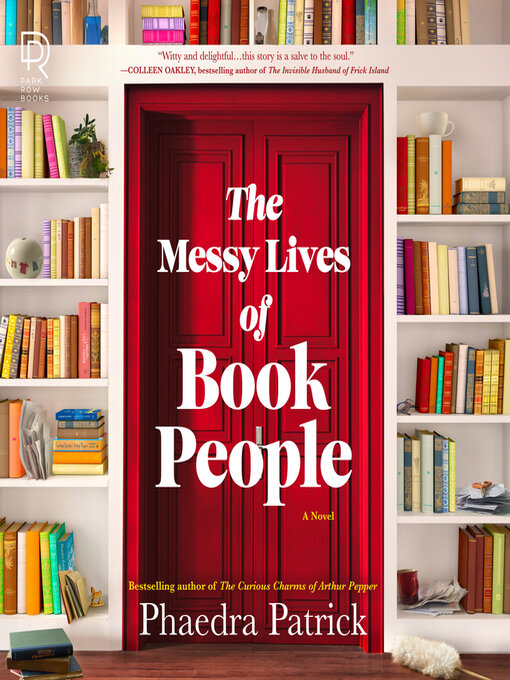
British author Phaedra Patrick has a gift for writing stories about characters discovering the unknown in their own history or in the history of someone they love. She did this in novels like The Curious Charms of Arthur Pepper and The Library of Lost and Found, and she does it again in The Messy Lives of Book People (2022).

Liv Green, a woman in her 40s with two sons in college, works as a cleaning lady for a famous novelist, Essie Starling. She once aspired to become a writer herself, but she has settled for working for one and reading every one of Essie's bestsellers over and over again. Her husband, Jake, is part of a family that owns a book publishing business.

Essie's sudden death comes as a shock. An even bigger shock comes when Liv is told that Essie, fearing her death, had declared that Liv should finish writing her 20th novel. She is given six months, until Nov. 1, to complete the task. And not until that day will Essie's death be announced to the world.

Liv recognizes that Essie's main character, Georgia Rory, represents Essie herself. To properly complete the series of novels, she feels she must dig into Essie's past and and try to discover the identity of her one true love.

Discovery follows discovery as she researches Essie's history, which shockingly intersects with her own history. The mystery of why Essie chose her cleaning lady, of all people, to complete her final novel becomes clear at last.

Liv must keep her work a secret, even from Jake, and this puts a strain on their marriage. The fact that her research puts her in close contact with Essie's attractive former lovers doesn't help her home life. Thus things do get messy for these book people. But Liv is a cleaning lady, or now a former cleaning lady, and she knows something about cleaning up messes.

Wednesday, August 21, 2024

Mangled relationships

 I thought I could be both. Mostly grandmother, and on occasion a bit wolf.

Idra Novey, Take What You Need


Little Red Riding Hood is not the only fairy-tale allusion in Idra Novey's striking 2023 novel Take What You Need. The story may also remind readers of Cinderella or any fairy tale with a wicked stepmother. Is Jean, Leah's stepmother, wicked or not? Is she the grandmother or the wolf?

Leah loved her stepmother when she was a little girl, but Jean's marriage to her father didn't last, and the two were separated for many years. A reunion a few years before left Leah questioning her previous affection for Jean, and they parted under unpleasant circumstances. Now with a family of her own, Leah learns Jean has died and she is invited by a man named Elliott to come to Jean's house to, in effect, "take what you need."

In alternate chapters we read Leah's story in the present and Jean's story filling in the time between her marriage to Leah's father and her own death from falling off a sculpture in her own home.

Jean is a frustrated artist who uses her retirement years to create sculptures in her living room. She calls them Manglements. Her art is made from scrap metal, discarded mirrors and other junk found in her Appalachian town —"take what you need," in other words. Eventually it becomes so enormous, yet so impressive, that after her death nobody knows what to do with it.

Elliott is a young man with no apparent future,  but with an unsuspected appreciation for art. He provides the muscle for her work and eventually moves in with her. In between he often breaks into her house at night (while she listens from her bed) and steals things — once again, "take what you need."

The novel's three major characters have complex relationships with one another, each of them mostly grandmother, and on occasion a bit wolf.

Monday, August 19, 2024

Puffery

Pick up a paperback book and on the cover you may see flattering quotes from famous authors or other notables. Some examples:

At the top of A.J. Finn's The Woman in the Window you find the words "Astounding. Thrilling. Amazing!" beside the name of Gillian Flynn. If you are a Gillian Flynn fan, those three encouraging words may have prompted you to buy this paperback.

Over Lisa Genova's named on the cover of Songs of Willow Frost by Jamie Ford one finds this: "If you liked Hotel on the Corner of Bitter and Sweet, you're going to love Songs of Willow Frost ... tender, powerful, and deeply satisfying."

And at the top of Marilynne Robinson's book of essays What Are We Doing Here? we find a quote from Charles Baxter: "Robinson's thinking is all in the service of humanity's survival, spiritually and environmentally."

Impressive stuff, right?

Such favorable words may help sell books, and I confess they have sometimes prompted me to purchase a book, but we readers should probably not take them too seriously.

Prominent authors are constantly being sent review copies of soon-to-be-published books along with a request from the publisher's marketing team for a kind word. And a kind word, not an honest review, is what the publisher wants, although the famous author's name may be actually more desired than whatever the favorable words happen to be.

Most writers hate this, I have been told. They have their own books to write. Why would they want to take the time to read somebody else's book, especially when that somebody may be a competitor? Thus just a few select words, such as Flynn's astounding, thrilling and amazing, can fill the bill quickly. 

In Blurb Your Enthusiasm, Louise Wilder reveals another secret. Some writers actually ask someone else to compose the puffery that will eventually go over their name on a book cover. That way they don't have to bother even opening the book in question. Wilder even says, "I confess that, yes, occasionally I have made up review quotes for a couple of high-profile authors in this manner (although luckily they did find the time to sign off on the finished piece of praise."

So rather than the familiar "Don't judge a book by its cover," the better advice might be: Don't buy a book because of praise from other writers on the cover. It's probably hogwash.

Friday, August 16, 2024

Selling the book

What is a blurb? If you are uncertain before reading Louise Wilder's Blurb Your Enthusiasm (2022), you may be even less certain afterward.

That's because Wilder, who writes blurbs for Penguin books, broadens the definition to include everything on a book cover, front or back, that is intended to help sell the book. This includes titles, subtitles, cover designs, cover color, quotes from reviews and quotes from notable people who may (or may not) have actually read the book.

More strictly, a blurb is the copy, usually on the back of a paperback, designed to give the flavor of the book and a glimpse into what the book is about. This is the basis of Wilder's successful career. Her witty and informative book demonstrates she could become a successful author herself and let somebody else worry about the blurbs.

She writes about both good blurbs and bad blurbs, blurbs that use puns, sexy blurbs, sexist blurbs, swear words in blurbs, sci-fi blurbs, romance blurbs, mystery blurbs and on and on. For certain readers, myself included, this is fascinating stuff. Wilder, who blurbs books published in Great Britain, contrasts British blurbs with American blurbs for the same books. And why are the titles of some books changed when they are republished in the other country, confusing readers in both countries?

The book, written in a breezy style, is packed with literary trivia. The author's most impressive insight may be her observation that a successful blurb captures the voice of the author. A blurb on a Hemingway novel should sound as if Hemingway wrote it himself, in other words.

Wilder's book will cause readers to consider the reasons they purchased this book or any other book. What part did the blurb play? Or was it the title? The cover illustration? Or simply the author or the subject matter? Her book tells us a lot about why we choose the books we choose.