Tuesday, December 21, 2021

Small novel, big punch

You might not expect much from a short novel (just 169 pages) with a title like Montana 1948 (1993). I didn't, but having read two later novels by Larry Watson, I should have known better. The title may sound like a book of regional history. The book itself may look like an ambitious tourism pamphlet. But this is Larry Watson, and the man can write.

This coming-of-age story set in northeastern Montana in the summer of 1948 is narrated by a boy who is the son of the county sheriff, Wesley Hayden, who is himself the son of a sheriff. David Hayden's grandfather is a blustery, powerful man used to getting his own way, both in his family and in Mercer Country. He has never made it a secret that his favorite son is not Wesley, who gave up a career practicing law to enforce the law as his own father did. The favored son is Frank, a handsome and charming war hero who is now a prominent doctor in the community.

This last summer in Bentrock, Montana, begins to unravel when Marie Little Soldier, the Indian woman who lives with the Haydens and watches over David, becomes ill. When calling a doctor is suggested, she protests, but Frank is called in anyway. Mariel screams in fear when he arrives.

Eventually David's mother learns from Marie that Frank has a reputation of sexually molesting Indian women. She persuades her husband to investigate, which he does, first with reluctance and then with determination to see it through, whatever the consequences.

And those consequences turn out to be profound for everyone involved.

This may be a little novel with an odd title, but it packs quite a punch.

Monday, December 20, 2021

Conformity first

No matter how rebellious, the poet has to account for what has come before.

Peter Roy Clark, The Art of X-ray Reading

We have all been influenced by somebody else, no matter how independent, how original or, as Peter Roy Clark puts it, how rebellious we may think we are. To rebel, one needs something or someone to rebel against. To be independent, one needs something to be independent from. To be original, one needs a contrast.

As ideas go, this one is hardly original, let along rebellious or independent, yet it seems important to recognize the debt we owe to those who have influenced us, whether to follow in their footsteps or to set off on our own path. Different influences would likely have turned us in different directions. Nature is vitally important — our talents, our aptitudes, our genes — yet nurture plays a role as well. We can never entirely free ourselves from either.

Clark is writing specifically about writers, and I will do the same. Writers are shaped by the language they heard as children, by the books they read when young and had read to them, by their teachers (perhaps especially their English teachers), by the writers who most moved them in their youth and, perhaps most significantly, by their own everyday experiences — their loves, their disappointments, their griefs, their successes. What writers (especially fiction writers) write usually reflects in some way their own lives. Novelist Richard Russo has admitted that he can't seem to stop writing about his own father, although most of his readers might never realize that.

Young writers often imitate other writers, whether consciously or not. Only gradually do they develop their own styles. Before rebellion comes conformity. You learn how others do it before you can discover your own way to do it.

Friday, December 17, 2021

Reading extensively

In an essay called "The First Steps Toward a History of Reading," Robert Danton makes a distinction between intensive reading and extensive reading. Basically this means either reading a few books often and well or reading many books once and then, in most cases, soon forgetting most of what what we read.

There was a time, before the 20th century, when most homes had very few books in them. These few probably included the Bible, Shakespeare's plays and perhaps an anthology of poetry and something by Dickens, Twain, Eliot or whomever. When you had a few moments to read, this is what you read. Or reread. Or reread again. Chances are you could quote passages by heart. They would come to mind at certain points of your life, and when you recited them, others would know their source and perhaps even finish the quote with you. 

Sven Birkerts calls this "desert island reading" in his book The Gutenberg Elegies. If you've ever made your own list of books to take with you to a desert island, they were probably books you thought were worth reading more than once. Since so few of us ever wind up on a desert island, we tend not to actually reread those books, although we may still keep favorites on a shelf somewhere just in case. We have too many other books we want to read first.

Today most of us read extensively, meaning we read more books than people once did, but we don't get to know any of them as well. After a few months have passed, we barely remember plots or characters. Mostly we just remember whether we liked the book or not. We certainly couldn't quote passages.

We have both gained something and lost something with this shift from intensive to extensive reading. We now have exposure to a much broader spectrum of writers, writing styles and ideas. Different books appeal to different people, so we now have something for everyone on our bookshelves. Each time we open a book we can expect to find something new.

What we've lost is common ground. When we don't all read the same books, it becomes more difficult to talk about books without joining a book club. That's why people are more likely today to discuss movies or television shows around a table, although now we are even less likely to watch the same movies and television shows. Our viewing habits have become more extensive as well.

Mostly what we've lost is the deep knowledge that comes with reading something multiple times. Some people do still make it a practice to read a portion of the Bible each day or to reread a favorite book, such as Pride and Prejudice, every year or two. Most of us, however, when we reach for a book, reach for something new. That is our blessing and our curse.

Wednesday, December 15, 2021

David wins, again

When a boy named David slew a giant named Goliath, it was not the oddity we might think it was. So says Malcolm Gladwell in his book David and Goliath (2013). It happens all the time. The underdog upsets the champion. The outnumbered defeat superior forces. Both Vietnam and Afghanistan send the United States fleeing, just as the Colonies once did to the British.

With greater size, strength or experience often comes overconfidence and erroneous assumptions. David doesn't stand a chance, the thinking goes. Yet apparent weakness in the conventional sense can force someone to discover a hidden strength, just as David thought to use his sling, a wicked weapon at a distance, against a giant with a sword, a wicked weapon up close.

Gladwell gives several examples. A basketball coach with no experience and even less knowledge of the game led his group of untalented girls to the championship game. He did this by emphasizing defense and full-court pressure. Teams have just so many seconds to get the ball inbounds and so many seconds to get it across the half-court line. If they can't do that, your team gets the ball. These girls prevented this from happening again and again and again, rarely giving more talented teams opportunities to even take a shot. Their complete lack of ability, says Gladwell, "made their winning strategy possible." More talented girls would never have worked that hard.

Many top business leaders have dyslexia, Gladwell discovered. Even now, at the top of their professions, they still have difficulty reading. How did they do it? By listening carefully and remembering what they hear and what, with great effort, they are able to read. "Dyslexia — in the best of cases — forces you to develop skills that might otherwise have lain dormant," he writes.

There's more than one way to win a battle or a war. Swords — or bombs and heavy artillery — are one way. But slings — and guerrilla warfare and simply refusing to surrender — are another way. Passive resistance made the civil rights movement successful. Forgiveness can be more powerful than revenge. Attending a state college can be better for your career than attending Harvard or Stanford. Gladwell covers a lot of ground in a 300-age book, all of it fascinating stuff.

Monday, December 13, 2021

The second invisible man

H.G. Wells beat Jules Verne to the punch with The Invisible Man, published in 1898. Probably inspired by Wells, Verne soon began writing his own novel about invisibility, which he called The Secret of Wilhelm Storitz. It was not published in France until after his death, but only after his son had badly mangled it with substantial editing and rewriting. Several of Verne's other late books suffered a similar fate.

Not until a decade ago was Verne's novel restored to the way he wrote it and, unlike so many other Verne novels in the past, given a decent English translation. The result is a book that, even if it came after the much more famous Wells book, is original and entertaining in its own way.

Henry Vidal travels from France to Hungary for the wedding of his brother, Marc, to a lovely young woman named Myra Roderich. Myra had previously spurned a proposal from Wilhelm Storitz, the son of a noted, if mysterious, Prussian scientist. Wilhelm has vowed to prevent the marriage of Marc to Myra from ever taking place.

As the wedding approaches, mysterious things begin to occur, such as disembodied voices and objects seemingly moving by themselves through the air. When it finally becomes clear that Wilhelm has found the secret of invisibility, panic overtakes not just the wedding party but the entire city. How can anyone be confident of privacy ever again? How can any secret be safe? How can Wilhelm be found, let alone captured, when he cannot even be seen? The story reaches it crisis point when Myra herself disappears.

Myra's importance to the plot is one reason this novel is considered noteworthy among Verne's work. Mostly he wrote books for boys, who had little interest in female characters. This novel appears to have been written more for an adult audience, especially as it contains romantic scenes and wedding details. Yet Verne perhaps does women no favors by making both Myra and her mother so fragile that they faint and must be carried to bed because of the shock caused by events. 

I won't discuss Verne's dramatic ending, one of the things that his son had badly rewritten, except to say that it is exceptional. H.G. Wells may have wished he had thought of it.

Friday, December 10, 2021

Let us imagine it

Description begins in the writer's imagination, but should finish in the reader's.

Stephen King, On Writing

When we read a novel, there are some parts of it — dialogue, for example, and action scenes — that we focus on intently, while there are other parts we may just skip over or skim or read without really giving the words our full attention. And these parts are likely to be description, especially description that continues for more than two or three words.

Are we really interested in exactly what a character is wearing? Do we care what color a house is, how many windows it has or what kind of shrubbery stands in front of it? Some writers are actually quite good at description, and entire paragraphs of it may be worth our attention. In most cases, however, the less description the better. It can get in the way of the story. And it can get in the way of our imaginations.

And that is Stephen King's point in the comment quoted above. Good writers, he argues, describe just enough to fire the reader's imagination. We all imagine characters and scenes in our minds as we read. I mentioned once before about being disappointed when, after imagining a female character as a blonde,  the author belatedly revealed her to be a brunette.

"I'd rather let the reader supply the faces, the builds, and the clothing as well," King says. "If I tell you that Carrie White is a high school outcast with a bad complexion and a fashion-victim wardrobe, I think you can do the rest, can't you? I don't need to give you a pimple-by-pimple, skirt-by-skirt rundown."

Just as an author's description can interfere with a reader's imagination, so can a movie version of a novel. The other evening I watched the film based on the novel Before I Go to Sleep, reviewed here last month. Both Nicole Kidman and Colin Firth were excellent in the major roles, yet both were jarring somehow because they were not the characters I had pictured while reading the novel. The actor playing the doctor was especially unsettling because he is a younger man in the novel. Had I seen the movie first, I would have pictured the actors in my mind while reading the book, and that too would have been jarring when the author's descriptions didn't match my film-shaped imagination.

And that may be why reading a story is better for us than watching it on a screen. It leaves more to our imagination.

Wednesday, December 8, 2021

View from the rear

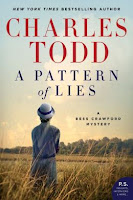
I was organizing Christian novels in a church library with a friend a few months ago when I noticed how many of the covers — the majority I would guess — had illustrations showing figures, in most cases women, from the back. Many of the illustrations were almost identical. They were attractive designs, yet all attractive in the same way. They all suggested mystery. Who is this woman? What does she look like? Where is she going? What is she thinking about? This is good, I suppose, but why did they all have to look the same?

It turns out I am not alone in noticing this book-cover trend. I recently visited Killer Covers, a website that shows and discusses paperback covers past and present. The Nov. 14 post, called "Bringing Up the Rear," shows a sampling of 59 recent covers showing the backs of figures, most of them walking away, often in darkness, in mist or in shadows. Many of these books are by authors of note, including Harlen Coben, David Baldacci, Charles Todd (most of Todd's Bess Crawford novels have covers like this) and John Le Carre.

This may be just a fad in the book publishing industry, something like using the word daughter or girl in a novel's title. Fads tend to burn out sooner or later. 

This fad may have staying power, however. Faces, like hands, are notoriously difficult for artists to draw realistically. With a rear view, both of these features can be avoided. And as I already noted, these images can be visually striking. They set a mood and hint subtly about the nature of the story inside. They also don't give too much away. That person looking away from us might be attractive or not, white, black or Asian. We all like to picture ourselves in a story. That is easier to do when we have no idea, at least until the author tells us, what this character looks like.

At some point, however, even publishers who prefer to follow each other may come to realize that these covers all look the same. Some art director with imagination may be encouraged to break the stereotype and give readers something different, something original. We can only hope so.