Friday, November 1, 2013

With wild hogs, rules do not apply

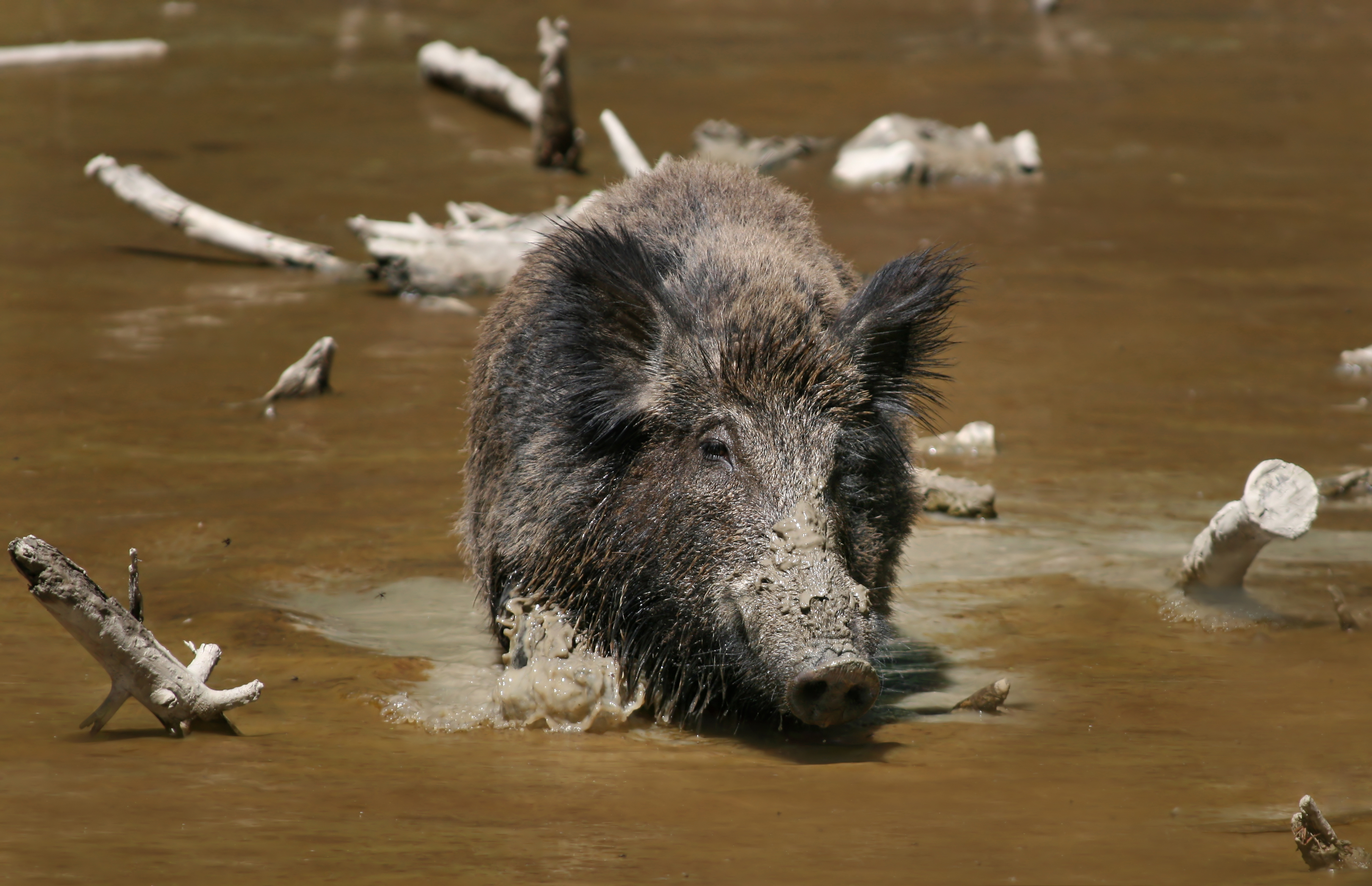
An article called A Plague of Pigs by John Morthland in the January 2011 issue of Smithsonian magazine caught my attention. Who knew there are as many as six million wild hogs in the United States and Canada, mostly in Texas? I was especially intrigued by these lines early in the story:

"Few purebred Eurasian wild boars are left today, but they hybridized with feral domestic hogs and continue to spread. All are interchangeably called wild or feral hogs, pigs or boars; in this context 'boar' can refer to a male or female. (Technically, 'feral' refers to animals that can be traced back to escaped domestic pigs, while the more all-encompassing 'wild' refers to any non-domestic animals.)"

Morthland, you'll notice throws in a lot of terms -- purebred, hybridized, feral and wild, for example -- and then says they all mean pretty much the same thing when you're talking about wild hogs. Even the word boar applies equally to both male and female wild hogs.

A Wikipedia article on the subject goes further: "The term 'boar' is used to denote an adult male of certain species, including domestic pigs. However, for wild boar, it applies to the whole species, including, for example, 'wild boar sow' or 'wild boar piglet.'"

I find it interesting that the author of the Wikipedia article refers to wild boar as a separate species, even though most of them, as Morthland writes, are either runaway domestic hogs or hybridized with the few purebred boars.

Even the words pig and hog seem to mean something different when talking about wild boar. In domestic agriculture, a pig becomes a hog when it reaches 120 pounds. Also in domestic agriculture, a boar is an uncastrated male. Among wild boar, however, all are boars, all are both pigs and hogs, all are both wild and feral and all, at least according to Wikipedia, belong to their own distinct species.

Wild hogs are apparently so wild that the usual definitions just don't apply.

Wednesday, October 30, 2013

Delusional reading

It's not necessary to read it immediately. Just having it on the shelf, the biblioholic is deluded into thinking, may help one grow intellectually.
Tom Raabe, Biblioholism: The Literary Addiction

I am not so certain this kind of thinking is limited to those of us who love books and crave more and more of them. Sports fans seem to believe that just wearing a jersey to a game makes them part of the team. Many students are convinced that just taking their homework home with them means it's as good as done. Some people think that owning an apron and a new set of pans makes them chefs or having a good set of tools makes them carpenters. Such illusions, it seems to me, are not that unusual.

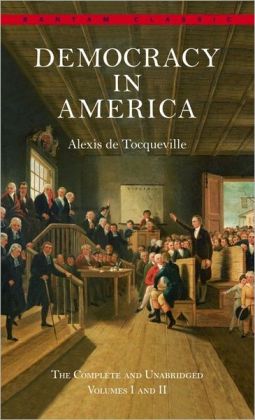
Yet book lovers are certainly not immune to this delusional thinking. If I am honest with myself, I must confess I own books, many books, I will probably never read, but I believe deep down that having them on my shelves somehow makes me smarter. Books like Alexis de Tocqueville's Democracy in America and St. Augustine's City of God certainly fit into this category. I have owned these books for decades without ever getting close to actually reading them. Most likely I never will read them. I feel better having them around anyway.

I have numerous other books that seem intellectually intimidating, dull or just massive, but at least I can look at them occasionally and feel more intelligent. Among these are The Slave Trade by Hugh Thomas (more than 800 pages long), Albion's Seed by David Hackett Fischer (900 pages about "four British folkways in America), Ruby V. Redinger's biography George Eliot: The Emergent Self and Witold Rybczynski's Looking Around: A Journey Through Architecture.

I read Lolita for a college class and again this year, so I know Vladimir Nabokov to have been a gifted writer. Even so I am put off by his other novels such as Pale Fire, Look at the Harlequins! and King, Queen, Knave. I usually pick up a murder mystery instead, preferring to get my Nabokov through some kind of osmosis.

Monday, October 28, 2013

Pausing during a murder mystery

Detectives all have private lives, but you wouldn't always know it by reading some mystery fiction. I'm thinking of Ross Macdonald's Lew Archer series, which reveals only sparse information about its main character. At the other extreme we have the novels of Alexander McCall Smith, which can be found in the mystery sections of most bookstores but in which the mystery is always secondary to the story about the detective, her friends and family.

Somewhere in the middle we find Milan Jacovich, hero of the terrific series of mysteries set in Cleveland and written by Les Roberts.Roberts keeps his focus on the mystery, yet there are frequent intermissions, usually just a sentence or two long, that remind readers Jacovich is a real, albeit fictional, person who isn't always chasing bad guys.

I reviewed the latest Milan Jacovich novel, Win, Place, or Die, last Friday, and I previously wrote about one of those "intermissions" in the story in my Oct. 11 post ("Scrabble, with coffee and tea"). Today I want to comment on two others, one I reacted to in a positive way and another I responded to negatively. First the one that bothered me:

"Hiram College came to being in 1850, thanks to the Disciples of Christ Church -- a liberal church back then, if anyone alive today even remembers those two words were sometimes used in the same sentence."

Now what do you suppose that means? The "two words" the author refers to are apparently "liberal church," a phrase that is probably heard as much today, especially in conservative churches, as ever. I'm a Presbyterian, a denomination still losing thousands of members yearly because so many people consider it a hopelessly "liberal church." Do a Web search and you will find plenty of references to "liberal Catholic Church," "How to Be a Conservative in a Liberal Church," etc. Roberts may not have heard the phrase "liberal church" lately, but that doesn't mean it's no longer in use.

Now here's a line from the novel I enjoyed: "Had two cups already," he said, a small lie; he'd had four cups of coffee and a cinnamon bun at Panera before he began his drive and had already stopped once at a McDonald's to use their facility on the way." This sentence actually refers to Jacovich's associate, K.O. O'Bannion, not to Jacovich himself, and it clearly has absolutely nothing to do with the mystery at hand. So why do I like it?

For one thing, I appreciate the details: four cups of coffee, a cinnamon bun, Panera and McDonald's. I also enjoy the phrase "use their facility." "Use the facilities" happens to be one my own favorite euphemisms, and when I stop at McDonald's while traveling, it is rarely to buy anything to eat. So I found this very amusing. It's an aside that humanizes the detective without boring the reader. After that sentence, Roberts returns immediately to the mystery. That strikes me as good writing.

Friday, October 25, 2013

Murder at the track

I have read quite a few of the 17 Milan Jacovich mysteries written by Les Roberts, but the new one, Win, Place, or Die (Gray & Company), is a bit different from the others I've seen. This time both the author and his hero need a little help.

This story is set in the world of harness racing, something Roberts concedes he knows nothing about. So he gives co-author credit to Dan S. Kennedy, a Cleveland businessman with a lifetime interest in the sport. As for the private investigator, Jacovich now has an assistant, K.O. O'Bannion, a brawny military vet. He has hired O'Bannion because he figures he's getting too old to take any more beatings or to sustain another concussion in the line of duty. So guess who gets beaten up and gets another concussion?

One of Jacovich's friends, Glenn Gallagher, a wealthy horse owner and sometimes driver, dies at the track right in front of the investigator. Gallagher has a history of heart trouble, so nobody suspects anything unusual and the body is cremated. Then Gallagher's son, a professor at Hiram College, begins to have doubts and hires Jacovich to snoop around at the track. He suspects his father may have been murdered. And since Jacovich wonders whether Gallagher, on the night of his death, had been about to hire him to look into something, he takes the case.

When a second death occurs at the track, this one much more suspicious than the first, Jacovich and O'Bannion know they must be on to something.

The novel is an enjoyable romp, even more so for anyone familiar with the Cleveland area. Roberts fills his story with numerous references to places, people and events that readers from northern Ohio will eat up.

The novel's title seems a bit lame, however, especially with such other great titles in the series as Full Cleveland, The Indian Sign and King of the Holly Hop. There have been several other mysteries with the same or a similar title, including one featuring Nancy Drew. Surely Roberts could have found something more original than Win, Place, or Die.

Wednesday, October 23, 2013

Book learnin' 4

Here are a few more things I've learned about our language lately.

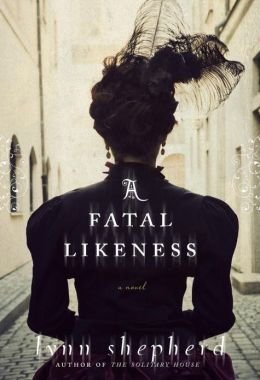
Deceit of lapwings: In Lynn Shepherd's novel A Fatal Likeness, Charles Maddox remembers as a boy asking his father why a gathering of lapwings was called a deceit. It seemed like such an awful word for such pretty birds. His father explains that the word had originally been desert, but that it had been corrupted over time to deceit. "Because parent lapwings will abandon their nest to lead predators astray -- protecting their young in the very act of appearing to forsake them." Of course, as Charles observes, that makes deceit also a very fitting term.

Penguin: Henry Hitchings explains in The Secret Life of Words that the word penguin is a composite of two Welsh words meaning "white" and "head." This is odd, he observes, because penguins have black heads.

Whisky: The Gaelic word usquebaugh was "viley corrupted" by the Saxons into the word whisky, A.J. Cronin writes in his memoir Adventures in Two Worlds. I have used the spelling of the word Cronin uses in his book.The Oxford American Dictionary tells me the word is spelled whiskey for American and Irish products, but whisky for Scotch and Canadian products. Cronin hailed from Scotland, although he lived a good part of his life in England and the United States.

Sleep tight: This odd expression, which so many of us have used, especially when putting children to bed, dates from the era of feather beds, which tended to sag to the point where they became a lot less comfortable than they looked. To correct the problem it was necessary to tighten the lattice of ropes under the bed. Bill Bryson reports this in At Home.

Tuesday, October 22, 2013

The Shelley mysteries

All historical novels are not the same. Most of them simply use history as a setting, giving their characters a particular time and place for their story. Sometimes authors weave real historical figures into their plots, usually just as minor characters, or attempt to recreate real historical events. Other historical novels actually engage history, sticking as close as possible to known events, while attempting to solve lingering historical mysteries.

Melanie Benjamin did this in her 2010 novel Alice I Have Been about the strange relationship between Lewis Carroll and Alice Liddell, the girl who became the model for Alice in Wonderland. Benjamin follows known history as far as it takes her, then fills in the blanks. The result is a story is still fiction, but it is convincing enough to at least stand a chance of being true.

Lynn Shepherd does the same kind of thing in A Fatal Likeness (Delacorte Press), a novel about poet Percy Bysshe Shelley and the women in his life, especially Mary Godwin Shelley and Claire Clairmont. Shepherd's novel doesn't stray far from what is known about these people and their turbulent relationships, but it does suggest possible answers to some of the lingering mysteries, such as whether two of then women in Shelley's life really committed suicide and whether the deaths of his children might have been murder.

To try to solve these mysteries, Shepherd invents two fictional detectives, or thief-takers as they would have been called at the time. One is Charles Maddox, a contemporary of Shelley's, who does an initial investigation but then gets a little too closely involved, and the other, years later, is his nephew, also named Charles Maddox, who is hired by Mary. She and Claire remain bitter rivals years after Shelley's death, and Maddox gets thrown into the middle of their conflict. He must also try to figure what his uncle, still living, learned but has remained silent about.

This is a complicated novel, often fascinating but sometimes just dull and confusing. Those with a keen interest in Shelley's life (the question of whether Mary Shelley or Shelley himself wrote Frankenstein is also addressed here) will be ones most rewarded by reading this novel.

Friday, October 18, 2013

Gone but forgotten

My home library contains an 1894 textbook by Mildred C. Watkins called American Literature. It's a tiny thing, smaller than a typical mass market paperback of today and just 224 pages long. Watkins writes in a preface that her objective was "avoiding on the one hand the verbiage of the larger manuals for schools, and on the other the prattle of the so-called first books for children. Brevity rather than condensation has been sought ..." Basically it is a literature primer unencumbered with actual literature, other than a few brief excerpts here and there.

One thing in American Literature that I found interesting is a chapter on "a group of minor writers." Watkins writes, "There is one common feature several writers of this period (before 1850) possessed: they did not fulfill the brilliant promise they seemed to give." In other words, they were popular in their own day but, by the end of the 19th century, were largely forgotten.

James K. Paulding
She lists three reasons for their fall into obscurity: 1) they were overrated to begin with, 2) they turned their attention to other things and 3) "we demand more to-day from writers than was demanded of them then." In other words, literary tastes change. Some writers, like Herman Melville, gain in reputation in the years after their deaths, while others fall into obscurity.

The writers Watkins mentions in this chapter, mostly poets, include James K. Paulding, Joseph Rodman Drake, Fitz-Greene Halleck, Samuel Woodworth, George P. Morris, Nathaniel P. Willis, Peter Parley, Washington Allston, John Howard Payne, Richard Henry White, Francis Scott Key and Clement C. Moore. Except for the latter two men, whom we remember for writing the Star-Spangled Banner and A Visit from St. Nicholas, respectively, these writers ring no bells with me.

Some of those Watkins mentions as significant writers in 1894 are, like Paulding, Drake, Halleck and the others, also mostly forgotten today. These include Bayard Taylor, Josiah Gilbert Holland, Helen Hunt Jackson, Margaret Preston, Frank R. Stockton and Edward Payson Roe.

In one chapter, Watkins discusses several then-contemporary novelists, admitting "it is hard to tells whose books will be read twenty or even ten years from now, and whose will be forgotten." Some she mentions, such as Henry James, William Dean Howells and Rudyard Kipling, are still remembered. Others, like F. Mason Crawford, Frank R. Stockton, Brander Matthews and Thomas A. Janvier have, in fact, been forgotten.

Having one's name on the cover of a book is no ticket to immortality, not even if that book happens to be a best-seller. Which of today's writers will still be remembered a few decades from now? As Mildred C. Watkins understood, there is just no way to know.