Thursday, September 17, 2015

Problem solver

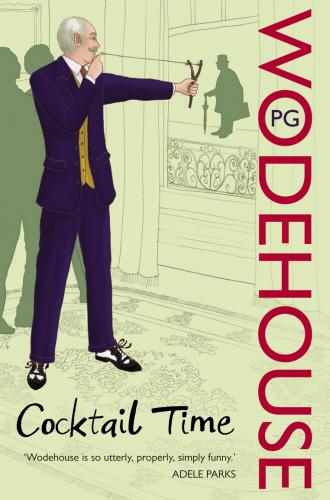
Cocktail Time, published in 1958 and relatively late in P.G. Wodehouse's career, may not rank among his best (make that funniest) novels. Even so, it tells a lively, satisfying story that true Wodehouse fans will enjoy.

The Earl of Ickenham, sometimes just called Uncle Fred, plays a supporting role in a number of Wodehouse novels, but in this one he gets the starring role. Essentially he plays the part Jeeves has in the Jeeves and Wooster tales, the genius who resolves all problems by the end of the story. But the earl is also the one who creates many of these problems in the first place when, to prove he can still handle a catapult as well as he could as a boy, knocks off the top hat worn by Sir Raymond Bastable, a grumpy barrister. Somehow this prompts Bastable to write a novel called Cocktail Time under an assumed name, not wanting to damage his career because the novel is something of a potboiler. He gets his nephew, Cosmo Wisdom, to take credit for writing the book, hoping the royalties from it will stop Cosmo from continually coming to him for money. Of course, the novel becomes a bestseller, with Hollywood offering big bucks for the movie rights.

Throw in a couple of con artists, a lovesick butler and a variety of other characters with seemingly unsolvable problems, and Uncle Fred has his hands full. His methods may seem unorthodox, such as suggesting the butler lock Bastable in his wine cellar, but somehow they all work.

The best part of any Wodehouse novel is not the story itself but the way Wodehouse tells it. Here are a couple of my favorite lines from the book:

"There was a brief pause while she seemed to contemplate the adjective, weighing it as Roget might have done if someone had suggested adding it into his Thesaurus."

"There's nothing like getting married. It's the only life, as Brigham Young and King Solomon would tell you, if they were still with us."

Wednesday, September 16, 2015

The right word

One night during my college days I had the opportunity to escort two coeds back to their dormitory. Along the way we met a mutual friend, who inquired what we were up to. I replied that I was simply "walking these ladies to their lair." I'm sure it was the alliteration that drew me to that particular choice of words, which got a laugh and an expression of mock offense from the girls. At least I hope it was mock offense. At any rate we remained friends.

A lair is defined as a den for animals or a hideaway, so maybe it was not the precise word for the situation. Yet it worked, I think. It turned an ordinary statement into something memorable, or at least memorable to me. This happened about 50 years ago.

Early in the Michael Cox novel The Glass of Time, there is a line that goes, "If she has suffered, well, there is suffering enough in the world, and we shall each have our share before we are released." It was the word released that caught my attention. It's not the word one would expect, not a synonym most of us would choose for dead. But it works, turning a routine sentence into something a little thought-provoking.

In another novel I am currently reading, Raymond Chandler's The Big Sleep, I was drawn to this sentence: "Another army of sluggish minutes dragged by." In that simple sentence of just seven words, at least three of them -- army, sluggish and dragged -- jump out at you. You could say the sentence is not just redundant but doubly so. Virtually every word in the sentence says the same thing, that Philip Marlowe is waiting a long time. Yet the metaphor he creates of a tired army of minutes is so much better than simply writing, "I waited a long time."

At the Country Music Hall of Fame in Nashville, which I visited last weekend, there is a display of lyrics of notable songs as they were originally written down on paper. These lyrics are greatly enlarged. I noticed that when Kris Kristofferson wrote down the words for Help Me Make It Through the Night, he first wrote the line, referring to the woman's hair, "shake it free and let it fall." But he crossed out free and replaced it with loose. It was just a small change, yet an important one that made the song better and all the more memorable.

Whether we are speaking or writing, small word choices can make a big difference.

Tuesday, September 15, 2015

Booking and picking in Nashville

My wife, a big fan of American Pickers on the History Channel, wanted to visit the Antique Archaeology shop in Nashville, hoping to catch a glimpse of Mike Wolfe. I wanted to stop at Parnassus Books, the shop co-owned by author Ann Patchett, although since I had seen Patchett a couple of times before, in Florida and in Ohio, spotting the novelist was not a high priority. Good thing because she, like Wolfe, was absent that day. Wolfe, it turned out, was in Ohio, which is where we had come from.

Since we were in Nashville anyway, we also saw the Grand Old Opry, toured the Country Music Hall of Fame and, yes, cut our own country record which, if you're lucky, you will never hear on the radio. It was good we included these other things on our agenda because our stops at Antique Archaeology and Parnassus Books took about an hour and a half total of our six-day vacation.

I loved the bookshop, which was smaller than I expected but has a wonderful assortment of books, especially in its fiction and biography/autobiography sections. I was surprised to find none of Patchett's own novels on the fiction shelves, but it turned out that her books have a section to themselves in the front of the store, each book already signed by the author. I bought two paperbacks there, Nick Hornby's Ten Years in the Tub: A Decade Soaking in Great Books and American Mirror: The Life and Art of Norman Rockwell by Deborah Solomon.

The store was busy on an early Sunday afternoon, mostly with female clientele. While not unfriendly to men, and with many books that appeal primarily to male readers, the store nevertheless has the feel of a bookstore with female ownership. This atmosphere alone may be what draws women to the shop and, apparently, keeps men away. Of course, this being a Sunday afternoon in September, the men may have been watching football.

Although we did not see Patchett in her store, we were greeted at the door by her dog. Cats in bookstores are a common sight, but finding a dog, one that mingles with customers and doesn't chew the merchandise, helped make it a pleasant experience.

Tuesday, September 8, 2015

More than a pretty face

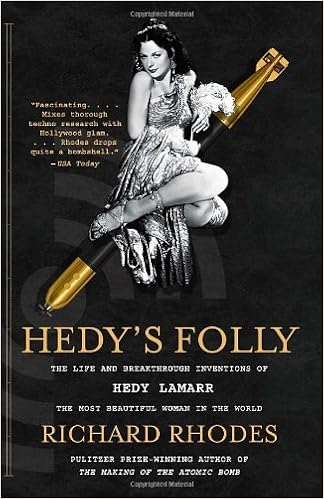
Hedy's Folly has a terrific title, a terrific cover illustration and terrific subject matter, the contributions to science, technology and the U.S. military by glamorous actress Hedy Lamarr. Unfortunately, the book itself, by veteran author Richard Rhodes, fails to be terrific. It is, at best, so-so.

Partly this is because, while this may seem to be a Hedy Lamarr book, there isn't as much about the actress as one expects. In truth, Rhodes is only being fair. Lamarr's inventions became military secrets and were hidden for many years. When they did become public knowledge, Lamarr received most of the attention even though George Antheil, one of America's most significant composers of the 20th century, played an equal role in these discoveries. According to Rhodes, Lamarr came up with the ideas, while Antheil provided most of technological expertise. He had earlier experience synchronizing player pianos, and from there he moved on to synchronizing torpedoes and guidance systems. So, yes, Antheil deserves as much attention as he gets in this book. Even so, it's a little like going to a Hedy Lamarr movie and discovering that it mostly stars Victor Mature.

Then there's all the technical detail in the book. I discussed Hedy's Folly last week with my last surviving uncle, a retired NASA engineer. He is someone who would probably love all this detail. Most of us, however, want more Hedy stuff, and less heady stuff.

Hedy Lamarr was an inventor for most of her life, much longer than she was an actress. Rhodes says she worked on ideas for a new design of the Concorde airliner, for a fluorescent dog collar and for a device for helping disabled people get in and out of the bathtub. Not bad for someone who quit school when she was 16

Monday, September 7, 2015

History's turning points

History, defined broadly, means everything -- literally, everything -- that has taken place up to now. To study history, one must somehow break it down or organize it such a way that it makes sense. This can be done in any number of ways. One common way is to examine history by following the most significant individuals, such as Alexander the Great, Julius Caesar, Napoleon, etc. You can study English history by looking at the English monarchs or American history by looking at the presidents.

You can also study history by geographical area, by period (such as, in the United States, the antebellum period, the Civil War, Reconstruction, etc.) or by wars. When I took American history in high school, I got the impression history was primarily the study of war (the French and Indian War, the Revolutionary War, the War of 1812, the Mexican War, the Civil War, etc.) The periods between wars seemed somehow like intermissions.

So I have been interested in listening to Turning Points in American History taught by Holy Cross professor Edward T. O'Donnell, a part of the Great Courses series. He views American history according to 48 turning points where events, instead of continuing in one direction, set off in a new direction. To me, this is a new and lively way of looking at history.

O'Donnell makes it clear, unlike traditional histories, that ordinary Americans, not just major figures, shape history. The migration of Americans out west because of the Homestead Act or of freed slaves to the North after the Civil War played a key role in making the country what it is today. Today being Labor Day in the U.S., O'Donnell's lectures on the labor movement need to be mentioned.

He has relatively little to say about America's wars. He considers the battle of Saratoga the turning point of the Revolution, and the Battle of Antietam the turning point of the Civil War, so those are the battles he talks about. George Washington was not at Saratoga, and Ulysses S. Grant was not at Antietam, so these two generals, credited in most histories with winning these wars, get very little attention here. World War I is hardly mentioned at all, and Word War II is covered in a discussion of the Battle of Midway, although another lecture focuses on the Manhattan Project.

Meanwhile, some developments that have been ignored in broad histories of the country get lectures of their own here. These include the invention of baseball and the defeat of hookworm in the American South.

There may be no ideal way to teach history, but I think this professor has hit on a strategy that covers a lot of ground in a way that, at least for this student, makes history fascinating.

Friday, September 4, 2015

Communication by lunchbox

Watching the superb Indian film The Lunchbox again the other night, I wrote down two of the best lines from the movie. The key line, said twice, has to be, "Sometimes the wrong train will get you to the right station." That seems fitting for a story about the wrong lunchbox that goes to the right man.

But I like the other line just as much: "I think we forget things if we have no one to tell them to." The lonely widower, about to retire, writes this to the lonely young mother, ignored by her preoccupied husband. The lunchbox she packs every morning for her husband is being delivered to the other man by mistake. The notes they exchange in that lunchbox give this man and woman, strangers to each other, an avenue for expressing their thoughts, feelings and the everyday experiences of their very different lives.

Our communication with spouses, friends and sometimes even strangers fills a deep need to express ourselves, to document our lives and, yes, help us remember those things that are important to us, however unimportant they may be to everyone else. It helps just to put things into words. I find dreams easier to remember if I can put them into words as soon as I wake up. If I can tell my wife about my dream, it becomes more fixed in my memory. Otherwise even the most vivid dreams are quickly lost.

The phenomenon of texting, something I have never engaged in, may be explained by this compulsion of people to express to someone the details of this lives. Blogs, something I do engage in, may serve the same function. Once I write in my blog about something that has been on my mind, I feel somehow relieved. It is like scratching an itch, as I told a friend recently.

If telling someone things helps us remember them, it may also, sometimes, help us forget them. Doesn't that help explain our desire to describe our feelings of grief, depression and suffering to others? It is not that we want to remember these things, but rather to get past them, to forget them. Telling someone else, whether that's a friend, a counselor or a stranger getting the wrong lunchbox, somehow helps.

Wednesday, September 2, 2015

Dickey delivers

Rarely can poets make a living writing poetry. Edgar Allan Poe wrote short stories and edited literary magazines, but still lived in poverty. Carl Sandburg wrote a popular three-volume biography of Abraham Lincoln to pay the bills. Many modern poets teach either literature or creative writing classes. James Dickey (1923-1997) wrote one of the best thrillers of the 1970s, Deliverance.

Earlier Dickey taught composition at Rice and wrote copy for an advertising agency. Of the latter he once said, "I was selling my soul to the devil all day ... And trying to buy it back at night." Dickey later used his experiences in advertising to create the character of Ed Gentry, the narrator of Deliverance.

Ed, an advertising artist,  is one of four city men who decide to canoe down a wild Georgia river before it is dammed and turned into a lake. Except for the macho Lewis, the men lack outdoor skills, although Ed has some experience with a bow. Yet when he has a chance to shoot a deer, he fails to make the kill.

Their canoe trip turns violent when when two backwoodsmen sexually assault Bobby and Ed. The assault is interrupted when Lewis sneaks up and kills one of the men with an arrow, while the other escapes. Drew argues they should report the assault to the authorities, but Lewis convinces the others that would be a mistake. They decide to bury the body and continue down the river.

Later Drew and Lewis fall out of their canoe in the rapids. Lewis breaks his leg and insists Drew was shot. (His body is later found, but even then they can't tell if he was shot or not.) In case there is a sniper on the cliff, Ed climbs it during the night and, at morning light, kills a man with his bow, although injuring himself in the process. Is the dead man one of those who assaulted them or just an innocent hunter? Moral ambiguity fills this powerful story, and it is the one thing, Ed finds, from which there is no deliverance.

I returned to Dickey's novel after an absence of more than 40 years and found its impact just as powerful as it was back in the early 1970s. It really doesn't read like the work of a poet just trying to make a buck.