Wednesday, July 31, 2013

A recipe for good writing

Writing, like cooking, can by fairly basic. A sentence like "See Dick run" is like pouring a can of soup into a pan, adding water and putting it on the stove. A more sophisticated piece of writing, say John Steinbeck's Grapes of Wrath, is more like making soup from scratch, using whatever ingredients happen to be on hand. Good writing uses ingredients from various sources, including the writer's own experiences and memories, to create something unique.

Do you remember in high school how your teachers told you to write an essay using at least four or six sources, or whatever. Most students in my era just wanted to go to the World Book and paraphrase what they found there. If you followed instructions, however, melding together the information you found in these various sources, you probably came up with the superior essay. It was, at least, original.

I wrote newspaper editorials for many years. My worst editorials were those based on just one article, usually one appearing in the previous day's edition. The editorial would paraphrase the information in that story, then tack on an opinion. This was not much better than paraphrasing a World Book article. Much better was when I used information from a variety of sources, perhaps even stories that were printed a year or more previously. Some of my favorite editorials were those citing two seemingly unrelated recent news stories and then finding some common thread between the two.

The psalmist who wrote, "The Lord is my shepherd, I shall not want," could have simply said, "The Lord gives me what I need," but it wouldn't be the same. So many people would not have memorized the 23rd psalm or want to refer to it in times of crisis. The metaphor of a shepherd and his sheep, probably rising out of the writer's own experience, turned a simple idea into a literary and spiritual masterpiece.

Writing involves taking a little of this and a little of that, tossing it into a pot and seeing what develops. It doesn't always taste good, and but it will always be original.

Monday, July 29, 2013

The language of the street

It's ridiculous to write a book in a language you don't understand.
Lyndsay Faye at a New York City book signing for The Gods of Gotham

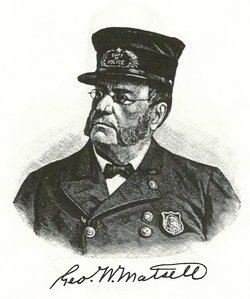
George Washington Matsell was notable in mid-19th century America for two things: 1) He was the first chief of the New York City Police Department. 2) He wrote a book called The Secret Language of Crime: Vocabulum, or the Rogue's Lexicon.

His book amounted to a lexicon of flash, an underworld slang term meaning "underworld slang." Matsell thought his fledgling police force might have more success arresting criminals if they understood what criminals were saying.

Lyndsay Faye, a former actress, makes both Matsell and flash important elements in The Gods of Gotham, her 2012 novel about the origins of New York's police. Matsell is not the book's main character, however. That role falls to Timothy Wilde, a bartender whose wilder brother, Valentine, talks into taking a job with the newly forming police force. Tim has his doubts about his new job, yet it soon develops that he alone among the recruits possesses any natural ability to solve crimes.

Tim's first big case is a lulu. He finds a little girl in a bloody nightdress running through the streets. The story she tells leads to the discovery of numerous bodies of children, The new cop risks everything to find out what happened to these children, wherever the trail might lead.

Faye uses flash extensively in her novel, making it difficult reading at times. Fortunately she places her own lexicon, based on Matsell's, at the beginning to help readers better understand what's going on. Here are some excerpts from the lexicon:

BAT. A prostitute who walks the streets only at night.
DIARY. To remember.
EASY. Killed.
HICKSAM.  A countryman; a fool.
HUSH. Murder.
JABBER. To talk in an unknown language.
MAZZARD. The face.
MOUSE. Be quiet; be still.
PEPPERY. Warm; passionate.
QUEER. To puzzle.
STOW YOUR WID. Be silent.
TOGS. Clothes.

Faye admits she wrote The Gods of Gotham without understanding the language her characters were using. Readers don't need to understand it either to enjoy this novel, which was nominated for an Edgar Award. In fact, you may find you already understand many flash terms. As Faye explains in an afterward, many of these terms found their way into the language most Americans speak today.

Thursday, July 25, 2013

The Tucker Coe subsidiary

On the dust jacket of Tucker Coe's 1972 novel Don't Lie to Me it says: "A self-made conglomerate, TUCKER COE is a subsidiary of a writer better known to most readers under a different name, perhaps his own."

That "different name" is Donald E. Westlake, who died in 2008 after writing more than 100 books, mostly crime novels and mostly under his own name. Among his many other "subsidiaries" were Richard Stark (the popular Parker novels), Samuel Holt, Alan Marshall,  Edwin West, Curt Clark, John Dexter, Andrew Shaw, Barbara Wilson, Timothy J. Culver, J. Morgan Cunningham, Judson Jack Carmichael and John B. Allan (a biography of Elizabeth Taylor). All those pen names allowed Westlake, always a prolific writer, to have more than one new book in stores at the same time, all with different publishers. It also gave him more opportunity to write different kinds of novels, everything from soft porn (in his early Alan Marshall period) to hardboiled crime (the Richard Stark novels). Under his own name he mostly wrote comic crime capers, such as the Dortmunder series.

The Tucker Coe novels had a hero, Mitch Tobin, on the right side of the law, which was a bit unusual for Westlake. Tobin is an ex-cop working as a private investigator, which made him very much like any number of other fictional heroes operating in the 1960s and '70s. This may be why Westlake lost interest Tobin after only five novels.

Don't Lie to Me, the last of the series, is always entertaining. Tobin is working as a night watchman at a museum when he discovers the body of a nude man in one of the galleries. Anyway, that's what he tells the police. The real story is that he has a woman with him at the time, his former lover named Linda, who has come to see him to enlist his help in keeping her husband straight after his release from prison. Tobin doesn't want Linda to get involved in a murder investigation, and he also doesn't want his wife to find out he is seeing Linda again.

While the cops, who know Tobin is lying, and a gang of criminals, who want Linda's husband to work with them, are both out to nail him, Tobin reluctantly solves the murder himself.

This is a short, fast-moving tale that makes one wish the Mitch Tobin subsidiary had lasted longer than it did.

Tuesday, July 23, 2013

Really devoted to awesome sausages

"You can't apply the word devoted to a sausage."
Ben to Kate in The Matchmaker of Kenmare by Frank Delaney

There aren't many light moments in Frank Delaney's novel, but this is one of them. Kate says, "I have become devoted to frankfurters," and Ben takes exception to her choice of words. "Devoted suggests a spiritual dimension," he argues.

And, indeed, the word once did suggest a spiritual dimension.Gradually, like the almighty dollar, the word became devalued until it could also be applied to one's country, one's lover, one favorite baseball team and, at last, sausages.

Many words have similarly become devalued with the passage of time. Awesome once referred to something that inspired awe, such as God, a cathedral, the heavens on a clear night or the Grand Canyon. Now anything, including unusually tasty frankfurters, can be described as awesome.

This probably has a lot to do with why the English language has so many synonyms. New words must be created to replace other words that have lost their value. Consider all the words for big: large, huge, great, gigantic, enormous, mammoth, etc. If you can describe a hamburger as enormous, then how do you describe a bull elephant? You need a different word. Thus we get words like ginormous entering the language.

After the events of 9-11, words like horrible and terrible seemed inadequate, even though they mean "inspiring horror" and "inspiring terror," and thus should have been perfect. So horrific became the most popular adjective in the new century. Already that word has lost its power through over use, and it will seem inadequate for the next great tragedy.

Rather than constantly discover new words, one option is to employ words like very and really to describe our descriptive words. Thus we often hear phrases like very awesome, really devoted or extra extra large. Perhaps after the next great tragedy, someone will call it "really horrific." That may have to do until the right word comes along, however temporarily
.

Monday, July 22, 2013

The perfect restaurant in my mind

Most of us sometimes fantasize about opening our own restaurants, but these fantasies take different forms with different people. Those who know their way around a kitchen probably think about menus. What cuisine will they offer? What dishes will they serve every day, and what might their daily specials be? Those with a gift for decorating will think about decor. What will their restaurant look like? Should they line the walls with antiques, teddy bears, movie posters, works of art or what? And what might they do to make the dishes they serve look especially appealing? The music-minded will imagine the live music they will present on Friday and Saturday nights. Would a karaoke night attract more customers than it will chase away? What kind of background music should be playing?

As for me and the perfect restaurant in my mind, I think about what my staff will say to diners or, more to the point, what they won't say. Here are some words and phrases that would be outlawed in my restaurant:

I'm (...) and I'll be taking care of you. Taking care of customers is the server's job. Why is it necessary to announce it? It's like the custodian saying, "I'm Harvey and I'll be emptying your waste basket." Most servers wear name tags, so introductions are not needed.

You guys. The waitress serving the family in the booth next to ours at Denny's yesterday managed to use the phrase "you guys" three times in her first three sentences. I can see why women would be offended at being called guys, but guys should be offended, too. The phrase is both too familiar and too slangy. It's also unnecessary. The Denny's waitress could have simply said, "I'm sorry you had to wait." She didn't need to say, "I'm sorry you guys had to wait."

Enjoy. The other day a waitress placed my food before me and said, "I hope you enjoy your meal." I actually liked that. It even sounded sincere. Most servers, however, just say the word enjoy, then walk away. I sometimes feel like tossing a dinner roll at their backs. A server need say nothing more than, "Will that be all?" Then just walk away and let the diners enjoy their meal in peace.

Let me take this out of your way. Just take the dirty plates out of the way. Again, servers don't need to make an announcement. Many servers seem to think they are the main attraction at the restaurant. They're not. The food is, and perhaps the atmosphere. Servers are there to serve, not to call attention to themselves. If anything needs to be said before taking plates away it might be "Are you finished?" or "Would you like a box?"

I will be your cashier. There's no hurry. Whenever I hear the phrase "There's no hurry," I'm reminded that there is a hurry and that management probably wants my table for other customers. Most customers already know they are entitled to remain at their table and converse for as long as they wish (whatever management may desire). Sometimes it's good to be told how to pay the check, although a few words on the check itself would clarify that.

Although I think servers should say less, I would be satisfied if they just didn't sound like they were all following the same script. Another waitress at Denny's yesterday complimented a little boy on his good manners. Never mind that the boy had been running around his table throughout most of the meal, the proud look on his mother's face told me the waitress had said the right thing. It wasn't in the script.

Friday, July 19, 2013

Reporters and writers

The best journalists are those who are both skilled reporters (able to dig out information, develop trusted sources and persist until the story is complete) and capable writers (able to turn facts into prose that people will read with pleasure and understanding). Not all journalists, as I noticed during my more than 40 years in the business, possess both skill sets in equal measure. Some are better reporters than writers; others are better writers than reporters. Too introverted to be a first-rate reporter, I always considered myself more of a writer.

At a Chautauqua performance in Ashland, Ohio, last week I heard Karen Vuranch perform as Hollywood gossip columnist Louella Parsons. "I don't care about grammar," Parsons said during the presentation. "I care about the story." She was a reporter. She got scoop after scoop. Getting the story and getting it first was what mattered to her, not grammar nor even proper word choices. She called herself "Mrs. Malaprop." William Randolph Hearst ordered his editors not to edit his star reporter, so her Malaprops, poor grammar and misspellings often made it into print. She didn't care as long as her facts were right.

When. fresh out of college, I worked for The Messenger in Athens, Ohio, back in the 1960s, and one of my colleagues was a middle-aged woman in Point Pleasant, W.Va., named Mary Hyre. She was an atrocious writer, and when her stories came through those of us in the newsroom would often read aloud some of her sentences and get a good laugh. It was my job to turn her jumbled stories into something printable. I still have a box full of Mary's original copy that I sometimes look through with amusement. Yet she seemed to know everyone in Point Pleasant, and there wasn't much that happened in that town that she didn't know about. She could cover the big stories (like the Silver Bridge disaster and the infamous Mothman sightings that they made a movie about a few years ago) and events like bake sales with equal enthusiasm. I may have been a J-school graduate who knew how to write a decent sentence, but I had no doubts about which of us was the more valuable Messenger employee. I would have been easy to replace, as I was within two years, but finding another Mary Hyre would have been difficult.

Some journalists fall at the other extreme. Mark Twain was like that. He got his start working for a newspaper, but his stories often turned out to be fanciful. Many of these stories, such as The Celebrated Jumping Frog of Calaveras County, are still read today. He was a writer, not a reporter.

Joe Eszterhas and I were both freshmen when we started working together on The Post, the Ohio University student newspaper, on the same day in the fall of 1962. He went on to become editor. I remained a reporter. Joe's long and richly detailed stories drew a lot of attention, but he was one of many reporters about whom it has been said that "he never let the facts get in the way of a good story." He worked briefly for The Plain Dealer in his hometown of Cleveland, where inaccuracies in a story he wrote about that same Silver Bridge collapse led to a U.S. Supreme Court decision against him and The Plain Dealer. After a stint at Rolling Stone, Joe, like Louella Parsons, ended up in Hollywood. He put his vivid imagination to work on screenplays for such movies as F.I.S.T., Jagged Edge, Flashdance, Basic Instinct and Showgirls.

The best journalists may be those who are both good writers and good reporters, but Louella Parsons, Mary Hyre, Mark Twain and Joe Eszterhas are all testimony to the fact that one can be mostly one or the other and still find success.

Wednesday, July 17, 2013

A tall tale

There are no leprechauns in Frank Delany's The Matchmaker of Kenmare. Even so it qualifies as an Irish tall tale. Narrator Ben McCarthy, also the hero of Venetia Kelly's Traveling Show, works as a folklorist. He travels about the Irish countryside in the early days of World War II collecting folk tales. While investigating the work of matchmakers, he meets Kate Begley, a young woman who is learning the business from her grandmother.

Ben becomes smitten with Kate, but there are a couple of problems. First, if you've read the earlier novel you'll know that he is married to actress Venetia Kelly, who has disappeared. While Ben roams the countryside, he continues his search for his missing wife. Second, while Kate likes Ben, she loves a dashing American officer named Charles Miller, and she enlists Ben's help as she tries to make her own match with him.

Amazingly, Ben goes along with Kate's plans, which soon involve sneaking into occupied France to kidnap a German officer and bring him back to Ireland. Before the war, Kate had found a wife for the German, who it turns out is only too happy to be rescued from the war and taken back to neutral Ireland. Upon returning with her prize for Charles, he agrees to marry her. Then he leaves for the war.

Soon Kate enlists Ben's aid once again. Charles, who has earned the nickname Killer Miller, is missing in action and presumed dead, but Kate remains convinced he is still alive. She and Ben return to France and go behind enemy lines to look for him. I don't know which is harder to believe: that a woman would venture into a war zone to find her husband to bring him home with her, that another man (who also loves her) would help her or that members of the underground would put their lives at risk for such a crazy scheme.

The search for Charles (and Venetia) continues even after the war's end and takes Ben and Kate to America, where they travel halfway across the country in the company of a giraffe. I said this was a tall tale.