Thursday, August 29, 2013

Amateurs in love

Stacy Horn, whose new book Imperfect Harmony I wrote about Wednesday, observes that not being a great singer has its advantages. She writes, "According to the study titled 'Does singing promote well-being?' the amateurs in the study experienced a heightened sense of joy and well-being following singing lessons. The professionals did not."

She quotes Tony Bellomy, an associate conductor, as telling her, "Amateurs don't have the hang-ups of full-on professionals. It is easy for professionals, me included, to get wrapped up in music as a job. This will kill the music faster than anything. Serious amateurs never seem to cross that line. It's because they are participating in music purely out of love for it."

And that, it turns out, is exactly what the word amateur means. The Latin word for love is amare. From this we get such words as amiable, amorous, paramour and, yes, amateur. Mark Forsyth, author of Etymologicon, writes that 150 years ago you could write that you were "not an amateur of melons" and others would understand you to mean that you didn't like them.

Forsyth also explains why in tennis the word for nothing is love. "Love is nothing because those who do something for the love of it do it for nothing. For example, people either marry for money or connections, or for love. Love therefore became a synonym for nothing, because if you do something purely for love, you get nothing."

Many people, of course, love their jobs. You sometimes hear people say, especially upon their retirement, that they would have worked for nothing because they loved what they did. Chances are, however, they would not have shown up for work every day so faithfully if they had not been paid for it. On any given day, there can always be something we love more, such as an extra hour in bed, than going to work, no matter how much we love our jobs. Professionals must show up whether they feel like it or not.

Those who sing, play baseball, marry or whatever else purely for love bring something to it that those who do it for money cannot.

Wednesday, August 28, 2013

Singing together

The melodies Verdi gives us (in Requiem) make it impossible to sing it any other way. But you don't get the full effect until all the different voice parts are singing together. The sweetness that Verdi wrote to embody such an important request as forgiveness and mercy comes from the harmony. No one voice alone can produce this sound.
Stacy Horn in Imperfect Harmony

These lines from the last page of Stacy Horn's Imperfect Harmony: Finding Happiness Singing with Others (Algonquin, $15.95) nicely sum up the message in her book. Singing together with other people, not alone in the shower, makes all the difference.

Horn, a middle-aged New Yorker, confesses to being an atheist, yet every week she walks several blocks to sing some of the greatest choral works of Christendom with the Choral Society of Grace Church. She has been doing this for a number of years. "Singing," she writes, "is the one thing in my life that never fails to take me to where disenchantment is almost nonexistent and feeling good is pretty much guaranteed." Maybe she doesn't always believe what she's singing about, but, she says, "I believe in singing." Elsewhere she writes, "Singing is the ultimate communion."

She cites research showing the benefits of singing to mind and body. She interviews other singers, as well as composers and choral leaders. Mostly, however, she writes about her own experiences and the joy she feels each time she sings with other people.

Horn admits to not being among the best sopranos in her choir. She says, however, that singers don't need to be great to make great music together. As evidence of this, she points to the Virtual Choir, the brainchild of composer Eric Whitacre. Thousands of people from around the world submit videos of themselves singing one of Whitacre's compositions, and the voices are combined into some intensely beautiful music. Nobody is turned away because of an inadequate singing voice. Imperfect voices blend into perfect harmony. Check out Virtual Choir 4 video on YouTube to see for yourself.

Monday, August 26, 2013

Books I forgot I owned

For the past year I have been gradually cataloging my books on LibraryThing, a site that allows members to compare their libraries, share reviews, chat and, in general, waste time that could be better spent reading. Lately I've been getting down to the bottom shelves and the bottom of stacks, discovering books I haven't seen in years and, in many cases, didn't even remember owning. Here are a few of those forgotten books:

K. Jason Sitewell's Book of Spoofs (1989) -- K. Jason Sitewell may have actually been Norman Cousins. At any rate, Sitewell used to write outlandish letters to the Saturday Review, such as one denouncing a bill in Congress that supposedly would have abolished golf. My notes in the book indicate that I once read it, but I don't remember it at all.

Somebody Else Is on the Moon by George H. Leonard (1976) -- Leonard, who according to his bio once worked for the government in unnamed federal agencies, reports that our government is withholding evidence of alien life on the moon.

Extraterrestrial Civilizations by Isaac Asimov (1979) -- Speaking of aliens, Asimov analyzes the chances of finding intelligent life on other planets. He likes those chances.

If No News, Send Rumors: Anecdotes of American Journalism by Stephen Bates 1989 -- One of the stories Bates tells is about John F. Kennedy (yes, that John F. Kennedy) covering the British elections for the International News Service in 1945. He predicted Winston Churchill's Conservatives would lose. William Randolph Hearst ordered Kennedy to change his article to predict a Conservative victory. He did. The Conservatives lost.

Art and the Accidental in Anne Tyler by Joseph C. Voelker (1989) -- I'm an admirer of Anne Tyler's novels, but I didn't remember owning a book of critical commentary about her early work. I must read this one day.

Strictly Personal and Confidential: The Letters Harry Truman Never Mailed (1982) -- In one of those letters Truman never mailed, he wrote, "I read your telegram of the tenth with a great deal of interest and outside of the fact there isn't a true statement in it, it is an interesting document."

Everybody's Dowser Book by Ona C. Evers (1977) -- This self-published, illustrated 70-page book tells hows to use anything from metal coat hangers to Y-shaped branches to find underground water. My dad used to use L-shaped wire to find the drainage pipe in his field, so I'm not going to knock dowsing, but I never tried it myself.

Man the Unknown by Alexis Carrel (1935) -- I must have once read a little of bit of this one-time bestseller. Inside I found my wife's college ID card that I had apparently used as a bookmark.

Friday, August 23, 2013

Coining new words

Anyone can create a new word. The trick is getting anyone else to use that word.

Toddlers unintentionally invent new words all the time. Forty years ago my toddler son had trouble saying Fritos. It came out friggy-toes, obviously a confusion with piggy-toes. Some corn chips do look a little bit like a baby's toes, don't they? I know parents are supposed to teach their children language, not the other way around, but we thought friggy-toes was so cute that we all started using the word. It was soon shortened to friggies. All these years later, I still sometimes refer to corn chips as friggies, but I am the only one who does. When I die, that word is likely to die with me.

Two factors may be most important in the acceptance of a new word.

1. Need. When a new word is needed, a new word is found.

Edward Fischer, anthropology professor at Vanderbilt University, tells of a tribe that at one time applied the same word to all metal objects. Whether they were talking about a tin box, a knife or an airplane, they called each of them the same thing. This didn't last long, however. As they encountered more and more metal objects, they quickly found a new word for each of them.

In our own culture, new technology also requires new words. Words like texting and blog were coined over the past few years because technology made them necessary.

2. A prominent sponsor. When it comes to coining words, some people obviously have more influence than others.

This includes anyone who invents or discovers something new. Naming rights is usually one of the perks that goes with being an inventor or discoverer.

Major publications like the New York Times and Time magazine can give a major boost to new words. If they use them, others will starting using them, too.

Important writers whose work is widely read can have a major influence on language, although this is probably not as true today as it once was. William Shakespeare introduced hundreds of new words into the English language. These include cranny, lonely, summit, radiance, majestic, hint, frugal and brittle. Scholars have said that as many a a tenth of all the words in Shakespeare's plays and sonnets cannot be found in earlier written material.

The poet Percy Bysshe Shelley died at 29, yet in his short life he introduced an amazing array of new words. These include bloodstain, moonlit, steamship, expressionless, undefeated and interestingly, among many others.

Thomas De Quincey, best known for writing Confessions of an English Opium Eater, also brought a number of new words into the language, among them subconscious, incubator, postnatal and intuit.

The Oxford English Dictionary credits Horace Walpole with originating 233 words. These include boulevard, bask, somber, caricature, malaria and beefy. Of course, Walpole had a few duds, too. He also suggested greenth, gloomth and betweenity as new words, but they never caught on.

Betweenity? Personally, I think friggies is a better word.

Wednesday, August 21, 2013

Showing off

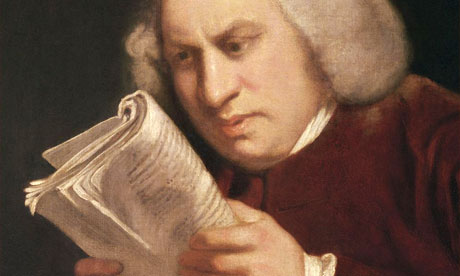
Read over your compositions, and where ever you meet with a passage which you think is particularly fine, strike it out.
Samuel Johnson, 1709-1784, citing a college tutor

Striking out the best passage is probably not the best advice one might give a budding writer. Most written work needs all the good lines it can get. I wonder how many of the great quotations found in Bartlett's wouldn't exist anywhere if all writers followed Samuel Johnson's advice. The particularly fine passages are the ones people remember.

Yet I do think Johnson, or his tutor, had a point. When I was working as a newspaper copy editor, I had to make stories fit into the available space. That often meant cutting out everything that wasn't absolutely necessary. On many occasions there would be one passage in the story that I thought was particularly fine. It might be a good metaphor, an excellent quote or just a nifty bit of description. More often than not, it seemed, that line or two had to go. It may have been fine writing, but it wasn't as necessary to the story as all the other lines.

Making this cut was especially galling when it was my own writing that I was trying to squeeze into the space.

Johnson was probably thinking of something else, however. This came to me while I was reading Stacy Horn's Imperfect Harmony, a book I hope to have more to say about within a few days. Writing about her own experience as an amateur composer, she says "there is the temptation to try to make your music too clever, coming up with all sorts of neat contrapuntal techniques, at the expense of what sounds musical (and what is fun and reasonable to sing!)."

What's true of composers is probably also true for other creative people. Have you noticed how many singers like to show off a little bit on the last line of the national anthem? Dancers may be tempted to throw in an extra fancy move and painters a little extra flourish to their work. Writers, too, sometimes like to show off. Some of those long, descriptive passages one often finds in novels are just writers showing off. Striking out such passages might, in many cases, improve the novel.

Reading over one's own compositions, it may be wise to remember Samuel Johnson's advice, and when you find a passage you are particularly fond of, ask yourself if it actually improves your work or if it is just showing off.

Monday, August 19, 2013

Cronin's Way

In the middle of the 20th century, A.J. Cronin was among the most popular novelists on both sides of the Atlantic. That's why you can find so many of his books at estate sales and Friends of the Library used book sales. Few people read him today, although copies of some of his best-known works (The Keys of the Kingdom, Shannon's Way and The Citadel) can still be found in some bookstores.)

His novels, if somewhat dated, remain worth reading, however, as does his memoir published more than 60 years ago, Adventures in Two Worlds. The "two worlds" of the title refer to the worlds of medicine and literature. He was a successful London doctor when his own doctor suggested he take an extended rest to recover from an ulcer. During that rest, he wrote a best-selling novel, Hatter's Castle, and never returned to the practice of medicine.

His memoir, if fascinating reading, is amazingly impersonal, as if he were just an observer to his own life story. You will find next to nothing here about his boyhood, his family, his friendship or his interests. If you want to know something about his life, including what the initials A.J. stand for (Archibald Joseph), you would be better off to look up his Wikipedia article.

Although Cronin turns philosophical and theological toward the end of Adventures in Two Worlds, his book is mostly a series of stories about the people he met during his life. Because he met far more people as a doctor than as a writer, that part of the book is both longer and more interesting. He writes, for example, about a young man he saved from a suicide attempt whom he met years later aboard an ocean liner and about a hermit known as Houseboat Tam who became ill and then ultimately married the woman who had agreed to nurse him back to health.

Some of his stories seem a little too creative for a memoir, as when he describes conversations that supposedly took place while he was absent. Adventures in Two Worlds could be described as a collection of short stories instead of a memoir with about the same degree of accuracy.

Friday, August 16, 2013

A funny man

While I was placing my order in a fastfood restaurant the other day, a woman stepped up to the counter beside me and almost immediately broke into loud laughter. When she finally brought herself under control, she explained, somewhat apologetically, that she had simply read the title of the book I was holding: Don't Vote: It Just Encourages the Bastards by P.J. O'Rourke.

I assured her that the book is even funnier than the title, which is a little surprising considering that it is a book about, among other things, foreign policy, global warming, the trade imbalance, terrorism, taxes and health care reform. Throughout his career, O'Rourke, who grew up near me in northwestern Ohio, has displayed a rare gift for making serious points with funny lines.

In fact, the Oxford Dictionary of Humorous Quotations, which I wrote about here a week ago, includes 38 O'Rourke quotations. This compares with such other notable wits as Woody Allen (28), G.K. Chesterton (14), Gore Vidal (22), Winston Churchill (25), Neil Simon (26) and Lewis Carroll (25). Mark Twain has 43 quotations in the book, but he's dead, while O'Rourke remains very much alive. Don't Vote alone has a line on practically every page that could bring the Oxford Dictionary of Humorous Quotations or Bartlett's calling before their next editions. Here are a few of them:

"Freedom of speech is important -- if you have anything to say. I've checked the Internet; nobody does."

"The best investment I've made lately? I left a twenty-dollar bill in the pocket of my tweed jacket last spring and I just found it."

"Assusing someone of being rich is like accusing someone of adultery in the Gospel of St. John. Let he who is without anything anybody wants cast the first vote."

"The best way to have a good political system is to avoid politics."

"You can remove morality from politics like you can remove the head from a chicken and they'll both keep going, politics much longer than the chicken."

"Government is so inefficient that it can't even get bribe-taking right."

That's P.J. O'Rourke out of context. In context, he's even funnier.