Wednesday, October 16, 2013

How to pretend to be intelligent

Obfuscation is power!
Tom Raabe, Biblioholism: The Literary Addiction

Tom Raabe is being a little facetious, but only a little. In his witty book Biblioholism, Raabe argues it's not enough just to own a lot of books. "You must be able to talk about them with a reasonable similtude to intelligence," he says. In other words, when discussing literature, it's not important that you actually be intelligent as long as you sound intelligent. Thus, obfuscation is power.

He offers what he calls the "Impenetrability Phrase Finder" to aid his readers in sounding intelligent when talking about books. You take, at random, one word from column one, one from column two and one from column three. String them together and you get phrases like "sentimentalized epiphanical verisimiltude" and "bourgeois neoclassical textuality" that sound like they might actually mean something. They also sound like complete nonsense, but what listeners are going to dare question them? To do so would be to admit that they don't understand what you are saying. They aren't likely to take that risk.

Do you remember Professor Irwin Corey, a comedian whose heyday was the 1960s and '70s? Pretending to be an authority on everything, Corey would say things like, "... we all know that protocol takes precedence over procedures. This Paul Lindsey point of order based on the state of inertia of developing a centrifugal force issued as a catalyst rather than as a catalytic agent, and hastens a change reaction and remains an indigenous brier to its inception. This is a focal point used as a tangent so the bile is excreted through the panaceas."

Professor Corey, who as far as I know is still alive although he is nearly 100 years old, has a website (www.irwincorey.org) that is worth checking out. Corey's routines satirize those pompous types who use big words to sound more intelligent than they really are.

Obfuscation can be used not just by those who talk and write about books but also by those who write them. In a book called A Reader's Manifesto, B.R. Myers rails against writers like Annie Proulx, Paul Auster and Cormac McCarthy who, like Irwin Corey, string together a lot of nonsensical words and metaphors to make themselves sound more intelligent than they really are. These are some of the writers most praised by literary critics, who, Myers says, don't want to admit they don't understand what they are reading.

In the back of his book, Myers suggests "Ten Rules for 'Serious' Writers," which work something like Tom Raabe's "Impenetrability Phrase Finder." Follow these rules and your audience will think you are more intelligent than you really are. Among the rules are Mystify, Keep Sentences Long, Pile on the Imagery, Bore and Play the Part. Why bore your readers? Because if they are enjoying themselves, they will assume you can't be very good. And if they understand what you are saying, they will assume you must not be very intelligent.

These are the writers who win the big prizes and get the rave reviews, even though they have relatively few readers. But many of them have secure jobs teaching creative writing at prestigious universities, so you might say, "Obfuscation is power!"

Monday, October 14, 2013

Worth rereading

I no longer underline interesting passages in my books the way I once did. I now don't like to mar them in anyway, yet I don't altogether regret the underlining I did decades ago. Now I can just leaf through those old books and immediately find the lines that were most important to me back then.

I see it has been nearly a year since I last posted something about underlining in books. (See Worth underlining, Oct. 17, 2012.) Here are a few more passages I have been rereading lately in old books about such topics as psychology and economics.

From The Pliant Animal: Understanding the Greatest Human Asset by George Weinberg (1981):

"Freud overlooked the possibility that even if we are the same over a period of time, such constancy may not indicate that we are victims of our personalities, but that by routine choices a person may unknowingly copy himself and thus remain the same."

"Continued violation of one's personal ethic reduces guilt over the activity. The very behavior that originally produces the guilt seems to have the opposite effect after a while."

From The Strong and the Weak by Paul Tournier (1963):

"The weak allow themselves to be crushed because they believe in the strength of the strong, not seeing that it is a cloak for weakness. The strong crush the weak in order to gain assurance from their triumph."

"As La Bruyere wrote, it is those who waste their time who complain of not having enough."

From The Spirit of Democratic Capitalism by Michael Novak (1982):

"The rich are useful because their odd tastes prevent our architecture from being monotonously bureaucratic."

"As an idea, socialism has been forced by its own failures to retreat from the field of economics to the high ground of morality."

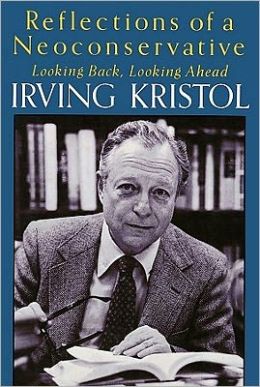
From Reflections of a Neoconservative by Irving Kristol (1983):

"Being frustrated is disagreeable, but the real disasters in life begin when you get what you want."

"No society can be utterly indifferent to the ways its citizens publicly entertain themselves."

Interesting stuff. Maybe I'll hang on to these books a little while longer.

Friday, October 11, 2013

Scrabble, with coffee and tea

The December issue of Games magazine, now on newstands, includes a six-page article called "The Evolution of Scrabble" by Julie Harris. An unemployed architect named Alfred Mosher Butts got the initial idea for a word game in 1931. He hoped to capitalize on the crossword puzzle craze. He called his game Lexico. It didn't catch on.

Butts kept tinkering with it and a few years later came up with a game he called Criss Cross Words. It didn't catch on either. Finally an investor named James Brunot came to Butts's rescue, made a few revisions in the rules and changed the name to Scrabble. a word meaning "to scratch, grope or claw about frantically." He found a manufacturer for the game, but it still didn't find success until 1952 when Jack Strauss, an executive at Macy's, played the game while on vacation, loved it and wondered why his department store wasn't stocking it. He placed a large order, which sold quickly, and Scrabble was finally on its way to becoming the classic board game it is today.

Reading that article reminded me of what Bill Bryson writes about coffee in At Home. The word coffee, like the game Scrabble, evolved over time. In the 17th century, the then new and exotic hot beverage was variously called coava, cahve, cauphe, coffa and cafe before everyone finally agreed upon coffee.

At about the same time, according to Bryson, Samuel Pepys recorded in his diary that he had just tried another new hot beverage called tea. He called it tee.

Mystery writer Les Roberts has his detective, Milan Jacovich, make a wonderful aside about tea in his new novel Win, Place, or Die: "Why is it, that, in most places like this, they'll refill your coffee at least ten times without a murmur; a tea drinker might get more hot water as often as he wants, but if he desires a fresh tea bag, he has to pay extra for it? That's one of those mysteries of life I've never been able to crack."

As a tea drinker, I well understand what Jacovich (or Roberts) is saying. Tea, I've found, is often treated like a back-of-the-bus beverage. I found that true a couple of times during our tour of the West last month. At an otherwise wonderful place in Jackson, Wyo., called The Bunnery (their motto is "Get your buns in here," although I might have gone with "Get thee to The Bunnery") I noticed a selection of teas on the menu. Some of them were clearly herbal, however, and because I despise herbal tea I asked our waitress if a particular tea with an unfamiliar name was "real tea." She assured me it was. As soon I opened the tea bag and got a whiff, I knew it was herbal. (I should have just read the package.) I complained to the waitress, who told me all the teas were herbal. I started to argue with her, then just ordered Earl Grey and enjoyed the rest of my meal.

Earlier at a Sante Fe hotel, where we stayed two nights, a full breakfast buffet was included. Well, it wasn't quite full. They offered just about anything you might want for breakfast, including a variety of coffees and juices. While my breakfast plate cooled, I looked around for the tea, but couldn't find any. When I asked for some, I was told that would be $1.95. Everything else under the New Mexico sun was included, but tea was extra.

At most restaurants you can get all the iced tea you want for one price, but as Roberts/Jacovich writes, more hot tea comes with a penalty. Sometimes my wife and I both order tea, and instead of one pot we get two, both of which get cold at the same time.

There are exceptions to this discrimination against tea drinkers, I am happy to report. At Boone Tavern in Berea, Ky., where we spent a night in July, I ordered tea in the morning and was given a big pot of hot water, plus a basket full of a wide variety of teas. Some Bob Evans restaurants do the same thing. Good for them.

Wednesday, October 9, 2013

True gold

True gold can be found in the love of a good woman.

That, in a nutshell, summarizes Sierra, Richard S. Wheeler's entertaining 1996 novel about the California gold rush, which follows the trail of two men to the gold fields in the late 1840s.

Stephen Jarvis actually arrives at Sutter's Mill before the discovery of gold. He's a Mexican War veteran looking for his future when he spies a beautiful Californio girl. Although he and Rita cannot speak the same language, each is smitten with the other. He determines to makes a success of himself, then return to ask for Rita's hand. He finds enough gold to establish a business supplying goods to other miners and soon accumulates more wealth than all but a few of the gold seekers. Then he learns Rita has been forced to marry another man.

Ulysses McQueen already has a pregnant wife, Susannah, and a farm in Iowa when he gets gold fever. He leaves both his farm and Susannah in the care of his father and brothers, then heads for California with dreams of riches. He arrives after the richest gold strikes have already been made, and he struggles to make enough money just to survive. He has failed to write a letter to Susannah all this time, not wanting to write until he has good news to tell her. Meanwhile, impatient with not hearing any news about Ulysses, Susannah, with her baby, takes off to California to find him.

Wheeler specializes in the non-traditional western. That is, he writes more about the West as it really was than about gunfighters and train robbers. This may be why his books can be so hard to find, at least east of the Mississippi. I did find a few last week in a wonderful little bookstore in Jackson, Wyo. To me, that seemed like true gold.


Monday, October 7, 2013

A book to fly west with

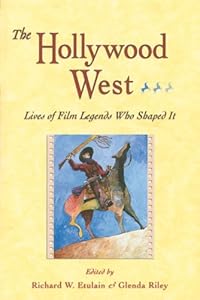
One of the books I read, mostly on airplanes, during my recent excursion through the Rocky Mountains was one called The Hollywood West: Lives of Film Legends Who Shaped It, edited by Richard W. Etulain and Glenda Riley. The 2001 book, a collection of short biographies of actors and, in the case of John Ford, a director, most responsible for how most of us picture the Old West in our minds.

I liked the book, in part, because it describes some of the places we visited on our bus tour, most notably Monument Valley, where Ford filmed Stagecoach and several other pictures starring John Wayne, another of those written about in The Hollywood West. Our tour guide mentioned that if you pay close attention you'll notice the stagecoach going past some of the same scenery again and again. Most of us don't notice it, however. Our son appears as an extra in The Shawshank Redemption (it was his summer job one year when he was in college), yet when my wife and I watch the movie we often miss him, even though we are watching for him, because it is so hard not to focus on the actors with the speaking parts.

Another thing I liked about the book is the obscure bits of trivia the various authors toss into the mix. For example:

-- Max Aronson (silent film star Bronco Billy Anderson) got his start in westerns by lying about being an expert horseman. When he tried to mount a horse for the first time on screen, however, he approached the horse from the wrong side and was thrown.

-- Tom Mix, who played a hero in so many western movies, went AWOL from the Navy and was officially a "deserter" throughout his lifetime.

-- As a girl, Dale Evans (Francis Octavia Smith) fantasized about marrying Tom Mix one day. Instead she married another movie cowboy, Roy Rogers.

-- You can tell the good guys from the bad guys in Gene Autry movies by how characters refer to the hero. Friends call him Gene. Enemies call him Autry.

-- Barbara Stanwyck, who feminized the Hollywood western, was afraid of horses.

-- Jay Silverheels played the Lone Ranger's trusty Indian sidekick Tonto in 221 television episodes, but his real name was Harold J. Smith. He didn't legally change his name until 1971.

This rather obscure little book also covers such people as Gary Cooper, Clint Eastwood, Katy Jurado, Iron Eyes Cody and Williams S. Hart. It's a good way to pass the time while flying west.

Monument Valley

Friday, October 4, 2013

One blog post I had to write before I die

The August 2010 issue of MAD magazine (I am always behind in my reading) contains a beautiful satire on Amazon.com, which writer Scott Maiko calls Scamazon.com. I don't find the magazine as amusing as I used to, but this two-page spread is an exception. The fake web page focuses on a book called 1001 Escalators You Must Ride Before You Die, complete with customer reviews and suggestions for other books anyone who buys this book might enjoy, such as 1001 Ambient Noises You Must Hear Before You Die, 1001 McDonald's Drive-Thrus You Must Visit Before You Die, 10001 Parking Meters You Must Park in Front of Before You Die, 1001 mg of Cyanide You Must Ingest Before You Die and 1001 '1001 ... Before You Die' Books You Must Buy Before You Die.

I found this to be even funnier when I surfed to the actual Amazon site and read the titles of some of the actual books in this vein. Here are a few of them:

1001 Books You Must Read Before You Die, 1001 Songs You Must Hear Before You Die, 101 Whiskies to Try Before You Die, 100 Things 49ers Fans Should Know & Do Before They Die, Fifty Places to Fly Fish Before You Die, 1001 Beers You Must Taste Before You Die, Fifty Places to Ski and Snowboard Before You Die, Fifty Places to Bike Before You Die, 100 Things to Do in St. Louis Before You Die, 300 More Beers to Try Before You Die, 101 Horror Movies You Must See Before You Die, 101 Places Not to See Before You Die, 1001 Foods You Must Taste Before You Die, 1001 Video Games You Must Play Before You Die, 1001 Paintings You Must See Before You Die, 1001 Dream Cars You Must Drive Before You Die, 1001 Buildings You Must See Before You Die, 1001 Comics You Must Read Before You Die, 101 Places to Have Sex Before You Die, 1001 Golf Holes You Must Play Before You Die, 100 Lies to Tell Before You Die and, believe it or not, 1001 MAD Pages You Must Read Before You Die.

Obviously, writing books like this is a little too easy. Reading any of them is among the last things I want to do before I die.

Wednesday, October 2, 2013

Words from the West

Grand Canyon
I returned yesterday afternoon from a week-and-a-half bus tour of the American Rockies, from Sante Fe to Yellowstone. Along with hundreds of photographs, most of which are just like the photographs everyone else takes who visits these places, and countless memories, I brought back a few tidbits, mostly language-related, to share in this blog.

On our first day, Phil, our tour guide, explained that the lavatory on the bus was a "Las Vegas restroom -- what happens there, stays there." In other words, don't use it anymore than necessary because it won't be emptied or cleaned for
the duration of the trip.

An Ohio farmer on our tour objected when Phil used the word mud. "Mud," she said, "is disrespectful to soil." She also objected to the word dirt.

Less sensitive were the people of the Navajo Nation, whom Phil said preferred to be called Indians, not Native Americans. On a board outside a Navajo high school were the words, "Home of the Redskins."

The so-called Navajo code talkers helped win World War II simply by communicating messages in their own language, which the Japanese could not understand. An excellent museum dedicated to the code talkers can be found, of all places, in a Burger King in Kayenta, Ariz. We got the chance to visit it only because our bus broke down in Kayenta. The Navajo language didn't have words for certain things, so here are some examples of what the code talkers used instead: battleship - whale; submarine - iron fish; destroyer - shark; America - our mother; Australia - rolled hat; January - crusted snow; October - small wind.
Bryce Canyon

Also in Kayenta, there stands an example of a Navajo sweat lodge. The sign outside the sweat lodge begins, "The scares' resource in the desert is waster."

Bryce Canyon is not actually a canyon. Monument Valley, where John Ford made so many westerns with John Wayne, isn't really a valley.

Garfield County in Utah is among the largest counties in the United States, yet it has but one traffic light and one lawyer.

Western towns often place a large letter on a nearby mountain to guide travelers toward their town. A big B on a mountainside, for example, promotes Beaver, Utah.

Antler arch in Jackson, Wyo.
A local guide for a tour of Salt Lake City told us that when she was a volunteer at the 2002 Winter Olympics held in Salt Lake City, she confiscated a handgun from Mitt Romney, president of the organizing committee. Romney congratulated her, explaining that he was carrying the gun to test whether security personnel were strictly following the rules. When he asked for the gun back, she refused. Still following the rules, she turned the gun over to the FBI.

Is it Jackson, Wyo., or Jackson Hole, Wyo.? You see it both ways on signs, advertising, newspapers, etc. Phil explained that the city itself is Jackon. Jackson Hole refers to the area, or the valley around Jackson. Early trappers referred to valleys as holes because they had to go down into them to do their trapping.