Wednesday, April 9, 2014

The plural you

There are, believe it or not, languages where pronouns vary only for person but not number, such that I and we are the same word, he, she, and they are the same word, and as such, singular and plural you are the same word. For some reason this tends to be in Indonesia and New Guinea. But for it to be this way only with the second person? Odd, and, again, illogical, inconsistent, unpretty.
John McWhorther, Our Magnificent Bastard Tongue

Back in the 1980s I served on a committee charged with finding an associate pastor for our church. Our choice was a lovely young woman with degrees from Swarthmore and Harvard Divinity School. One thing that puzzled me about Connie was her frequent use of the phrase "you all." She did not speak with a drawl, yet this phrase still made her sound as though she were raised in Georgia, not eastern Pennsylvania.

Connie came to mind after reading John McWhorter's comments quoted above. Was she, like so many other English speakers, simply uncomfortable with using the pronoun you as a plural? The word sounds to our ears like it refers to just one person, not two or more. The plural you is, as McWhorter puts it,illogical, inconsistent and unpretty. So many of us find alternatives.

In the South, you all or y'all is favored. Elsewhere in the country, you guys serves the same purpose, but without the charm. In Florida this winter I heard you guys much more than y'all. This could be because so many people in Florida are transplanted from elsewhere, but it could also mean that you guys is spreading. Even older women, who once hated to be referred to as you guys, now use the term themselves.

You might also hear you lot (common in Britain), you-uns, yinz (Pittsburgh area) or youse or youse guys.

We all tend to repeat the language we hear everyday, but I do hope Connie, who last I heard was serving a church in Virginia, is still saying you all, not you guys.

Monday, April 7, 2014

Pint-sized secret agents

The very best literature for children appeals equally, or almost equally, to adult readers. I'm thinking of books like Alice in Wonderland, Charlotte's Web and the Dr. Seuss books. I was over 18 when I read both Winnie-the-Pooh and the Narnia books, and I loved them. I still read children's books from time to time, and when I do I judge them not on how I think a child might like them but rather on how I like them. At the very least I judge them according to what might have appealed to me when I was at a particular book's target age.

Nick and Tesla's Secret Agent Gadget Battle by "Science Bob" Pflugfelder and Steve Hockensmith (2014) does not pretend to be great literature. It's just a comic adventure tale for kids nine and over. I give it a mixed grade. At times I got caught up in the story, finding the comedy genuine and the mystery truly suspenseful. At other time it seemed dull and repetitious, as if the authors were just filling pages until they could legitimately move on to the exciting climax.

The book, the second in a series, concerns twins named Nick and Tesla, who are staying with their batty Uncle Newt while their parents are away on a secret mission. They suspect that someone hanging around the house is really a spy, and they are determined to discover who it might be. They have a number of suspects.

I would not be surprised if my grandson, about to turn 10, reacts as I did when he reads the book, which I hope he will do. I think he'll love the instructions on how to build a fingerprint kit and a secret code wheel, among other gadgets contributed by Pflugfelder. I know those kinds of things would have thrilled me when I was 10, whether I actually would have built the gadgets or not. I think, too, he will laugh at the funny bits Hockensmith, author of the Holmes on the Range mysteries, brings to the book.

I just hope he doesn't get bored and give up on the book before it gets interesting again, as I was tempted to do. Young readers aren't really that different from older ones. They like stories, such as Winnie-the-Pooh, that stay fun all the way through.

Friday, April 4, 2014

Baby steps

Lately readers have begun to complain about my short chapters, although in my opinion there is no particular reason why a chapter should be long.
Larry McMurtry, Hollywood

The above sentences takes up three lines in the 26th chapter of Larry McMurtry's memoir about his many years writing screenplays for Hollywood and writing novels that Hollywood turned into movies. The entire 26th chapter runs to just six lines.

The book itself takes just 146 pages but has 60 chapters. You can do the math. I made Hollywood my lunchtime book for a brief while. Sometimes I could read an entire chapter between bites. I loved it. Like McMurtry, I favor books with short chapters.

The author explains his short chapters like this, to quote the third sentence of his three-sentence 26th chapter: "In fact I am old and there are very many subjects about which I have something to say -- just not much." Perhaps advancing age explains my own preference for short chapters, but I don't think so. I favored them even in my youth.

The other night I watched yet again the old Bill Murray comedy What About Bob? He plays a man who has great difficulty just leaving his own apartment, let alone coming into contact with other people. His new doctor (Richard Dreyfuss) gives him a copy of his new book, Baby Steps, which urges people like Bob to think in terms of baby steps. Think only as far as the next step. After that step, focus on the next. You can go far just taking one small step after another.

I feel that way about reading books, especially long books. Short chapters break the text down into baby steps. Instead of thinking about the 500-page biography or novel that lies before me, I think just about the next chapter. The shorter that chapter is, the easier it seems to start reading and keep reading. I found this true again recently when reading Donna Tartt's massive novel The Goldfinch, which is 771 pages long. It has only 12 chapters, but each chapter is broken down into numerous subchapters, some of them not much longer than McMurtry's chapter 26. I think the novel would have been much harder to read if it had only those 12 chapters, each more than 50 pages long.

It's not just short chapters that make reading easier. Short paragraphs and short sentences also help. In  the newspaper business, where I devoted my career, keeping paragraphs brief, rarely more than two or three sentences, is considered mandatory to improve readability. Copy editors also often divide long sentences into two shorter ones for the same reason.

A college professor once reviewed a book manuscript of mine (never published). One of her main complaints was that my paragraphs were too short. In academia, of course, long paragraphs are the rule, but I came out of journalism, where the focus lies on brevity. Larry McMurtry probably would have agreed with me. His six-line chapter 26 has three paragraphs, one for each sentence.

Wednesday, April 2, 2014

Surprises from Larry McMurtry

Larry McMurtry has written more memoirs than most people have written letters home. I have just finished reading Hollywood (2010), the third of his literary memoirs, but he has written at least two other books, Paradise and Walter Benjamin at the Dairy Queen, that might be termed memoirs, as well. As sketchy as these books are, the 77-year-old writer may still have a few more memoirs left to write.

In Hollywood, his recollections of his many years as a scriptwriter, McMurtry makes the surprising, at least to me, comment that he works "harder at screenwriting than I do at fiction -- fiction comes to me easily, and scripts don't. I have to work at them; they're a craft I've only partly mastered -- the character part." Much of McMurtry's fiction, like his memoirs, has an easy-going style, as if it were just poured onto a page. Even so, I would have thought any serious novel would be more difficult to write than any screenplay. True, scripts are often written by committee, with the director getting the final say about what actually goes into the movie, which must be frustrating for any scriptwriter. But this doesn't appear to be what McMurtry is talking about.

Elsewhere in the book he recalls that after a heart attack in the 1990s, "I could write fiction, which doesn't really require a clear mind: it's a semivisceral experience ... No one can write screenplays in this trancelike state." Fiction doesn't require a clear mind? That seems revealing. I would love to hear other novelists comment on this observation. Is this why so many writers thrive in the party atmosphere of Key West? (See my March 20 post, "Key West literary tour.")

McMurtry says he's grateful to Hollywood because "it's essentially financed my fiction, my rare book business, and, to a huge degree, my adult life." Besides, he confesses, he just loves Hollywood and numbers actress Diane Keaton among his best friends. He hates movie sets, however, and makes a point to avoid them. Speaking of directors, he writes, "the kindest thing an author can do is stay out of the way and not slow them down."

Another surprising thing in McMurtry's memoir is that he believes Loop Group a much better novel than Lonesome Dove. I've read his Hollywood novel Loop Group, and I enjoyed it, but it seemed slight to me, again as if it were written on the run, while I consider Lonesome Dove a masterpiece of western fiction. Most readers and not a few critics seem to feel the same way. It did win the Pulitzer Prize in 1985, while Loop Group went largely ignored. McMurtry could be right, however. I would love to read both of those novels again.

Monday, March 31, 2014

A wilderness of guilt

An early chapter in Donna Tartt's third novel The Goldfinch begins with the words "a wilderness of gilt." The phrase refers to the workshop of Hobie, the furniture restorer who becomes a father figure to Theo Decker, the novel's narrator. Add just one letter to the phrase, turning it into "a wilderness of guilt," and you are left with a pretty good four-word summary of what Tartt's story is about.

Theo, 13, and his mother stop at a New York City art museum on their way to his school, where he is being disciplined for misbehavior. A bomb explodes, killing his mother and leaving Theo shaken. In the confusion that follows, the boy slips a priceless painting called "The Goldfinch" into his school bag and walks home. His wilderness of guilt begins with his blaming himself for mother's death. If he hadn't gotten into trouble in school or if he had just told his mother he was hungry and wanted something to eat before they entered the museum, she would still be alive. Then there is the painting, which he doesn't want but doesn't know how to return to the museum.

As time passes, imagined guilt becomes actual guilt. Theo becomes a drug addict and, after becoming an adult and a partner in Hobie's furniture shop, sells fake antiques for inflated prices and pocketing the money to support his habit. The painting becomes an ever heavier burden. His life spirals out of control, lost as he is in his wilderness of guilt.

Much happens in Tartt's 771-page novel, yet she writes at such a deliberate pace that sometimes it seems nothing is happening at all. Some readers will object to this, yet as I found when I read her earlier novel, The Little Friend, her prose is never better than when nothing much seems to be happening.

There is no cheap grace in Tartt's work. She does, however, suggest the possibility, so unlike what Thomas Hardy expressed in his best novels, that good can sometimes be a product of evil, that easy or not, there can be a way out of the wilderness.

Friday, March 28, 2014

Insights on reading

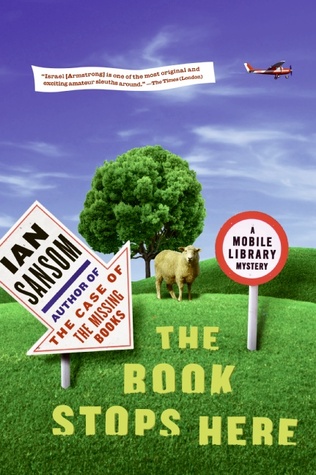
As mysteries, Ian Sansom's Mobile Library books don't amount to much. Their strengths lie in vivid characters, comic dialogue and situations and, not of least importance in my view, the author's reflections, through his characters, on literature and reading in general. Here are some of the comments I found most interesting The Books Stops Here, the book I reviewed here two days ago.

"Eileen believed passionately in what you might call the trickle-down theory of literature; according to her, the reading of Booker Prize-winning novels by Tumdrum's library-borrowing elite would lead inevitably and inexorably to the raising of social and cultural values among the populace at large."

I have commented previously on the idea that great literature, like great art in general, carries moral value, that better reading can make us better people. Any correlation, and I agree there may be some, is minimal. If the people who wrote those great books were not saints, why should we expect more from those who read them?

"Israel's reading had always been erratic and undisciplined; there were huge chunks missing in his knowledge, while other areas were grossly-over-represented... he was a kind of mental hunchback -- misproportioned, a freak."

Aren't most of us "mental hunchbacks" in this respect? We tend to read those books that interest us and ignore the rest. My reading is probably more varied than that of most people because I have been reviewing books for more than 40 years, but even I have significant gaps. Some great authors I have missed altogether. One of the qualities I like about Israel Armstrong, Sansom's main character, is that he worries about this sort of thing.

"There were, of course, some books he could see on his shelf, in his mind's eye, that he didn't regret -- his Kurt Vonneguts, for example. How could he possibly -- how could anyone possibly -- regret Kurt Vonnegut?"

My own regrets have more to do with buying books than reading them. I regret spending money on books I quickly realized I wouldn't like or, more seriously, books I later found I already owned. I regret all those books I haven't read yet and may, in fact, never get around to. I also regret that I have forgotten so many books almost in less time than it took to read them.

"He was his books; and his books were him."

I got a sense of this idea last when I visited the Little White House in Key West and examined the shelves of books once owned and read by Harry S. Truman. Most were not classics or even books I had ever heard of, but rather books printed in the 1940s and 1950s that appealed to Truman but, apparently, to relatively few others. More than the furniture, the photographs or even the "The buck stops here" sign on his desk, these books revealed who Truman really was.

I wonder what my books say about me.

Wednesday, March 26, 2014

The missing mobile library

Something's always going missing in Ian Sansom's Mobile Library mysteries. Israel Armstrong has just become the mobile librarian in the Northern Ireland community of Tumdrum when, in The Case of the Missing Books, he discovers all the books have vanished. His first assignment is to find them. Then in Mr. Dixon Disappears, Israel must find a prominent local businessman because he is a suspect in his disappearance. Now in The Book Stops Here (2008), the third and arguably the best novel in the series, it is the mobile library itself that goes missing.

Israel and Ted, the disgruntled older man responsible for driving and maintaining the vehicle, take it to London for the Mobile Meet. Israel yearns to return to London after six annoying months in Tumdrum. He wants to see Gloria, the girlfriend he has not heard from in awhile, and reconnect with friends. The first stop is at his mother's house, where she and Ted hit it off immediately, much to Israel's dismay. That night the mobile library disappears from the street.

How Israel, Ted and Israel's mother track down and recover the van makes a rollicking adventure. Done right, this would make an entertaining film.

There's a bittersweet quality to the tale. Both Israel, who wants to go to London, and Ted, who doesn't, are shaken by their journey. Israel finds you really can't go home again. In just six months, everything has changed. As for Ted, a man he has not seen in many years turns out not to be the kind of man he thought he was.

As in the previous books, poor Israel gets verbally abused by everyone, his mother included. Seeing him prevail yet again gives pleasure to the reader, as do Sansom's insightful comments about literature sprinkled throughout the novel. I'll have more to say about that next time.