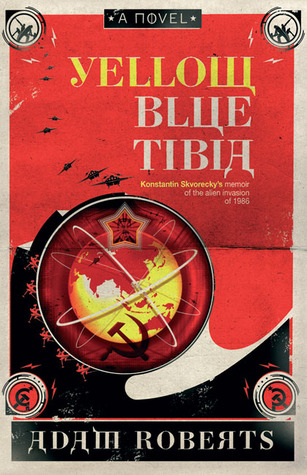
Combine Joseph Heller dialogue with a Kurt Vonnegut Jr. plot and you might get something like Adam Roberts's brilliant 2009 novel Yellow Blue Tibia.
Funnier than any story about an alien invasion, nuclear disaster and KGB assassins has any right to be, the novel starts wacky and keeps getting wackier. It begins after the close of World War II when Stalin gathers together some of the best Soviet science fiction writers and orders them to come up with a plot about an invasion from outer space. They concoct a wild story about "radiation aliens" who attack the Ukraine. Stalin likes it, files it away and swears them all to secrecy.
Years later during the winter of 1985-86, one of those writers, Konstantin Skvorecky, now an old man who works as a translator, is approached by another survivor from that strange writing project and told that their plot is all coming true. The aliens have invaded exactly as they described in their story.
Soon, pursued by the KGB, Skvorecky is taking a wild taxi ride to the Chernobyl nuclear plant with a former nuclear scientist, now a cab driver with an extreme fear of being touched by another man, and a fat American woman, a Scientologist, with whom he falls in love. They are trying to prevent the disaster they fear is coming before the KGB can catch up with them.
So is there an alien invasion or not? And is this novel science fiction or not? One must read to the end to find the answers.
Friday, July 15, 2016
Wednesday, July 13, 2016
Adventure at sea
Sometimes the third time really is the charm. So it is with Alistair Maclean and me. I missed McLean entirely during his heyday when he was one of the world's most popular writers of thrillers, yet I had heard so many good things about his books that I finally decided to give them a try. The first two novels I read, Partisans and Puppet on a Chain, proved disappointing. My third attempt, however, produced different results.
San Andreas, published in 1984, is a World War II adventure that takes place entirely aboard a hospital ship in the North Atlantic in winter. Hospital ships, marked with big red crosses, are supposedly neutral, yet the Germans seem determined to stop, if not sink, the San Andreas. One or more saboteurs aboard keep destroying navigational equipment, while planes and submarines attack with relatively light arms, suggesting they want to do damage, but not too much damage. So what's going on?
When the ship's captain is badly wounded in one attack, the responsibility for getting the San Andeas to safety falls on Archie McKinnon, the bosun. The hospital ship has no weapons aboard, so McKinnon must defend the ship using the bad weather, the long winter nights and the ship itself. Then there are the problems of finding the saboteurs(s) and getting the ship to a friendly port.
McKinnon turns out to be my kind of hero, one who uses brains more than brawn, and the result proves thoroughly entertaining. San Andreas may be the name of a California fault line, but McLean's novel with that title turned out to be nothing like a disaster.
Tuesday, July 12, 2016
Dubbed
Another word is accolade, originally from a French word meaning to embrace. The English used the word to refer to the bestowal of knighthood. Now almost any type of award or expression of approval can be called an accolade..
To take knighthood away from someone is termed degradation, a word now used in the fields of chemistry and geology, as well as when anyone or anything declines in condition or quality.
Thursday, July 7, 2016
Some like it again and again and again
Yes, the anniversary was a few years ago, but the book, like the movie, doesn't show its age. This is a coffee-table book, one that house guests are almost guaranteed to want to pick up and leaf through. It's filled with photos, both movie stills and publicity shots, plus a number of behind-the-scenes photographs you are unlikely to find anywhere else. Maslon also tosses in some choice excerpts from the script, photo copies of documents showing Monroe's frequent tardiness and absences from the set and other assorted goodies. He devotes an entire chapter to the various efforts to put Some Like It Hot on television and the stage over the years. An attempted sitcom never survived beyond the pilot.
For my money, the book's best feature is a two-page essay called, for some reason, "Spills, Thrills, a Laughs, and Games." Once you get past that silly title, the essay provides some fascinating insights into why this movie turned out to be as good as it is, other than those reasons already mentioned above. For example, it defies categorization. Is it a screwball comedy, a buddy picture, a gangster movie, a sex farce or a romantic comedy. Well, yes to all those. Just when you think it's one thing, it becomes something else.
Maslon's points out how the Wilder-Diamond script frequently recycles bits of dialogue for comic effect, such as when Joe and Jerry (Curtis and Lemmon) claim to have attended the Sheboygan Conservatory of Music, and later Sugar (Monroe), also trying to make a good impression, says she attended the same fictional school. Maslon's essay helped me enjoy the movie all the more when I watched it the other night.
Wednesday, July 6, 2016
Had Lincoln survived
Imagine that Abraham Lincoln survived John Wilkes Booth's assassination attempt but that Vice President Andrew Johnson, also a target of the plot that night, had been killed. Further imagine that it was then Lincoln, not Johnson, who was impeached by Congress during the political struggle over Reconstruction following the Civil War. This is what Stephen L. Carter imagines in his terrific 2012 novel The Impeachment of Abraham Lincoln.
Carter goes on to imagine that a brilliant and beautiful young black woman, fresh out of Oberlin College, becomes a part of Lincoln's legal defense team, albeit a lowly clerk responsible more for sweeping floors than determining legal strategy. Still Abigail Canner becomes central to the story, and what an exciting story it is.
The author paints a Congress in 1867 not so different from Congress today, a group of individuals more interested in political gain than anything else. With Johnson dead, the president pro tempore of the Senate is next in line to be president, yet it is the Senate that must vote on removing the president from office. Meanwhile several others, including Chief Justice Salmon P. Chase, who presides over the impeachment trial, also have political ambitions that might benefit from Lincoln's departure. Clearly the deck is stacked against the president.
Carter gives us a riveting political thriller, legal thriller and, after the head of the defense team is found murdered in front of a brothel in the company of a black woman, crime thriller. Yet there are flaws. The impeachment of Lincoln proves easier to believe than certain other parts of the plot, such as that other members of Abigail's family also play important roles in the story. And the author leaves too many questions unanswered.
The novel leaves us with at least two conclusions about history. One is that even if Lincoln had survived Booth's attempt on his life, the aftermath of the war would have proceeded pretty much as it did. The other is that one thing that might have been different is our perception of Abraham Lincoln. Had Lincoln been caught in the middle of the Reconstruction fight, perhaps his historical reputation would have suffered, just as President John F. Kennedy's standing in history might have suffered had he not been assassinated.
Carter goes on to imagine that a brilliant and beautiful young black woman, fresh out of Oberlin College, becomes a part of Lincoln's legal defense team, albeit a lowly clerk responsible more for sweeping floors than determining legal strategy. Still Abigail Canner becomes central to the story, and what an exciting story it is.
The author paints a Congress in 1867 not so different from Congress today, a group of individuals more interested in political gain than anything else. With Johnson dead, the president pro tempore of the Senate is next in line to be president, yet it is the Senate that must vote on removing the president from office. Meanwhile several others, including Chief Justice Salmon P. Chase, who presides over the impeachment trial, also have political ambitions that might benefit from Lincoln's departure. Clearly the deck is stacked against the president.
The novel leaves us with at least two conclusions about history. One is that even if Lincoln had survived Booth's attempt on his life, the aftermath of the war would have proceeded pretty much as it did. The other is that one thing that might have been different is our perception of Abraham Lincoln. Had Lincoln been caught in the middle of the Reconstruction fight, perhaps his historical reputation would have suffered, just as President John F. Kennedy's standing in history might have suffered had he not been assassinated.
Monday, July 4, 2016
Very different brains
"Yes," said Piglet, "Rabbit has Brain."
There was a long silence.
"I suppose," said Pooh, "that that's why he never understands anything."
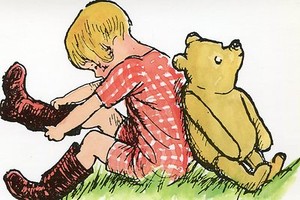
A.A. Milne fills his Winnie-the-Pooh books with references to brains. Christopher Robin has the best one, and he is the one the other characters always turn to when they are really stumped. Owl, like Rabbit, has a brain, and earns respect because he can spell his own name, even if he does spell it WOL, and he can even "spell Tuesday so that you knew it wasn't Wednesday." Others of them just have fluff in their heads, we are told, and Pooh himself is "a Bear of Very Little Brain."
Yet Pooh writes songs, which he calls Hums, Tigger can bounce better than anyone else and Kanga is an excellent mother to Roo. Each character in the stories contributes something, and none of them can do everything. At one time or another, each depends on others in their group.
I don't watch many current television series, but I have become a belated fan of both The Big Bang Theory and Bones, and I have enjoyed Scorpion since the first episode. Each of these series, like others of recent vintage like Monk and the many variations on the Sherlock Holmes stories, features one or more characters with exceptional brains but who are deficient in social skills or are unable to understand such things as irony or sarcasm. On episodes of Bones, I've heard characters say things like, "I don't know what that means," "I'm not good with metaphor" and "that's slang, right?" The geniuses in these shows always have friends with more average brains to help them understand things their more powerful brains cannot grasp.
In one Calvin and Hobbes panel, Calvin defends himself after screwing up a class project by saying, "Some of us are too smart for the class." When a classmate scoffs, he adds, "You know how Einstein got bad grades as a kid? Well, mine are even worse!" Calvin is right about one thing. His brain does work differently than other brains, and in his own way, he is a genius.
A friend of mine was in an Eeyore kind of mood one day, a bit down on herself, and she said, "Nobody else seems to think the same way I do." "Nobody does," I told her. "That's why you are necessary."
There was a long silence.
"I suppose," said Pooh, "that that's why he never understands anything."
A.A. Milne, The House at Pooh Corner
Yet Pooh writes songs, which he calls Hums, Tigger can bounce better than anyone else and Kanga is an excellent mother to Roo. Each character in the stories contributes something, and none of them can do everything. At one time or another, each depends on others in their group.
I don't watch many current television series, but I have become a belated fan of both The Big Bang Theory and Bones, and I have enjoyed Scorpion since the first episode. Each of these series, like others of recent vintage like Monk and the many variations on the Sherlock Holmes stories, features one or more characters with exceptional brains but who are deficient in social skills or are unable to understand such things as irony or sarcasm. On episodes of Bones, I've heard characters say things like, "I don't know what that means," "I'm not good with metaphor" and "that's slang, right?" The geniuses in these shows always have friends with more average brains to help them understand things their more powerful brains cannot grasp.
In one Calvin and Hobbes panel, Calvin defends himself after screwing up a class project by saying, "Some of us are too smart for the class." When a classmate scoffs, he adds, "You know how Einstein got bad grades as a kid? Well, mine are even worse!" Calvin is right about one thing. His brain does work differently than other brains, and in his own way, he is a genius.
A friend of mine was in an Eeyore kind of mood one day, a bit down on herself, and she said, "Nobody else seems to think the same way I do." "Nobody does," I told her. "That's why you are necessary."
Friday, July 1, 2016
Dated title
When I read George Orwell's Nineteen Eight-Four in the early Sixties, the year 1984 still seemed far in the future. More than three decades after 1984, Orwell's novel is still being read, yet I wonder if its impact has somehow declined as 1984 has faded into the past. Has his choice of a title, plus the passage of time, turned a futuristic novel into, at least in some readers' minds, a historical novel?
This thought follows from my post of two days ago about time-related words like modern and new. You might also include the words contemporary, present, now, current, today, yesterday and tomorrow, among others. The passage of time can change the meaning of these words to the reader. In a similar way, dates mentioned in stories, especially in stories set in the future, can make those stories seem dated as time passes.
When setting a story in some future time, it might be wise to keep that time ambiguous, or at least put it far enough in the future that it will be a very long time before that future becomes past. When Orwell's novel was published in 1949, he probably didn't imagine people would still be reading it in the 21st century.
In the late Nineties I read a novel about the terrible things that happen on Jan 1, 2000, when the world's computers fail. I doubt anyone bothered to read that novel after that date, when nothing terrible happened at all.
Before Orwell wrote his visionary novel, Aldous Huxley wrote Brave New World, a book to which Nineteen Eight-Four is often compared. I don't think Huxley wrote the better book, but I do think he chose the better title. Brave New World will always suggest the future, something Nineteen Eight-Four can never do again.
Subscribe to:
Posts (Atom)