Wednesday, August 3, 2016

Questions of identity

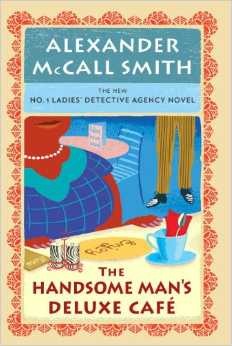
Alexander McCall Smith's 2014 novel The Handsome Man's De Luxe Cafe, the 15th in his The No. 1 Ladies' Detective Agency series, revolves around questions of identity.

The agency's only case this time around involves a woman known only as Mrs. who says she doesn't remember who she is or where she is from. With few clues to work with, Precious Ramotswe and Grace Makutsi must try to discover who she is.

But identity questions don't only ask who someone is but also what someone is. Take Mma Makutsi, for instance. She was hired in the first novel in this series as a secretary, even though Mma Ramotswe, still having no cases, really didn't need a secretary. Over the years, the ever ambitious younger woman has won from her employer not more money -- the agency makes little money -- but a series of new job titles, each more impressive than the last. Now she is made a partner, or perhaps a co-director, although Mma Ramotswe struggles to make it clear she remains the senior director.

Yet Mma Makutsi still works at defining herself. In previous novels she has started a typing school for men, married a prosperous furniture store owner and become a mother. Now she decides to open her own restaurant, The Handsome Man's De Luxe Cafe, even though as co-director of a detective agency, wife and mother, she has little time to manage a restaurant. And who are those people she has hired for her new business? Soon the restaurant has an identity problem of its own: Is it really The Handsome Man's De Luxe Cafe or something else?

Then there is the problem with Charlie, the longtime apprentice of Mr. J.L.B. Matekoni, the auto mechanic husband of Mma Ramotswe. Mr. J.L.B. Matekoni can no longer afford to pay the young man, who shows no promise of ever becoming anything more than an apprentice, so he lets him go. The compassionate Mma Ramotswe then hires him, even though she cannot afford to pay him either. He becomes an assistant detective or perhaps an auxiliary detective, or should it be an apprentice detective? The discussion of choosing the right title is priceless.

After Charlies bungles his first assignment, Mma Ramotswe decides they need a secretary more than they need another detective, especially since Mma Makutsi, now a co-director, no longer likes to do secretarial work. But should he be a full secretary? The prickly Mma Makutsi strongly objects to that title. So should he be a para-secretary, an assistant secretary, a clerk or what? Again the debate proves entertaining, especially as it reminds us how important job titles become in actual workplaces.

Mma Ramotswe once again displays her gift for solving problems. The novel's closing lines -- "She held her husband's hand. No further words were exchanged, or needed." -- reveal two people who know exactly who they are and what they are.

Monday, August 1, 2016

Our mountain resort

We spent last week at a resort near Gatlinburg, Tenn. It seemed more like a log cabin to me, although a luxurious log cabin and nothing like the one Abe Lincoln was born in. There was a swimming pool and a tennis court on the property. Is that what made it a resort?

Turning to The American Heritage Dictionary, I see a resort is "a place frequented by people for relaxation or recreation." By that broad definition, a resort might also be your neighborhood tavern, a city park, a pool hall, a bowling alley or, for that matter, your own living room.

Driving through Gatlinburg, I noticed few motels and even fewer hotels or inns, but there was one resort after another, even though most of them looked, at least to me, more like motels, hotels or inns. Some looked like campgrounds.

Last year we stayed at two resorts. One of them, located in Michigan, looked like a nice motel, although we had a three-room suite with a balcony. Did that make it a resort? The other, within 10 minutes of the Disney parks in Florida, had a gate and guard, and inside, in addition to the large pool and tennis courts, there was a clubhouse with a store, a game room, a lobby and even a movie theater. Now that was a real resort.

Clearly the word resort has become cheapened so that it can mean practically anything. We loved our log cabin adjacent to the Great Smoky Mountains National Park and may even return there next year. But it's not what I picture in my mind when I hear the word resort.

Wednesday, July 27, 2016

Language fashions

No matter how cool you may have thought you were in high school, when you look at your yearbook a decade or more later you are likely to laugh, not just at yourself but also at all the other cool kids. That's because clothing styles and hairstyles change with time, making earlier styles laughable. Fashions change in other kinds of things, also, such as cars, furniture and architecture. One thing we don't usually think of as going out of fashion, however, is language, and yet it does.

Read something written 200 years ago and you are likely find that the past tense of swim was swimmed,  not swam. The past tense of dig was digged, not dug. The past tense of hang was hanged, not hung. Today's those older past-tense verbs seem laughable. They are long out of fashion. If we could go back in time, proper English speakers would likely laugh at the way we talk.

Pronouns, too, change with the times. Today it is fashionable to use they as a singular pronoun, when our English teachers probably taught us to use either he or she, and when in doubt, use he. That was the fashion then. But if you read William Shakespeare and certain other writers from earlier times, you will find they used they as as singular pronoun, too. This is a fashion, like hemlines, that goes one way, then the other.

Reading a Jules Verne novel recently I was reminded once again that writers of his era, including Sir Arthur Conan Doyle, were fond of the word singular. Some people still use that word on occasion, but today we much prefer unique. The use of singular has simply gone out of fashion. So have the words thee and thou.

You may have heard of  Strunk and White Elements of Style or the AP Stylebook. These are guides for English usage, the latter often used by journalists, the former by writers in general. The word style in these titles is suggestive of the fashionable nature of language. The writers of these guides are saying, in effect, there may be other ways of saying this, but this is the way we approve. This is what's fashionable here and now.

Monday, July 25, 2016

Of tea, plans and partners

There might have been no scientific connection between drinking tea and getting one's thoughts in order, but that was the way it seemed, at least in Mma Ramotswe's opinion. Tea brought about focus, and that helped.
Alexander McCall Smith, The Handsome Man's Deluxe Cafe

I just finished my morning cup of tea, and now I am ready to start writing. So I understand Precious  Ramotswe's point of view. Others swear by that mug of coffee in the morning. Others require a cigarette to achieve the focus they desire. For still others something else may be needed. I used to find that the 30-minute drive into work every morning prepared my brain for what lay ahead, just as the 30-minute drive home later cleared my mind and helped me escape work for the night.

So maybe it isn't tea or coffee or cigarettes or anything else that does the job, but simply the habit itself. Caffeine and nicotine may strengthen the habit, but perhaps it is just the routine, the sense of the familiar and comfortable that we need to focus our minds. For Mma Ramotswe and me, that means a cup of hot tea.

I am still in the early chapters of Alexander McCall Smith's The Handsome Man's Deluxe Cafe and already I've found three passages worth a comment. That was the first. Here is No. 2:

Mma Ramotswe slipped the business plan into a drawer. The trouble with plans, she thought, was that they tended to be expressions of hope. Everybody, it seemed, felt that they should have a plan, but for most people the plan merely said what they would like to happen rather than what they would actually achieve. Most people do what they wanted to do, whether or not that was what their plan said they should do.

Again I agree with Mma Ramotswe. I have never worried much about plans, whether career plans or financial plans or any other kind of plans. Right now I am vacationing in a Tennessee cabin, but do I have a vacation plan, other than a date to leave and go back home? No. That's what makes it a real vacation, as far as I'm concerned.

Nor have I ever cared for listing objectives or writing mission statements. I would hate when as a copy editor charged with building newspaper pages, I was told by management to state my objectives for the coming year. These had to be stated in numerical form for easy measurement and show improvement over the previous year's production. But if I designed x number of pages a day last year, do I really want to say I will do x+1 pages in the future? I was already doing my best. Was I supposed to sacrifice quality for quantity? No, I was more likely to be criticized for making errors than for being slow. So, like Mma Ramotswe, I "slipped the business plan into a drawer," metaphorically speaking, and went on doing what I had been doing.

Partner, though, had come to mean something else -- as Mma Ramotswe had read in a magazine -- and she felt a different word was needed.

So what do you call that person you are living with, especially if that person is of the same sex? The word partner seems to be the one that has been chosen, never mind the anxiety it has produced for lawyers, cops and many others who for years have had partners in a non-sexual sense? Mma Ramotswe is certainly is not alone in feeling the use of the term could now be misunderstood. Nowadays when a cowboy calls someone "pardner" in an old western movie, the audience is likely to giggle.

Thursday, July 21, 2016

Making up words

Barbara Wallraff calls it "recreational word coining," that practice of making up new words just for fun. It sounds like something that could use a new word.

I suspect that most of us play this game whether we realize it or not, sometimes just making up new words on the spot. Families often have their own unique words for things that you won't find in any dictionary. When I tell my wife I am going rest-roaming, she knows I am off in search of a restroom in an unfamiliar restaurant, mall or whatever. I have never heard anyone else use that word and never expect to.

Several books have been dedicated to recreational word coining, including Wallraff's own Word Fugitives. In a column she writes for The Atlantic Monthly, she asks readers to suggest new words for something that doesn't have a word but should. Her book collects some of the best suggestions.

Shouldn't there be a word for choosing the slowest-moving line in a grocery store or fast-food restaurant? Among the best suggestions are misqueue and misalinement. The trouble is we already have the words miscue and misalignment. The suggested words are clever puns, but they probably have no staying power as words.

How about a word to describe trying to avoid someone, like an ex-spouse, who happens to be in the same room? Among the suggestions are snear miss, snubterfuge and can't-standoffish. Again clever puns and not much else.

Similarly, fridgety was suggested as a word to describe when you repeatedly look into the refrigerator, more because of restlessness than hunger. Numblers seems like a good term for people who recite their phone numbers so quickly on answering machines that you can't hope to remember them. And virtuecrat nicely describes those people, in the words of Joseph Eptein who coined it, "whose sense of their own high virtue derives from their nauseatingly enlightened political opinions." Don't you know such people?

Such words are amusing, but will they ever find their way into a dictionary? Sometimes they do, as with scofflaw and couch potato, but usually they don't. To gain wide acceptance, new words must fill a need and must be repeated often enough that others will remember them and use them themselves. According to Allan Metcalf, author of Predicting New Words, new words should look old. They should give the impression they've been around for awhile, but we just haven't noticed them. Some words like snubterfuge and fridgety are just too clever. We couldn't have missed them.

Wednesday, July 20, 2016

A collective activity

"Literature," I went on, "has always been a collective activity. Writers adapting plots from other writers, sharing ideas and characters and images, all the way back to Homer. Shakespeare didn't invent a single one of his plots. You have nothing to be ashamed of."
Adam Roberts, Yellow Blue Tibia

The speaker in the Adam Roberts novel quoted above is one Soviet science fiction writer talking to another who has just admitted most of his books have just been rewrites, little more than Russian translations, of books by western writers. Yellow Blue Tibia is a humorous novel, and this passage is intended to be amusing. Yet it does contain a germ of truth. Writing, perhaps the most solitary of occupations, is, in at least three senses, "a collective activity."

Mark Winegardner
1. Writers, as the Adam Roberts character suggests, do feed off other writers. Plots, character types, metaphors and styles are imitated or recycled again and again. As I mentioned once before here, I congratulated Mark Winegardner on his novel Crooked River Burning, which I said reminded me of John Dos Passos. My comment must have surprised him, as his reply surprised me. He said he had been reading Dos Passos before writing the novel. He had, whether deliberately or not, imitated another writer's style.

Later Winegardner wrote one or more of those Godfather novels, using characters and plot lines developed by the late Mario Puzo. And so, while plagiarism may be wrong, writers do borrow from other writers all the time.

2. Wes Anderson quotes Austrian writer Stefan Zweig in the screenplay for his film The Grand Budapest Hotel, "It is an extremely common mistake: people think the writer's imagination is always at work, that he is constantly inventing an endless supply of incidents and episodes, that he simply dreams up his stories out of thin air. In point of fact, the opposite is true. Once the public knows you are a writer, they bring the characters and events to you -- and as long as you maintain your ability to look and carefully listen, these stories will continue to seek you out."

Perhaps some ideas do originate entirely in the author's mind,  but usually ideas come from a variety of sources -- other writers (as mentioned above), experiences, newspapers, magazines, television, stories told by friends and acquaintances, etc. -- and are then mulled over in the writer's mind until they are ready to emerge in an entirely original form. Writers may need to be alone to write, but if they are too alone they will have nothing to write about.

3. Finally, writers need readers. I met Mark Winegardner at the Buckeye Book Fair held each November in Wooster, Ohio. Similar events are held throughout the country to introduce authors to readers in hopes some of those readers will buy their books. Authors and publishers depend on book events, including book signings, to sell copies. Not all writers can support themselves with their writing. Whether they can or not depends on readers. Their work, after all, is a collective activity.

Tuesday, July 19, 2016

Grace under pressure

In the same way that a badly adjusted set of binoculars gives you two overlapping images, the two McCains don't come together for me. It must be frustrating for his handlers to be be unable -- due to some internal blockage in the candidate -- to get the amiable self onstage instead of the less palatable one who shows up for debates and now hollered speeches.
Dick Cavett, Talk Show

My beloved granddaughter has played soccer almost from the time she could run. This fall she will begin playing for her Pennsylvania high school team. A few days ago my son, her father, told me how beautifully she played in a recent scrimmage. He lamented that she rarely played that well in actual games when she knew people were watching and any mistake on her part could be costly. As Dick Cavett similarly laments about presidential candidate John McCain in 2008, this young soccer player "gives you two overlapping images."

As a newspaper journalist, and especially as an editorial page editor for so many years, I got to know many politicians, and I observed that McCain was not alone in seeming one way when campaigning for votes, or newspaper endorsements, and another way in more casual circumstances. In fact, many of us, probably most of us, behave differently under pressure. Some students know the material but do badly on tests. People can speak effortlessly in small groups but freeze up if asked to give a speech to a crowd. I have observed that even beauty contestants often look so much better after the pageant is over. Their smiles are no longer forced, their gestures no longer posed. They become real women again.

Mike Royko
Newspaper deadlines force reporters to write under under pressure, sometimes great pressure. I did it for many years, but I never felt I did my best writing under such circumstances. I thought I did better with my weekly column when I had days to write and rewrite.

All this brings me around to Mike Royko, the great Chicago columnist, who turned out five pieces a week, mostly for the Chicago Daily News. I recently started reading One More Time, a collection of his best columns published in 1999 after his widow and several friends sorted through the nearly 8,000 columns he wrote. "Considering the gems Mike regularly wrote, selecting the best was not an easy job," said Judy Royko, his widow.

My newspaper often used Royko 's column on our op-ed page, so I got to read many of them. They were always good, and even though they were mostly about Chicago, they still informed and entertained readers in Ohio. And to think, Royko wrote five columns a week, or one column each working day. From experience I know the difficulty of writing just one column a week. The pressure of doing five a week seems unbearable. Yet Royko did it, and did it well, for many years. There are some of us who can do our best even when the heat is on.