PolitiFact was created by the Tampa Bay Times to determine the truthfulness of public statements, mainly those made by politicians, but anything said by anyone, including the media, can be subject to judgment. There is a PolitiFact website, and a detailed analysis of some statements are printed in the Times several times a week. PolitiFact strives to be objective, and certainly members of both political parties and groups of all kinds have been rated both true and false. But just how objective is it really?
A journalist for more than 40 years, I strove for objectivity every day (or at least those days when I was not writing editorials or columns) and I know how difficult that can be to achieve. Bias can sneak through in a million ways without our even being aware of it.
With PolitiFact, though the goal may be objectivity, a number of subjective decisions have to be made along the way. For example, which statements, among the thousands made each day, are going to be selected for testing? Certainly there must be a temptation to check those statements one disagrees with more than those one agrees with.
Which, of all the statements checked on the website, will be printed in the newspaper? And where in the paper will they be placed? Those appearing on the front page or on section covers will be seen by more people than those buried on inside pages. Sometimes statements are checked individually, other times as part of a group of related statements. Those judged by themselves, whether determined to be true or false, will presumably get more attention.
Then there is the very subjective matter of how a statement is judged and by what standard. On Sunday the Times rated a comment made by House Speaker Paul Ryan, abbreviated by the Times to, "We tax our exports and don't tax our exports." To rate the accuracy of that statement, PolitiFact turned to Joel Trachtman, professor of international law at the Fletcher School at Tufts University. (This raises the obvious questions of how objective Professor Trachtman is and how truthful his own statements were.)
What the professor said is that Ryan's comment was "in principle true, but there's a lot of important exceptions." Among these exceptions are tariffs, which if not taxes have very much the same impact as taxes. Ryan's office "acknowledged to us that tariffs are another form of tax, but pointed out that he had been asked about the tax code, which is administered by the Internal Revenue Service rather than the U.S. Customs and Border Protection," the article said.
Ryan's statement was rated "half true," although it might just as easily have been judged "mostly true." Yet the headline on the article, "House speaker stumbles on issue of U.S. tariffs," suggests his comment was "mostly untrue."
Anytime one attempts to generalize or to speak of something complex in just a few words, the statement will almost always be something less than perfectly true. Take the statement, "Americans are free," for example. We hear this all the time, especially around the Fourth of July. But someone could point out that educators, doctors, businesses and others in America face mountains of regulations, good or bad, restricting their freedom and limiting their efficiency. And the IRS confiscates a significant portion of workers' income before they even see it. So are Americans free, or is that statement, like Ryan's, just half true?
As another example, take the simple statement, "PolitiFact is objective." The best we could say is that it is mostly true. Were I to let my own bias slip in, I would have to call it no better than half true.
Wednesday, February 15, 2017
Monday, February 13, 2017
The disease of adolescence
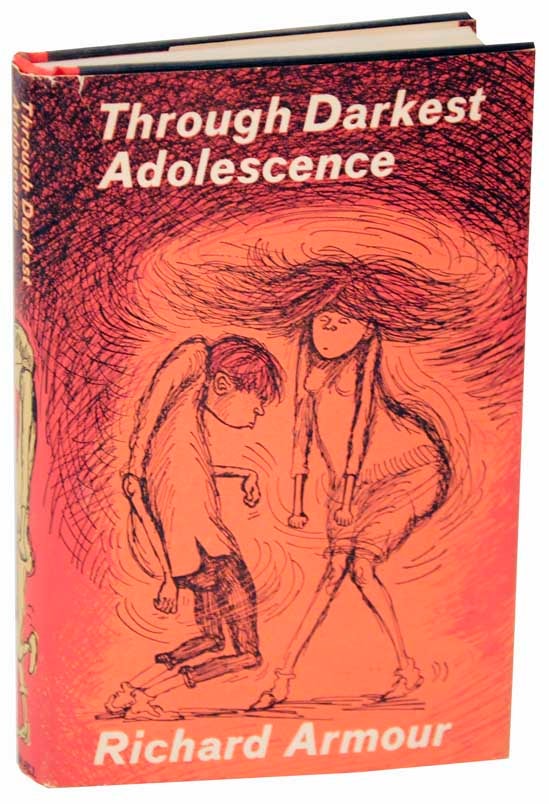
I was quite a number of pages into Through Darkest Adolescence, Richard Armour's comical lament about raising teenagers, before I realized that, since the book was published in 1963, I myself was one of those teenagers in question. From then on the book became a little more personal, even a little more amusing.
Armour is at his best in the opening chapter where he discusses adolescence as a disease, a disease that is not contagious and that you get only once, although it can hang on for several years. For a few people, he warns, it can last much longer, as among those people who act like teenagers well into middle age. After writing about some of the more serious symptoms of this disease, he concludes, "Some day a Dr. Salk will probably come along with a vaccine for adolescence. If so, the only question will be which Nobel Prize he should get -- the one for medicine or the one for peace."
From there, he moves on to such topics as getting a chance at the bathroom when there are teens in the house, teen parties, what to do when your kids are old enough to drive and problems related to cutting hair and straightening teeth. He uses his own son and daughter as examples, which must have embarrassed them terribly. However, since he was born in 1906, his kids may have been well into adulthood by 1963.
Armour wrote light verse to rival that of his contemporary, Ogden Nash. Unfortunately some of his poems are often wrongly attributed to Nash. We get a nice sampling of his verse scattered throughout this book. Here is one example:
We've only a teen-age daughter,
A two-legged creature indeed,
And yet from the shoes
She incessantly strews,
You'd think we've a centipede.
Armour's wit seems to fail him late in his book when he addresses the subjects of smoking and drinking. His strategy for discouraging these behaviors is to encourage his kids to smoke cigars and consume large quantities of alcohol on the theory that after this they will not want to smoke or drink at all. Of course, this strategy fails. None of this misbehavior, and I'm referring to that of the parent, seems funny now, and I doubt that it was funny even in 1963.
However I do recall that when I was a little boy my father offered me a sip of his beer. I cried loudly at the taste, and my mother came running from the kitchen, giving Dad a firm lecture when she found out what had happened. But I have never wanted a beer since. So maybe Armour's strange strategy might have worked if he had only tried it a decade earlier.
Armour is at his best in the opening chapter where he discusses adolescence as a disease, a disease that is not contagious and that you get only once, although it can hang on for several years. For a few people, he warns, it can last much longer, as among those people who act like teenagers well into middle age. After writing about some of the more serious symptoms of this disease, he concludes, "Some day a Dr. Salk will probably come along with a vaccine for adolescence. If so, the only question will be which Nobel Prize he should get -- the one for medicine or the one for peace."
From there, he moves on to such topics as getting a chance at the bathroom when there are teens in the house, teen parties, what to do when your kids are old enough to drive and problems related to cutting hair and straightening teeth. He uses his own son and daughter as examples, which must have embarrassed them terribly. However, since he was born in 1906, his kids may have been well into adulthood by 1963.
Armour wrote light verse to rival that of his contemporary, Ogden Nash. Unfortunately some of his poems are often wrongly attributed to Nash. We get a nice sampling of his verse scattered throughout this book. Here is one example:
We've only a teen-age daughter,
A two-legged creature indeed,
And yet from the shoes
She incessantly strews,
You'd think we've a centipede.
Armour's wit seems to fail him late in his book when he addresses the subjects of smoking and drinking. His strategy for discouraging these behaviors is to encourage his kids to smoke cigars and consume large quantities of alcohol on the theory that after this they will not want to smoke or drink at all. Of course, this strategy fails. None of this misbehavior, and I'm referring to that of the parent, seems funny now, and I doubt that it was funny even in 1963.
However I do recall that when I was a little boy my father offered me a sip of his beer. I cried loudly at the taste, and my mother came running from the kitchen, giving Dad a firm lecture when she found out what had happened. But I have never wanted a beer since. So maybe Armour's strange strategy might have worked if he had only tried it a decade earlier.
Thursday, February 9, 2017
Building character
Building character, like life itself, is a journey, and we get that point with the title of the David Brooks book The Road to Character. We may be born with a certain personality, but not with character. That's something that takes a lifetime to develop, assuming we even bother to try.
Brooks studies character building by studying the lives of a variety of men and women who made more effort to develop character than most of us do. They never became perfect people, but all were better later in their lives than earlier. Dorothy Day and Augustine were sexual libertines in their youth. Both later became devoted to Christian service. Dwight Eisenhower struggled with a terrible temper. Thanks to the influence of his mother and his military training, he learned to control it to become both the supreme Allied commander in World War II and the president of the United States. Frances Perkins fought to subdue her own wants and needs to better serve others.
Character building has become an old-fashioned concept, which is why younger readers may not be drawn to this book. With all the emphasis on self-esteem today, children are inclined to believe they already have it made. Why work to improve when you are already perfect? Brooks says that 53 percent of all students now get A's. Some graduating classes have a half dozen valedictorians or more. If high school is easy, why not the rest of life? And if virtue is relative and what's right for you is not necessarily right for me, then why work to become more virtuous?
Brooks contrasts Johnny Unitas with Joe Namath. Both were great NFL quarterbacks from the same region of Pennsylvania, yet their concepts of character were radically different. Unitas believed in working hard and keeping a low profile. Namath believed in having fun and showing off. Brooks sees them as symbols of their respective generations, Even though both men played in Super Bowl III, we tend to associate Unitas with the 1950s and Namath with the 1960s, when because of Vietnam and a lot of other factors, social change was rampant. Yet Brooks suggests it was actually the postwar Unitas generation, sometimes called the Greatest Generation, that actually brought about the change in how people view character. After years of Depression and war, this generation focused on material success, building big homes in the suburbs and acquiring nice things. Developing character became a minor issue, then no issue at all in many homes and schools.
Brooks says there are "resume virtues" and "eulogy virtues." The first includes the kinds of things we brag about and use to get jobs and impress others. The second kind of virtue includes what might be said about us at our funerals, at the end of our life journeys. And this second kind of virtue is what makes character.
Brooks studies character building by studying the lives of a variety of men and women who made more effort to develop character than most of us do. They never became perfect people, but all were better later in their lives than earlier. Dorothy Day and Augustine were sexual libertines in their youth. Both later became devoted to Christian service. Dwight Eisenhower struggled with a terrible temper. Thanks to the influence of his mother and his military training, he learned to control it to become both the supreme Allied commander in World War II and the president of the United States. Frances Perkins fought to subdue her own wants and needs to better serve others.
Character building has become an old-fashioned concept, which is why younger readers may not be drawn to this book. With all the emphasis on self-esteem today, children are inclined to believe they already have it made. Why work to improve when you are already perfect? Brooks says that 53 percent of all students now get A's. Some graduating classes have a half dozen valedictorians or more. If high school is easy, why not the rest of life? And if virtue is relative and what's right for you is not necessarily right for me, then why work to become more virtuous?
Brooks contrasts Johnny Unitas with Joe Namath. Both were great NFL quarterbacks from the same region of Pennsylvania, yet their concepts of character were radically different. Unitas believed in working hard and keeping a low profile. Namath believed in having fun and showing off. Brooks sees them as symbols of their respective generations, Even though both men played in Super Bowl III, we tend to associate Unitas with the 1950s and Namath with the 1960s, when because of Vietnam and a lot of other factors, social change was rampant. Yet Brooks suggests it was actually the postwar Unitas generation, sometimes called the Greatest Generation, that actually brought about the change in how people view character. After years of Depression and war, this generation focused on material success, building big homes in the suburbs and acquiring nice things. Developing character became a minor issue, then no issue at all in many homes and schools.
Brooks says there are "resume virtues" and "eulogy virtues." The first includes the kinds of things we brag about and use to get jobs and impress others. The second kind of virtue includes what might be said about us at our funerals, at the end of our life journeys. And this second kind of virtue is what makes character.
Wednesday, February 8, 2017
Situation comedy
Most of the comedy in today's TV sitcoms seems to come not from situations but from put-downs, one-liners, sexual innuendos and parents behaving badly. In earlier days of television, sitcom comedy flowed from situations, and many of these situations resulted from misunderstandings. Gracie Allen would hear George Burns, her neighbor Blanche or one of the Harrys (can you think of any other TV series in which two of the main characters had the same name?) say something, and what she understood was always entirely different than what was meant. The results of that misunderstanding kept things interesting for the rest of the 30 minutes. A decade or so later, The Beverly Hillbillies also made the most of misunderstandings. Someone would be speaking of one thing, and the Clampetts would assume something else entirely.
In real life, such misunderstandings happen all the time, but they are rarely this amusing. In fact, the results can be disastrous. What one person says is misunderstood by another, who then fires back with a sharp comment that cannot be misunderstood, and the fight is on. Such misunderstandings can result in feuds that last for decades.
Sometimes, however, a simple misunderstanding can be amusing, at least to a third party. This happened to me twice in the past few weeks, both times involving conversations involving my wife, Linda.
On a recent Sunday morning a woman entered the worship service with two children, but she arrived 30 minutes late. After the service and after most of the people had left, another woman showed up with four small children, asking for money to feed her family and pay an overdue electric bill. A few days later I overheard Linda in conversation with another woman, Joy, about "the woman who arrived late to church." I soon realized each was talking about a different woman because Linda hadn't been in the sanctuary when the first woman arrived, and Joy had already left when the second woman arrived. Joy's and Linda's statements must have each confused the other, especially when they were speaking of the number of children, yet the conversation went on for some time before, as an act of mercy, I finally broke in to point out they were each talking about a different woman.
A few days later Linda conversed with Ted about a group going out to eat. As it happened, two groups involving some of the same people had gone out to eat twice, on Thursday to a seafood restaurant and on Saturday to a pizza restaurant. Ted, who hadn't gone out for pizza, was talking about the Thursday gathering, while Linda was speaking about Saturday's meal. For a brief while, only I realized they were not both talking about the same thing, so only I saw the comedy.
A few years ago I was the Gracie Allen or one of the Clampetts. One of the my sisters was visiting from out-of-state and wondered if Linda and I could meet with her, her husband and another sister for a meal. Would Friday work? I agreed. I even suggested a restaurant. Not until Thursday did I learn by some miracle that the Friday she was talking about was not the next day but the following Friday. My sisters had started the conversation earlier and knew which weekend was meant, but I had come in late and made the wrong assumption. The misunderstanding would not have been very funny if Linda and I had waited at the restaurant for a couple of hours on Friday, although I imagine it would have made a funny story at family reunions years later.
In real life, such misunderstandings happen all the time, but they are rarely this amusing. In fact, the results can be disastrous. What one person says is misunderstood by another, who then fires back with a sharp comment that cannot be misunderstood, and the fight is on. Such misunderstandings can result in feuds that last for decades.
Sometimes, however, a simple misunderstanding can be amusing, at least to a third party. This happened to me twice in the past few weeks, both times involving conversations involving my wife, Linda.
On a recent Sunday morning a woman entered the worship service with two children, but she arrived 30 minutes late. After the service and after most of the people had left, another woman showed up with four small children, asking for money to feed her family and pay an overdue electric bill. A few days later I overheard Linda in conversation with another woman, Joy, about "the woman who arrived late to church." I soon realized each was talking about a different woman because Linda hadn't been in the sanctuary when the first woman arrived, and Joy had already left when the second woman arrived. Joy's and Linda's statements must have each confused the other, especially when they were speaking of the number of children, yet the conversation went on for some time before, as an act of mercy, I finally broke in to point out they were each talking about a different woman.
A few days later Linda conversed with Ted about a group going out to eat. As it happened, two groups involving some of the same people had gone out to eat twice, on Thursday to a seafood restaurant and on Saturday to a pizza restaurant. Ted, who hadn't gone out for pizza, was talking about the Thursday gathering, while Linda was speaking about Saturday's meal. For a brief while, only I realized they were not both talking about the same thing, so only I saw the comedy.
A few years ago I was the Gracie Allen or one of the Clampetts. One of the my sisters was visiting from out-of-state and wondered if Linda and I could meet with her, her husband and another sister for a meal. Would Friday work? I agreed. I even suggested a restaurant. Not until Thursday did I learn by some miracle that the Friday she was talking about was not the next day but the following Friday. My sisters had started the conversation earlier and knew which weekend was meant, but I had come in late and made the wrong assumption. The misunderstanding would not have been very funny if Linda and I had waited at the restaurant for a couple of hours on Friday, although I imagine it would have made a funny story at family reunions years later.
Monday, February 6, 2017
OK Corral in brief
How many novels do you suppose have been written about Wyatt Earp, Doc Holliday and the gunfight at OK Corral? Probably about as many as the movies made about these subjects. The last such novel I read was Richard S. Wheeler's excellent Trouble in Tombstone. Mary Doria Russell's recent efforts (Doc and Epitaph) still await my attention. Meanwhile there's Larry McMurtry's minimalist version, The Last Kind Words Saloon (2014).
The novel is just 196 pages long and has 58 chapters, plus an epilogue. This includes several blank pages and four two-page photographs. The famous gunfight itself takes up less than a half page. It's hard to believe this is the same Larry McMurtry who wrote such monsters as Lonesome Dove and Texasville. But that was a younger McMurtry. The older McMurtry, now 80, writes small. Yet it is amazing how much story and how much character development he fits into these few pages.
The novel begins in the small town of Long Grass. Wyatt and Doc think it may be in Texas, but they aren't sure. They travel to Denver to appear briefly in Buffalo Bill's Wild West Show, then back to Mobetie, Texas, and finally to Tombstone, Ariz. The Last Kinds Words Saloon, or at least the sign for that wandering saloon, travels with them. One of Wyatt's brothers, Warren, sets up a saloon business wherever he goes, and he goes wherever Wyatt and his other brothers go. Wyatt's wife, Jessie, tends bar in that saloon. For that reason, Wyatt does his drinking elsewhere. He doesn't mind his wife working, especially since working is not something he likes to do himself, but he doesn't like seeing cowboys flirt with her. When he does, there is trouble, not for the cowboys but for Jessie. The most violent part of the novel is not that famous gunfight but when Wyatt strikes Jessie. She takes it as a sign that he really does love her.
Most of the novel's characters were real people, not just Doc, the Earps and the Clantons, but also Buffalo Bill, cattle baron Charlie Goodnight, reporter Nellie Courtright (featured in McMurtry's Telegraph Days) and others. The brutal Indian warriors Satanta and Satank are here, too, though they are dealt with so quickly that one wonders why McMurtry bothered. Probably just to stretch the novel to 196 pages.
The novel is just 196 pages long and has 58 chapters, plus an epilogue. This includes several blank pages and four two-page photographs. The famous gunfight itself takes up less than a half page. It's hard to believe this is the same Larry McMurtry who wrote such monsters as Lonesome Dove and Texasville. But that was a younger McMurtry. The older McMurtry, now 80, writes small. Yet it is amazing how much story and how much character development he fits into these few pages.
The novel begins in the small town of Long Grass. Wyatt and Doc think it may be in Texas, but they aren't sure. They travel to Denver to appear briefly in Buffalo Bill's Wild West Show, then back to Mobetie, Texas, and finally to Tombstone, Ariz. The Last Kinds Words Saloon, or at least the sign for that wandering saloon, travels with them. One of Wyatt's brothers, Warren, sets up a saloon business wherever he goes, and he goes wherever Wyatt and his other brothers go. Wyatt's wife, Jessie, tends bar in that saloon. For that reason, Wyatt does his drinking elsewhere. He doesn't mind his wife working, especially since working is not something he likes to do himself, but he doesn't like seeing cowboys flirt with her. When he does, there is trouble, not for the cowboys but for Jessie. The most violent part of the novel is not that famous gunfight but when Wyatt strikes Jessie. She takes it as a sign that he really does love her.
Most of the novel's characters were real people, not just Doc, the Earps and the Clantons, but also Buffalo Bill, cattle baron Charlie Goodnight, reporter Nellie Courtright (featured in McMurtry's Telegraph Days) and others. The brutal Indian warriors Satanta and Satank are here, too, though they are dealt with so quickly that one wonders why McMurtry bothered. Probably just to stretch the novel to 196 pages.
Friday, February 3, 2017
Shelf life
We normally think about shelf life in terms of groceries or drugs. Such staples as bread and milk can be kept on display in grocery stores for just a brief time before the bread goes stale and the milk turns sour. Canned goods, by contrast, have a long shelf life, perhaps a year or more.
It occurs to me that shelf life is a term that can be applied to books, as well. A week ago I visited the Friends of the Library book sale in Largo, Fla. The book I saw the most copies of, by far, was Sarah Palin's Going Rogue. I counted seven hardback copies of Palin's 2009 memoir. This fact suggested two things to me. First, if that many copies showed up at one used book sale in one community, a lot of copies of that book must have sold. Second, a lot of people are now disposing of their copies of that particular book. In other words, it was a book with a short shelf life.
I suspect that most books by and about political figures have short shelf lives. In general I don't want such books on my shelf for even five minutes, but even those people who buy them probably don't want to keep them a long time, certainly not after their subjects have faded from then political scene. Now that Barack Obama has left the White House, I suspect many copies of The Audacity of Hope will be showing up at used book sales.
I make a distinction between serious biographies of former political figures like Calvin Coolidge and Franklin D. Roosevelt and books by and about current political figures. During last year's election, virtually every candidate was the subject of at least one book. You cannot be a serious candidate for the presidency these days without either writing a book about yourself or hiring someone to do it for you. Most of these books do not sell very well, and once the election's over they are virtually worthless.
Back in 1988 when Stephen Hawking's A Brief History of Time was a surprising best seller, Charles Krauthammer wondered in a Washington Post article why so many people were buying copies of a book they probably couldn't understand even if they bothered to read it. "They only want to own them," he wrote. "Not out of snobbery, I think, but out of a kind of reverence. Not many people read their Bibles, either. But they like having them around."
Books with a long shelf life tend to be those we have "a kind of reverence" for. These may be religious books, favorite books of poetry, certain cookbooks, certain reference books and books that were special to us at certain points in our lives. Such books as Charlotte's Web, Alice in Wonderland, The Catcher in the Rye, Little Women, Of Mice and Men, Brave New World and To Kill a Mockingbird have extremely long shelf lives for certain people.
The condo association library that my wife and I oversee in Florida depends entirely on donated books. It frustrates me that so many of these donations are books by James Patterson, Danielle Steel, Nora Roberts, David Baldacci and the like. I would love to see a bit more variety. But these are donated books, books that many people buy but few people want to keep around long after they finish reading them. In other words, books with a short shelf life.
I expect a copy of Going Rogue to turn up any day now.
It occurs to me that shelf life is a term that can be applied to books, as well. A week ago I visited the Friends of the Library book sale in Largo, Fla. The book I saw the most copies of, by far, was Sarah Palin's Going Rogue. I counted seven hardback copies of Palin's 2009 memoir. This fact suggested two things to me. First, if that many copies showed up at one used book sale in one community, a lot of copies of that book must have sold. Second, a lot of people are now disposing of their copies of that particular book. In other words, it was a book with a short shelf life.
I suspect that most books by and about political figures have short shelf lives. In general I don't want such books on my shelf for even five minutes, but even those people who buy them probably don't want to keep them a long time, certainly not after their subjects have faded from then political scene. Now that Barack Obama has left the White House, I suspect many copies of The Audacity of Hope will be showing up at used book sales.
I make a distinction between serious biographies of former political figures like Calvin Coolidge and Franklin D. Roosevelt and books by and about current political figures. During last year's election, virtually every candidate was the subject of at least one book. You cannot be a serious candidate for the presidency these days without either writing a book about yourself or hiring someone to do it for you. Most of these books do not sell very well, and once the election's over they are virtually worthless.
Back in 1988 when Stephen Hawking's A Brief History of Time was a surprising best seller, Charles Krauthammer wondered in a Washington Post article why so many people were buying copies of a book they probably couldn't understand even if they bothered to read it. "They only want to own them," he wrote. "Not out of snobbery, I think, but out of a kind of reverence. Not many people read their Bibles, either. But they like having them around."
Books with a long shelf life tend to be those we have "a kind of reverence" for. These may be religious books, favorite books of poetry, certain cookbooks, certain reference books and books that were special to us at certain points in our lives. Such books as Charlotte's Web, Alice in Wonderland, The Catcher in the Rye, Little Women, Of Mice and Men, Brave New World and To Kill a Mockingbird have extremely long shelf lives for certain people.
The condo association library that my wife and I oversee in Florida depends entirely on donated books. It frustrates me that so many of these donations are books by James Patterson, Danielle Steel, Nora Roberts, David Baldacci and the like. I would love to see a bit more variety. But these are donated books, books that many people buy but few people want to keep around long after they finish reading them. In other words, books with a short shelf life.
I expect a copy of Going Rogue to turn up any day now.
Wednesday, February 1, 2017
How we think
One of the features that sold me on the house my wife and I purchased in 1977 was the large, unfurnished attic. It struck me as a place that would hold my growing library, as well as all the other stuff that naturally migrates into attics, things like winter coats and Christmas decorations. Home libraries suggest wood paneling, as well as shelves, but I knew I could barely afford the shelves, let alone the paneling. How was I going to turn this attic into a library besides by just adding books?
I have no gift for home decorating, yet one day a vision came to me in a flash. I could picture in my mind how to create passable paneling using cheap particle board and do most of the work myself. Forty years later, despite all the clutter that has accumulated in that time, my library still looks pleasing to the eye, at least to my eye.
With that major exception, I normally think in words, not pictures. I may be a lousy conversationalist, yet I have conversations in my mind all the time. It is one way I process information and ideas.
Lately I seem to be coming across references, in my reading, to how some of us think in words. Martin Gardner says this in his introduction to one of his essays collected in The Night Is Large: "It has been said that the best way to learn about a difficult, complex subject is to write a book about it." That essay is about relativity, something I probably still wouldn't understand even if I tried to write a book about it. Yet I find that writing does help clarify my own thinking. As I've said before, I often don't feel I really know what a book is about until I start to write about it.
In the novel The Sherlockian by Graham Moore, we find this line about Arthur Conan Doyle: "Things made sense when Arthur wrote them down." Things made sense both to Doyle himself and to his readers. So it's not just a matter of understanding things better by writing them down. It is also a matter of being better able to explain these things to others by writing them down. It's a shame people don't write love letters, or any kind of letters, like they once did. Some things, at least for some people, are just easier to express in writing.
Others, of course, are useless when they attempt to express themselves in writing, but can do very well in conversation. That is, real conversation, not the fantasy kind I mentioned above. Others need both kinds of expression. David Brooks writes in his book The Road to Character about the author George Eliot. As a young woman still calling herself Mary Anne Evans, she was highly intelligent but knew nobody else of equal intelligence she could talk with. Writes Brooks, "She received information but could not digest it through conversation." I like his use of the word digest. Each of us receives information all day long. But how do we digest it? How do we process it? How do we make sense of it? How do we turn it into our own ideas about how we view the world?
I seem to do some of my best "digestion" in the shower. That's where, this morning, this particular blog post took shape. Sleep somehow can stimulate our thinking. Some people do their best thinking while driving, doing routine chores or exercising. Novelist Charles Dickens was famous for his very long nightly walks through the streets of London. I suspect the reason for these walks had less to do with physical fitness than with using the time to plot his stories and decide what to do with his various characters. He also liked to walk though the areas where his stories took place to remind himself of what was where.
We all have our own tricks for helping us think. Then there are those who find tricks for avoiding thinking altogether.
I have no gift for home decorating, yet one day a vision came to me in a flash. I could picture in my mind how to create passable paneling using cheap particle board and do most of the work myself. Forty years later, despite all the clutter that has accumulated in that time, my library still looks pleasing to the eye, at least to my eye.
With that major exception, I normally think in words, not pictures. I may be a lousy conversationalist, yet I have conversations in my mind all the time. It is one way I process information and ideas.
![]() |
| Martin Gardner |
In the novel The Sherlockian by Graham Moore, we find this line about Arthur Conan Doyle: "Things made sense when Arthur wrote them down." Things made sense both to Doyle himself and to his readers. So it's not just a matter of understanding things better by writing them down. It is also a matter of being better able to explain these things to others by writing them down. It's a shame people don't write love letters, or any kind of letters, like they once did. Some things, at least for some people, are just easier to express in writing.
Others, of course, are useless when they attempt to express themselves in writing, but can do very well in conversation. That is, real conversation, not the fantasy kind I mentioned above. Others need both kinds of expression. David Brooks writes in his book The Road to Character about the author George Eliot. As a young woman still calling herself Mary Anne Evans, she was highly intelligent but knew nobody else of equal intelligence she could talk with. Writes Brooks, "She received information but could not digest it through conversation." I like his use of the word digest. Each of us receives information all day long. But how do we digest it? How do we process it? How do we make sense of it? How do we turn it into our own ideas about how we view the world?
I seem to do some of my best "digestion" in the shower. That's where, this morning, this particular blog post took shape. Sleep somehow can stimulate our thinking. Some people do their best thinking while driving, doing routine chores or exercising. Novelist Charles Dickens was famous for his very long nightly walks through the streets of London. I suspect the reason for these walks had less to do with physical fitness than with using the time to plot his stories and decide what to do with his various characters. He also liked to walk though the areas where his stories took place to remind himself of what was where.
We all have our own tricks for helping us think. Then there are those who find tricks for avoiding thinking altogether.
Subscribe to:
Posts (Atom)