Wednesday, November 9, 2022

Flapper words

For several years now I have been celebrating the 100th birthdays of words used by Americans, at least according to Sol Steinmetz in his 2010 book There's a Word for It. I've noticed that many of the words seem to reflect the times in which they were coined, which certainly makes sense.

By 1922 the war had been over for a few years and Prohibition had yet to begin. The Roaring Twenties were in full swing, and so many of the words coined that year seem to reflect happy times. I'm thinking of words like beauty queen, beauty salon, bistro, chorine, downfield, duplex, gigolo, jayvee, motorboat, moviegoing, mudpack, off-tackle, oops, playset, Pollyannaish, prepper, putt-putt, rumba and tux. These are fun words, words that suggest gaiety and leisure.

Other words that first appeared in print that year suggest more serious topics, reflecting new technology and social change, among other things. These include bicarb, broadcaster, decommission, entrepreneurial, Formica, isolation, libidinal, millisecond, notarize, polyester, pre-puberty, sickle-cell anemia, sodbuster and transvestite.

Some words from 1922 may seem older than that. Sodbuster, for example. Haven't we heard that word in movie westerns set in an earlier time? Uncle Tom was first used in that year too, decades after Uncle Tom's Cabin was published. Other words, such as vacuum used as a verb and putt-putt, might sound newer to us.

Monday, November 7, 2022

Longing is belonging

Why do we like sad songs? Susan Cain began thinking about that question in college while listening to melancholy tunes by Leonard Cohen and others. Now in middle age she has written Bittersweet (2022) about how sad songs, sad stories and a deep longing for an ideal world connect us with each other.

Cain, whose book about introversion, Quiet, became a bestseller, once again probes her own experience to make sense of the experience of others, and vice versa. The central experience of her life may have been her relationship with her mother, who showered love on her during her early years, then became possessive, demanding and suspicious when she became a teenager. One day, while a Princeton student, she gave her mother her diaries to take home for her, perhaps knowing her mother would read them.

And so a bittersweet relationship developed, deep love counterbalanced by recrimination and conflict.

Other Princeton students always wore smiles and seemed to lead blissful, fulfilling lives with perfect parents and a perfect home. She eventually came to realize this wasn't true, and years later she returned to the university to prove it by surveying some of Princeton's "perfect" students. She describes this false front, which goes way beyond Princeton, as a "culture of enforced positivity." We wear smiles to hide what's really going on in our lives. When we pretend perfection, it only makes others resent us because they know they don't have perfect lives. When we let our pain and insecurities and doubts show, it brings others closer to us. Those sad songs and sad stories do much the same thing.

From Leonard Cohen to C.S. Lewis and from studies in psychology to the writings of most of the major religions,  Cain explores the wisdom of balancing bitter and sweet — "a time to weep and a time to laugh," as it says in Ecclesiastes.

I suddenly remember the wonderful comedy Lovers and Other Strangers released in 1970. One of the lines repeated several times in the film is, "You gotta take the good with the bad." Susan Cain would agree.

Friday, November 4, 2022

Padlocks and letters

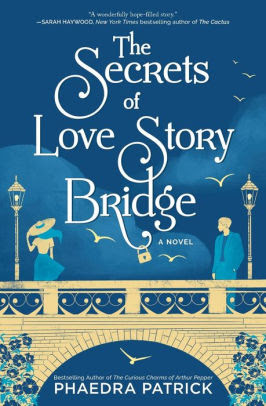
British author Phaedra Patrick likes to build her stories around meaningful objects, such as the charm bracelet in her debut novel The Curious Charms of Arthur Pepper. In The Secrets of Love Story Bridge (2020), there are two such objects — or three if you want to count the bridge.

Mitchell Fisher, still mourning the death of his girlfriend, is a former bridge designer whose downhill career has fallen to removing the padlocks that people fasten to a certain bridge. Instead of carving their initials on trees, lovers signify the permanence of their love with padlocks, before tossing the keys into the river. The city wants the padlocks gone, and that's now Mitchell's job.

One day he sees a woman in a yellow dress attach a padlock, then fall into the river. He jumps in after her. After he saves her life, he becomes a hero, but somehow the woman remains anonymous. His daughter's music teacher, Liza, thinks the mysterious woman is her missing sister, and she enlists Mitchell's help in finding her.

Meanwhile Mitchell starts getting dozens of letters, mostly praising his heroism. And letters become the second physical object guiding the story, but not just these letters from strangers. Mitchell still writes letters to his late girlfriend almost daily, while being afraid to open a letter she wrote to him shortly before her accidental death. And then there is the letter he writes to Liza at the novel's conclusion. Letters, in the end, mean much more than padlocks.

Perhaps because of all those various objects battling for significance, this Patrick novel lacks the curious charm of her others.

Wednesday, November 2, 2022

Fools for censorship

There is a distinct affinity between fools and censorship. It seems to be one of those breeding grounds where they rush in.

Heywood Campbell Brown

I have long believed that virtually everyone supports censorship, except that everyone favors drawing the line at a different point. Child pornography is one point that almost everyone can agree on. As a general rule, conservatives like to draw their line somewhere on matters relating to sex and/or religion. Liberals usually draw their line on political and social thought. Puritan-like, holier-than-thou attitudes can be found at both ends of the spectrum.

Amy Coney Barrett
Recently most of the push for censorship has been coming from the left. A number of authors, members of the press, publishers and people who work for publishing companies and even Barnes & Noble just sent an open letter to Random House urging the publisher to stop publication of Supreme Court Justice Amy Coney Barrett's scheduled book, on which a $2 million advance has already been paid. 

The signers began their letter by claiming they "care deeply about freedom of speech," before demonstrating that they actually don't. "We are not calling for censorship," they wrote in a letter calling for censorship. Without having read Barrett's book, they advocate blocking its publication. And these are people whose very livelihoods depend on freedom of expression and the publication and sale of books not everyone will agree with.

The controversy over Elon Musk's purchase of Twitter sounds very similar. Critics claim to favor free expression of ideas while objecting to the wider spectrum of ideas that Musk's ownership may bring about. These may be the same people who argue that fair elections somehow threaten democracy.

The United States was founded with a fundamental belief in free speech and a free press. Courts may sometimes permit exceptions, such as child pornography and falsely yelling "Fire!" in a crowded theater. Everything else must be allowed, including fools who claim to oppose censorship while advocating censorship.

Monday, October 31, 2022

Thoughts becoming words

Does the act of writing clarify one's ideas or obscure them? There would seem to be two points of view on that question, and I side with both of them.

The essayist Logan Pearsall Smith said this, "What things there are to write, if one could only write them! My mind is full of gleaming thought; gay moods and mysterious, moth-like meditations hover in my imagination, fanning their painted wings. But always the rarest, those streaked with azure and the deepest crimson, flutter away beyond my reach."

Virginia Woolf said something similar in fewer words: "No book is born entire and  uncrippled as it was conceived."

I can recall hearing the novelist Ann Patchett say that no matter how hard she tries, the words she puts down on a page never quite equal the vision she had in her mind.

I know this can be true, for I have experienced it myself. Yet more often I have experienced just the opposite, where the words that come out are much grander than the thoughts that inspired them. Where, I wonder,  did that come from? I don't remember thinking that, but there it is.

Samuel Butler wrote, "Books want to be born: I never make them. They come to me and insist on being written, and on being such and such."

And E.M. Forster famously said, "How do I know what I think till I see what I say?" Exactly. Writing clarifies one's thoughts, except of course when it doesn't.

Friday, October 28, 2022

Bookshop rants

A book with a title like Seven Kinds of People You Find in Bookshops has got to be good, right? Well, it's not, unless you happen to enjoy reading someone's rants.

Shaun Bythell owns a used bookshop in Scotland. Writing a book making sport of his customers doesn't seem like a sound business strategy, but that's what Bythell does here. Perhaps he can get away with it because often he writes about those people who visit his shop without buying anything and those who try to sell him old books he doesn't want in his store.

Yet the author even disparages those who do buy books, such as those who try to bargain for lower prices and those who seek out fine old books he hasn't yet had the chance to raise the prices on.

Bythell groups customers in the way a biologist would group animal species, complete with Latin names. Senex cum barba, for example, translates as "bearded pensioner." In this chapter he discusses the retirees with time on their hands who spend too much of their time in his shop. Unfortunately he devotes several paragraphs to lamenting the annoying driving habits of elderly people, as if that has anything to do with his bookshop.

Then he breaks down each species of bookshop customer into subspecies. In the retirees group, for example, he includes Downsizers, who try to sell him their old Reader's Digest books, and the Lycra-clad, who annoy the shopkeeper simply by what they wear.

Occasionally Bythell says something witty or something kind, but this doesn't happen often enough to make his book as much fun to read as you might hope


Wednesday, October 26, 2022

Get to the story

Alice was beginning to get very tired of sitting by her sister on the bank, and of having nothing to do; once or twice she had peeped into the book her sister was reading, but it had no pictures or conversations in it, "and where is the use of a book," thought Alice, "without pictures or conversations?"

Lewis Carroll, Alice in Wonderland

In The Heart's Invisible Furies, novelist John Boyne gives us a minor character who would agree with Alice. In a conversation with Cyril, the main character, about books they are reading, she asks whether Colm Toibin's novels are anything like Jeffrey Archer's.

"'Does this fella tell a story? He doesn't spend twenty pages describing the color of the sky?'"

"'He hasn't so far.'"

"'Good. Jeffrey Archer never talks about the color of the sky and I like that in a writer. I'd say Jeffrey Archer has never even looked up at the sky in his entire life.'"

This wonderfully comic passage goes on, but you get the idea.

We may think of this woman as stupid and Alice as immature, but most of us probably would agree with both of them to some extent.

We all like conversation in our stories. The Boyne passage above is composed entirely of conversation, and it is wonderful. No description is necessary. Most novels don't really get going until a second character shows up and a conversation begins.

As for pictures, we may think we left picture books behind us years ago, but admit it, don't you love to find pictures of any kind in the books you read? The pictures I've discovered in novels by William Boyd, Umberto Eco, Marisha Pessi and others have enriched the reading of all of them. The popularity of graphic novels proves, too, that grownup readers enjoy illustrations with their stories almost as much as children do. When I read a history book, a science book, a biography, or any other kind of nonfiction, I  want there to be photographs, drawings or graphs to break up the text.

Descriptions in novels are intended to take the place of pictures, and the best writers can do this very well. But some take it to an extreme. How much detail do we really need about the sky or the weather or the clothing worn by a character. A phrase or two can usually do the job. Then give us some action. Give us some conversation. And a picture or two wouldn't hurt either.