Friday, October 7, 2022

Titles that sing

Most of us love lists, especially lists that represent someone's opinions when we have opinions of our own on the same subject. And so I stopped for a moment at, and then later returned to, Michael Dirda's list in Browsings of some of his favorite book titles.

He lists Jane Austen's Persuasion as No. 1 on his list, and I agree it is a terrific title, or at least it is once you have read the novel. Until you do it is no more than a single word, hardly the equal of Pride and Prejudice.
Several of the titles Dirda lists leave me baffled, perhaps because I haven't read the books. They include Pavane and, most curious of all, A History of English Prose Rhythm. More to my liking are The Man Who Was Thursday, The Well at the World's End, Trent's Last Case and The Door Into Summer.

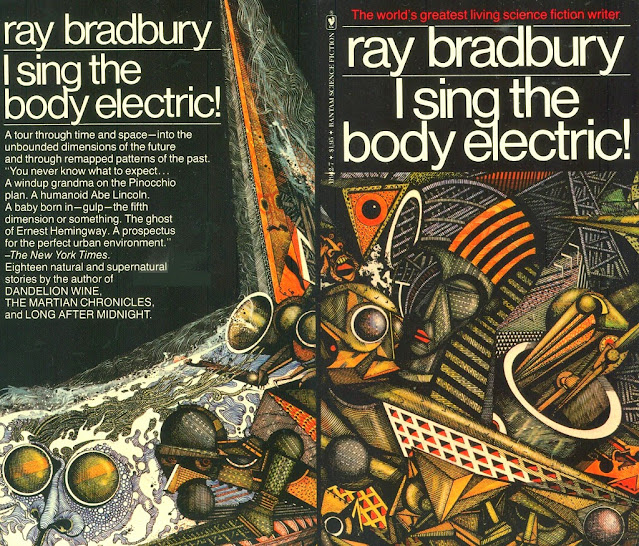
Just a few days ago I noticed the brilliance of some of Ray Bradbury's titles: I Sing the Body Electric!, The Golden Apples of the Sun and Something Wicked This Way Comes, for example. Fahrenheit 451 is pretty good, too.

Other writers also have a knack for terrific titles. Among the best is Alexander McCall Smith, whose novels have titles like Tears of the Giraffe, Morality for Beautiful Girls, The Minor Adjustment Beauty Salon, A Promise of Ankles, The Right Attitude to Rain, The Geometry of Holding Hands and so many more.

Mystery writer Donna Leon has some excellent titles, many of which employ familiar phrases: Suffer the Little Children, Earthly Remains, Friends in High Places and Through a Glass, Darkly, for example.

Then there is Francine Prose, who has given us Bigfoot Dreams, Household Saints and Guided Tours of Hell.

If Dirda likes one-word titles, I tend to favor wordy ones. I have yet to read The Dictionary of Lost Words by Pip Williams, but I may have purchased it just for the title. The same goes for Love and Other Consolation Prizes by Jamie Ford and The Psychology of Time Travel by Kate Mascarenhas. And Hazards of Time Travel by Joyce Carol Oates. And Special Topics in Calamity Physics by Marisha Pessi. And how could I resist The Department of Rare Books and Special Collections, a novel by Eva Jurczyk?

Don't judge a book by its cover? You had me at the title.

Wednesday, October 5, 2022

Rediscovery

I have one more thing to say about Christopher Fowler's The Book of Forgotten Authors before I place it back on the shelf — make that two more things. These are just comments on two things Fowler says near the end of his book, in which he writes about 99 talented writers who are now all but forgotten.

If you rediscover one author from this selection of ninety-nine, you will have conferred upon them a kind of immortality.

Harper Lee
The late Harper Lee did not achieve "a kind of immortality" by writing To Kill a Mockingbird. Rather it was achieved, at least for the time being, because people continue to read it. For the authors Fowler writes about in his book, immortality, you might say, hangs by a thread. In most cases, their books are out of print. Old copies of their books can still be found in used bookstores and perhaps a few attics, but few of us want to read old books we've never heard of by authors we've never heard of.

Fowler aids the cause by writing about them after reading their books himself, but any of us can do the same by finding and reading their books, too. And there are countless other forgotten authors for whom we can give a temporary breath of life simply by reading their work.

Life is not a box of chocolates, it's a weathered old paperback, and you never know what you're going to find in it.

This metaphor seems a bit confused to me since, unlike Forrest Gump, Fowler really isn't talking about our lives but rather just the lives of old books. But I do like the suggestion that old books can contain great stories, surprising information and amazing wisdom. Or we may find they are better left forgotten.

Earlier I wrote that few of us want to read old books we've never heard of by authors we've never heard of, but I could have condensed it to just "few of us want to read old books." And even when we do read old books, we prefer them in new editions.

But I agree with Fowler that many old books do deserve to be given new life. Somebody once thought these books were worth writing, worth publishing and worth reading. Perhaps that worth, that treasure, still rests within them waiting to be rediscovered. You never know.

Monday, October 3, 2022

Finding herself

Sometimes it's easier to go on living, not even knowing who you are, when at least you know precisely where you are while you go on not knowing.

Fredrik Backman, Britt-Marie Was Here

Britt-Marie Was Here (2014) by Fredrik Backman is nothing like The Readers of Broken Wheel Recommend by Katrina Bivald, reviewed here on Aug. 31, except for the fact that they both tell the same story.

That story is this: An introverted woman still trying to discover her place in the world finds herself in a very small town in the middle of nowhere and within days dramatically changes the town, just as the town dramatically changes her.

The novels actually have something else in common: Both were written by Swedish authors and became bestsellers in the United States and elsewhere. Was Bivald influenced by the blueprint developed two years previously by Backman? Who can say?

Britt-Marie Was Here picks up a subplot from My Grandmother Asked Me to Tell You She's Sorry, another Backman novel published a year earlier and reviewed here on July 1. Britt-Marie is a 60-something woman with firm ideas about what's proper and what's not and whose quest for orderliness in the world leads her to compulsive cleaning. In the earlier book we learn that her husband, Kent, is unfaithful. Before she can go to bed each night, she must wash Kent's shirt to remove the perfume smell.

Now in Britt-Marie Was Here, she has left Kent and accepts the only job she can find, as the temporary director of a recreation center scheduled for demolition in the nothing town of Borg. The few kids in Borg are soccer crazy, but they have neither a pitch nor a coach. As recreation director Britt-Marie reluctantly agrees to become their coach, even though she lacks both any knowledge of or any interest in soccer.

Before long violence comes to Borg, boys die, a policeman falls in love with Britt-Marie, the soccer team and its coach give the town hope for its future and Kent tracks down his wife and begs her to return home. But has he really changed or does he just have a lot of dirty shirts? Britt-Marie, who craves order, faces a decision that could change everything.

Backman has a gift for making a narrative both terribly funny and terribly poignant at the same time, leaving a reader to wonder about the reason for all those tears.

Friday, September 30, 2022

Minority views

Some things are implicitly understood: you don't eat crisps at the opera and you don't admit that an author beloved by the intelligentsia leaves you cold.

Christopher Fowler, The Book of Forgotten Authors

Several weeks ago I engaged in a fascinating conversation with a man, a retired sanitary engineer as I recall, who was a big Mark Twain admirer, but he argued that Personal Recollections of Joan of Arc, not Adventures of Huckleberry Finn, is Twain's greatest novel.

A Wikipedia article about this book says "critics have not favored Recollections, and it is hardly read or acknowledged in the mainstream today." This makes me admire my momentary friend all the more. Not only was he a brilliant conversationalist on Mark Twain, but he was willing to espouse, and back up, an unpopular point of view.

As Christopher Fowler notes in The Book of Forgotten Authors, most of us hesitate to say anything counter to what the experts say about literature, or anything else for that matter. When is the last time you heard anyone say anything negative about William Shakespeare or James Joyce or William Faulkner or Virginia Woolf or Homer or anyone else esteemed by the intelligentsia? Yet how many of us actually read — and enjoy — these writers? Most of us would rather read Dan Brown or, well, Christopher Fowler.

As Michael Dirda says in Browsings, "We don't read for high-minded reasons. We read for aesthetic, emotional, and intellectual excitement."

It's not that the great writers aren't actually great writers. Rather, tastes differ and we each find our excitement in different places. For the most part, this is no big deal. Barnes & Noble sells a lot of different books, and there is probably something there for everybody. The problem comes when other members of the intelligentsia or literary critics or reviewers bow to more prominent points of view, while burying their own opinions, which may be no less valid.

Who is the greatest living American author? Thankfully, that question remains far from being answered, meaning that there are still many contenders, many points of view and many opportunities for new writers to enter the competition. Only when such questions are answered does the conversation get stifled, making dissenters afraid to speak up.

Which is the greatest Twain novel? The majority view might be Huck Finn, but it's good to know Joan of Arc has a brave champion.

Wednesday, September 28, 2022

Banned books? Hardly

Another Banned Books Week (Sept. 18-24) has come and gone with another ho-hum from me. I am a strong opponent of banning books. So why don't I get more excited about Banned Books Week? Two reasons.

1. The week has come to be more about politics and social posturing than either literature or censorship.

Most of the books at the top of this year's list have to do with LBGT-etc. These include Gender Queer, Lawn Boy, All Boys Aren't Blue and other books of this sort aimed primarily at children and teenagers. Books from the other side of the political and social spectrum are even more likely to be kept out of classrooms and school libraries, but they are ignored. Even some Dr. Seuss books have become controversial. No mention of that here.

2. What they call "banned books" aren't really banned. They are readily available, including in many classrooms and school libraries. Rather they are termed banned because many parents and educators object to their presence in classrooms and libraries. Many people consider such books little more than child pornography, or perhaps pornography for children. They probably would object to books with strong heterosexual content, as well.

Just as authors should be free to write any books they choose and publishers should be free to publish any books they choose, so should parents be free to choose which books they object to in their children's schools. And so should school boards and librarians be free to make decisions about which books to include and which to exclude. Excluding a certain book is not censorship; it is just a decision they are entitled, even required, to make. It's their job. Not every book can be taught in every classroom or shelved in every library.

And if a book like Gender Queer is taken off a school reading list, it remains readily available in bookstores. lt is hardly banned, any more than the Bible is banned just because a public school teacher is forbidden to teach it.

Monday, September 26, 2022

A mother's love

C.J. Box is at his best in Endangered, a 2015 novel in which a mother's love takes an evil twist.

Box includes a quote from Ralph Waldo Emerson before his story begins: "Men are what their mothers made them." That's certainly true here in the case of the Cates family in which the matriarch shapes her three sons to believe that family trumps everything and everyone.

Joe Pickett's adopted daughter April has run off with the youngest Cates son, Dallas, a rodeo star. Now she's found along a road badly beaten and with severe brain trauma, while Dallas lies with broken ribs in his Wyoming home, the result, he says, of a rodeo injury.

Pickett, a game warden and the hero in this series of novels, is ready to believe the worst about Dallas Cates, but the evidence suggests the young man may be telling the truth, more or less. When another man is found with some of April's possessions, that seems to establish Dallas's innocence.
 
Yet there are other mysteries that prevent Pickett from forgetting about Brenda Cates, her mindless husband and those three loyal sons. Nate Romanowski, Pickett's friend with a shady past, is ambushed with shotgun blasts in a barn, and his girlfriend disappears. A flock of rare sage grouse is massacred. One of Brenda's sons, Timber, is released from prison with a mission from Mom.

All this is going on while April lies in a Montana hospital in an induced coma, while a blizzard threatens.

This is exciting stuff, and Box weaves it altogether into a satisfying and totally believable whole.

Friday, September 23, 2022

Dating writers

In effect, anthologies resemble dating. You enjoy some swell times and suffer through some awful ones, until one happy hour you encounter a story you really, really like and decide to settle down a while with its author.

Michael Dirda, Browsings

I can't remember the last anthology I've read, an anthology being a book, often a long book, filled with stories by different writers. These can be collections of the best stories of the year, for example, or collections of stories on a certain subject or theme. College literature classes often involve reading stories from anthologies — or at least they did when I was in college.

Years ago I used to read those paperbacks with Alfred Hitchcock's picture on the cover, mystery stories of the sort he might have featured, or sometimes did feature, on his television show. The anthologies that most stick in my mind are the science fiction collections I read as a teenager, books like Science Fiction Showcase and A Century of Science Fiction. And yes, as Michael Dirda observes above, this was something like dating.

At this time in my life I knew very little about either mystery writers or sci-fi writers — or about girls either, for that matter. Reading anthologies introduced me to a number of writers, some of whom I liked very much, others not at all. When I read a story I really enjoyed, I usually remembered the name of the author, and this in many cases led me to other stories or even novels by this same author. I believe my "romance" with Isaac Asimov and Clifford D. Simak, among others, may have begun by reading science fiction anthologies.

Now I prefer reading novels or books of short stories by a single author, but  I do have happy anthology memories ... and happy dating memories, as well.